Welcome
Every time you turn a key or press a start button, you are commanding thousands of precisely engineered parts to work together in a controlled sequence of explosions, electrical signals, & mechanical force.
The modern automobile is one of the most complex consumer products ever built. A typical car contains over 30,000 individual parts, dozens of electronic control modules, and miles of wiring: all designed to get you from point A to point B safely and reliably.
Understanding how cars work is not just for mechanics. It is the foundation for diagnosing problems, making informed repair decisions, & building a career in one of the largest industries on the planet.
In this lesson, we will cover internal combustion engines, drivetrains, electrical & diagnostic systems, brakes & suspension, & the career paths available to anyone who wants to work on vehicles for a living.
Warm-Up
Before we pop the hood, let us find out what you already know.
Four-Stroke Cycle
Air, Fuel, Spark, & Force
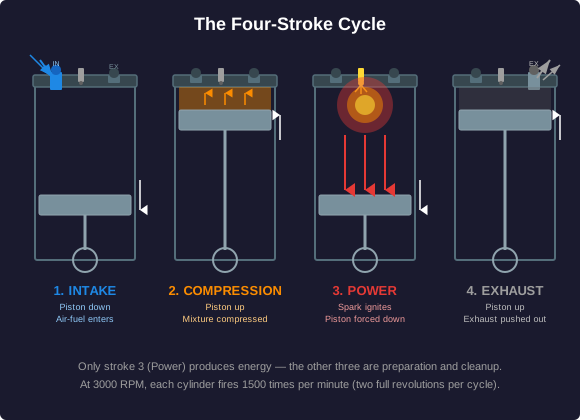
The internal combustion engine converts chemical energy in fuel into mechanical motion. The vast majority of gasoline engines use the four-stroke cycle, invented by Nikolaus Otto in 1876. Each cylinder repeats four strokes: two up, two down: for every power event.
Stroke 1: Intake: The piston moves down, the intake valve opens, and a precisely metered mixture of air and fuel is drawn into the cylinder. Modern engines use fuel injection: a computer-controlled injector sprays atomized fuel into the intake port or directly into the cylinder.
Stroke 2: Compression: Both valves close and the piston moves up, compressing the air-fuel mixture into a small space at the top of the cylinder. A typical gasoline engine has a compression ratio of about 10:1, meaning the mixture is squeezed to one-tenth of its original volume. Compression raises the temperature and pressure of the mixture, making combustion more efficient.
Stroke 3: Power (Combustion): At the top of the compression stroke, the spark plug fires. The spark ignites the compressed air-fuel mixture, which burns rapidly and expands, driving the piston down with tremendous force. This is the only stroke that produces power: the other three are preparation and cleanup.
Stroke 4: Exhaust: The exhaust valve opens and the piston moves up, pushing the spent combustion gases out of the cylinder and into the exhaust system. Then the cycle repeats.
Displacement is the total volume swept by all pistons in one complete cycle. A 2.0-liter engine has cylinders that collectively displace 2 liters of volume. Larger displacement generally means more power but also more fuel consumption.
Compression ratio is the ratio of cylinder volume at the bottom of the stroke to the volume at the top. Higher compression ratios extract more energy from the fuel but require higher octane gasoline to prevent knocking: uncontrolled detonation that can damage the engine.
Diagnosing a Misfire
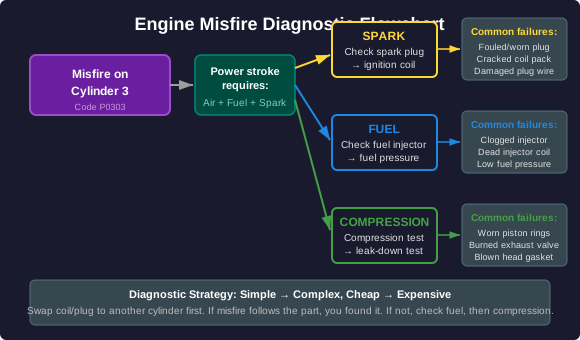
A customer brings in a four-cylinder car. The engine is running rough & shaking at idle. The check engine light is on, & the diagnostic scanner shows a code for a misfire on cylinder 3. The engine runs on three cylinders instead of four.
Transmission, Differential, and Drive Layout
Getting Power to the Wheels
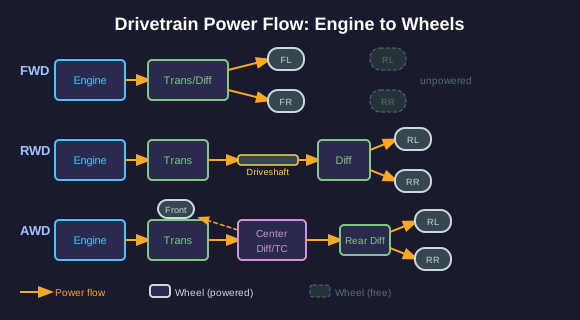
The engine produces rotational force (torque) at the crankshaft. But that raw power cannot go directly to the wheels: it needs to be adapted for speed, direction, and traction. That is the job of the drivetrain.
Transmission: The transmission changes the gear ratio between the engine and the wheels. In a low gear, the engine spins fast relative to the wheels: high torque for acceleration and climbing hills. In a high gear, the engine spins slower relative to the wheels: efficient cruising at highway speed. Manual transmissions use a clutch and a driver-selected gear. Automatic transmissions use a torque converter and planetary gear sets controlled by the transmission control module (TCM).
Differential: When a car turns, the outside wheel travels a longer path than the inside wheel. The differential is a set of gears in the axle housing that allows the two drive wheels to rotate at different speeds while still receiving power. Without a differential, the tires would scrub and skip through every turn.
Drive layouts:
- FWD (Front-Wheel Drive): Engine and transmission are up front, driving the front wheels. Most passenger cars use FWD because it is compact, lighter, and provides good traction in rain and light snow since the engine weight sits over the drive wheels.
- RWD (Rear-Wheel Drive): Engine up front, power sent through a driveshaft to the rear axle. Better weight distribution, handles higher horsepower, preferred for trucks, sports cars, and towing. Tendency to oversteer in slippery conditions.
- AWD (All-Wheel Drive): Power goes to all four wheels, usually through a center differential or transfer case. A computer may vary the torque split between front and rear axles based on traction. Common on crossovers and SUVs.
- 4WD (Four-Wheel Drive): A part-time or selectable system with a transfer case that locks front and rear axles together. Designed for off-road and low-traction conditions. Should not be used on dry pavement in locked mode because it binds the drivetrain in turns.
Choosing a Drive Layout
A customer is shopping for a new vehicle. They live in Minnesota where winters bring heavy snow & ice. They also tow a 5,000-pound boat to the lake every summer. They want something that handles well in winter & can tow reliably.
12-Volt Systems, CAN Bus, and OBD-II
The Vehicle's Nervous System
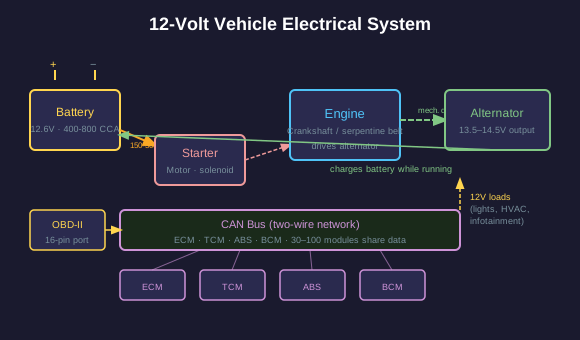
A modern car runs on a 12-volt DC electrical system powered by a lead-acid battery & charged by an alternator driven by the engine's serpentine belt.
The battery provides the stored energy needed to crank the engine on startup. A typical car battery delivers 400-800 cold cranking amps (CCA) to spin the starter motor, which turns the engine's crankshaft until combustion takes over.
The alternator is a belt-driven generator that converts mechanical energy from the engine into electrical energy. Once the engine is running, the alternator powers all electrical systems and recharges the battery. A failing alternator means the battery slowly drains while driving: eventually the car dies.
The starter motor is a high-torque electric motor that meshes with the engine's flywheel ring gear to crank the engine. It draws the highest current of any component in the car: 150 to 300 amps for a few seconds.
CAN bus (Controller Area Network): Modern vehicles have 30 to 100 electronic control modules (ECUs) that need to talk to each other. The CAN bus is a two-wire communication network that connects all of them. The engine control module (ECM), transmission control module (TCM), anti-lock brake module (ABS), body control module (BCM), and dozens of others share data over CAN. When the ECM needs to know the wheel speed, it reads the ABS module's data on the CAN bus.
OBD-II (On-Board Diagnostics II): Since 1996, every car sold in the United States has a standardized 16-pin diagnostic port under the dashboard. A scan tool plugs in and reads diagnostic trouble codes (DTCs) set by any control module on the network. A code like P0301 means misfire detected on cylinder 1. P0420 means catalytic converter efficiency below threshold. OBD-II is the universal language of automotive diagnostics.
Electrical Diagnosis
A customer's car will not start. When they turn the key, they hear a rapid clicking sound but the engine does not crank. The headlights are dim & get even dimmer when they try to start the car. The battery is three years old.
Stopping and Handling
Disc Brakes, ABS, & Suspension Geometry
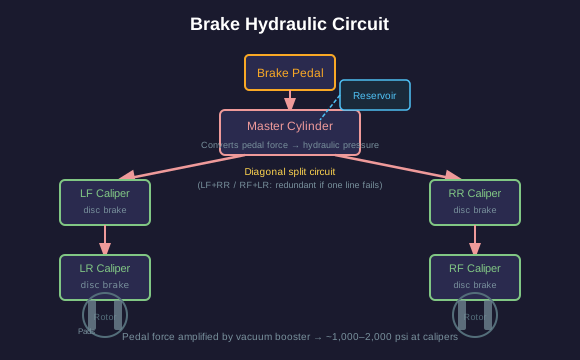
The brake system converts kinetic energy (motion) into thermal energy (heat) through friction. When you press the brake pedal, you push hydraulic fluid through brake lines to calipers at each wheel.
Disc brakes: A cast-iron or composite rotor spins with the wheel. A caliper straddles the rotor and squeezes brake pads against it when hydraulic pressure is applied. The friction slows the rotor and wheel. Disc brakes handle heat well, resist fade, and are self-cleaning. Most modern cars use disc brakes on all four wheels.
Drum brakes: Brake shoes press outward against the inside of a spinning drum. Cheaper to manufacture and still used on the rear axle of some economy cars and trucks. Drums retain heat and water, making them more prone to fade under heavy braking and less effective when wet.
ABS (Anti-lock Braking System): Wheel speed sensors at each corner report to the ABS module. If a wheel locks up during hard braking, the ABS module rapidly pulses the hydraulic pressure to that wheel: releasing and reapplying the brake dozens of times per second. This prevents the tire from skidding and allows the driver to maintain steering control during emergency stops. ABS does not shorten stopping distance on dry pavement: it preserves steering ability.
MacPherson struts: The most common front suspension design in passenger cars. A single assembly combines the shock absorber, coil spring, and steering knuckle into one compact unit. The top of the strut bolts to the strut tower in the body, and the bottom connects to the steering knuckle and lower control arm.
Wheel alignment: Alignment refers to the angles of the wheels relative to the vehicle body and road surface. The three primary angles are camber (tilt in or out when viewed from the front), caster (tilt of the steering axis when viewed from the side), and toe (whether the fronts of the tires point in or out when viewed from above). Incorrect alignment causes uneven tire wear, pulling to one side, and poor handling.

Brake Diagnosis
A customer complains that when they brake hard, the steering wheel shakes & the brake pedal pulsates under their foot. The vibration goes away during normal gentle braking. The car has disc brakes on all four wheels & is five years old with 60,000 miles.
Automotive Career Landscape
Where Automotive Knowledge Takes You
The automotive industry employs over 4 million people in the United States alone. The demand for qualified technicians consistently exceeds supply: dealerships and independent shops struggle to fill positions.
ASE Certification (Automotive Service Excellence): The industry-standard credential. ASE offers certifications in specific areas: Engine Repair (A1), Automatic Transmission (A2), Manual Drivetrain (A3), Suspension and Steering (A4), Brakes (A5), Electrical Systems (A6), HVAC (A7), and Engine Performance (A8). Passing all eight earns you the ASE Master Technician designation. Each certification requires passing a written exam and demonstrating two years of relevant work experience.
Dealership technician: Works on a specific brand (Ford, Toyota, BMW, etc.) and receives factory training on those vehicles. Dealerships pay based on a flat-rate system: each job has an allotted time, and the technician is paid for the allotted hours regardless of how long it actually takes. Fast, skilled technicians can earn significantly more. Dealerships offer structured career advancement from lube tech to master technician.
Independent shop technician: Works on all makes and models. Requires broader knowledge and stronger diagnostic skills because you see everything. Independent shops may pay hourly or flat-rate. More autonomy, less brand-specific training.
EV specialization: Electric vehicles are the fastest-growing segment. EV technicians work with high-voltage battery packs (400-800 volts), electric drive motors, regenerative braking systems, and thermal management. High-voltage safety certification is mandatory: the voltages in an EV battery pack are lethal. Manufacturers like Tesla, Rivian, and Lucid are building their own service networks and hiring technicians with EV-specific training.
Diesel technician: Works on commercial trucks, buses, heavy equipment, and marine engines. Diesel engines use compression ignition (no spark plugs) and operate at much higher pressures and temperatures than gasoline engines. Diesel techs are in high demand in trucking, construction, and agriculture. Many diesel techs earn over $70,000 per year, and specialized heavy equipment techs can earn more.
Getting started: Community college automotive programs (1-2 years), manufacturer-sponsored training programs (UTI, Lincoln Tech, or OEM programs like Toyota T-TEN or Ford ASSET), and apprenticeships at dealerships or shops are the main entry points.
Planning Your Path
Connect Automotive Knowledge to Your Future
You now understand the fundamentals of internal combustion, drivetrains, electrical diagnostics, and brakes and suspension: the core systems that every automotive technician must master.