Welcome
Humans have watched birds for thousands of years & asked: how do they do that? The Wright brothers answered on December 17, 1903 — 12 seconds of powered, controlled flight at Kitty Hawk, North Carolina. Within 66 years, humans walked on the Moon.
Flight is not magic. It is physics: the same physics that explains why a kite climbs, why a curveball curves, & why a paper airplane glides across a room. Every aircraft that has ever flown, from the Wright Flyer to a Boeing 787, obeys the same fundamental principles.
This lesson covers those principles: the four forces of flight, how pilots control an aircraft, the instruments that keep them oriented, the weather that can ground or kill them, & the career paths that put people in cockpits, control towers, & maintenance hangars.
Whether you want to fly, build, fix, or manage aircraft: it all starts here.
Warm-Up
Before We Begin
A commercial airliner like a Boeing 737 weighs about 80,000 kg fully loaded. It has no balloons, no lighter-than-air gas, no rockets. It is a metal tube with two engines bolted to its wings. And yet it climbs to 35,000 feet & cruises at 500 mph for hours.
Lift, Drag, Thrust, and Weight
The Four Forces
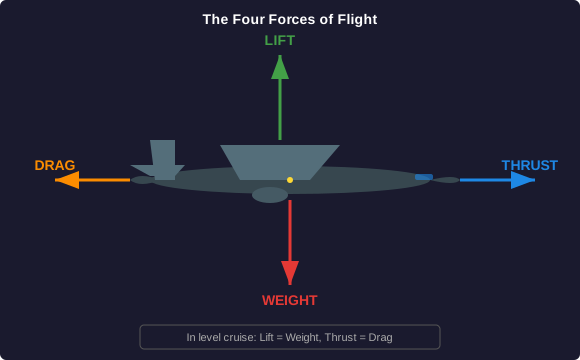
Every aircraft in flight is subject to exactly four forces:
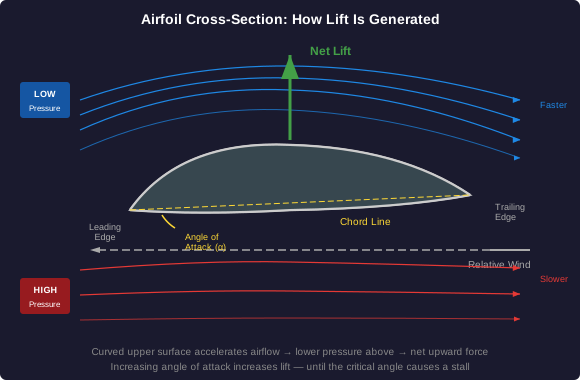
Lift acts perpendicular to the relative wind (the airflow the wing encounters). It is generated by the pressure differential across the wing. Lift depends on airspeed, air density, wing area, wing shape, & angle of attack.
Weight acts straight down toward the center of the Earth. It is the force of gravity on the aircraft & everything in it: fuel, passengers, cargo. Weight changes during flight as fuel is burned.
Thrust is the forward force produced by the engines: propeller, turbofan, turbojet, or rocket. Thrust accelerates the aircraft & maintains airspeed against drag.
Drag is the rearward force that resists the aircraft's motion through the air. There are two main types: parasite drag (friction & form drag from the fuselage, landing gear, antennas) which increases with speed, & induced drag (a byproduct of generating lift) which decreases with speed.
In straight & level unaccelerated flight, all four forces are in equilibrium: lift equals weight, thrust equals drag. Change any one force & the aircraft accelerates, climbs, descends, or turns.
Forces in Action
Equilibrium & Beyond
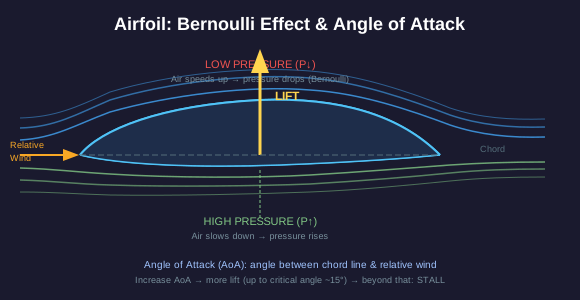
Understanding the four forces is not just academic: it is how pilots think. Every phase of flight is a managed imbalance of these forces. Takeoff: thrust exceeds drag. Climb: lift exceeds weight. Descent: weight exceeds lift. Landing: drag exceeds thrust.
The interaction between drag types is especially important. At low speeds, induced drag is high (the wing works hard at a high angle of attack). At high speeds, parasite drag is high (the airframe pushes through denser relative airflow). There is a speed where total drag is minimized: this is the speed for maximum range & endurance.
Ailerons, Elevator, and Rudder
Three Axes of Rotation

An aircraft rotates around three axes, each controlled by a specific flight control surface:
Longitudinal axis (roll): Controlled by the ailerons, which are hinged surfaces on the outer trailing edge of each wing. Move the control stick left & the left aileron goes up (reducing lift on that wing) while the right aileron goes down (increasing lift). The aircraft rolls left. Roll is how aircraft turn: banking into a turn so that a component of lift pulls the aircraft around the curve.
Lateral axis (pitch): Controlled by the elevator on the horizontal stabilizer at the tail. Pull back on the stick & the elevator deflects upward, pushing the tail down & the nose up. Pitch controls the angle of attack &, indirectly, airspeed.
Vertical axis (yaw): Controlled by the rudder on the vertical stabilizer. Press the left rudder pedal & the rudder deflects left, pushing the tail right & the nose left. The rudder is used primarily to coordinate turns & counteract adverse yaw, not to turn the aircraft by itself.
Flaps are hinged surfaces on the inner trailing edge of the wings. Extended during takeoff & landing, they increase both lift & drag, allowing the aircraft to fly at lower airspeeds. Flaps change the camber (curvature) of the wing.
Trim allows the pilot to adjust the neutral position of the elevator so the aircraft maintains a desired pitch attitude without constant stick pressure. Proper trim reduces pilot workload enormously.
Coordinated Flight
Turning an Aircraft
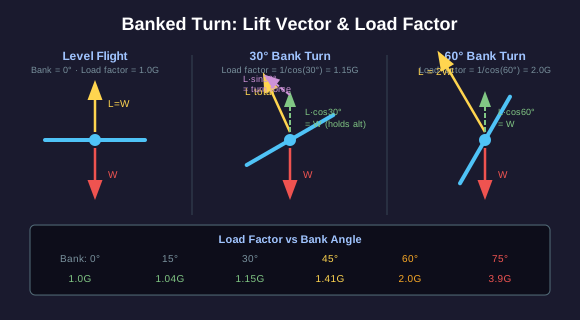
A common misconception is that aircraft turn using the rudder, like a boat. In reality, an aircraft turns by banking, rolling the wings so that a component of lift pulls the aircraft horizontally around the curve. The rudder's job in a turn is to coordinate, to keep the nose pointed along the flight path & prevent the aircraft from slipping or skidding.
In a banked turn, some of the lift vector that was supporting the aircraft's weight is now directed horizontally. This means less vertical lift is available, so the aircraft loses altitude unless the pilot increases back pressure (or adds power) to increase the total lift.
Six-Pack & Navigation Systems
The Six Primary Flight Instruments
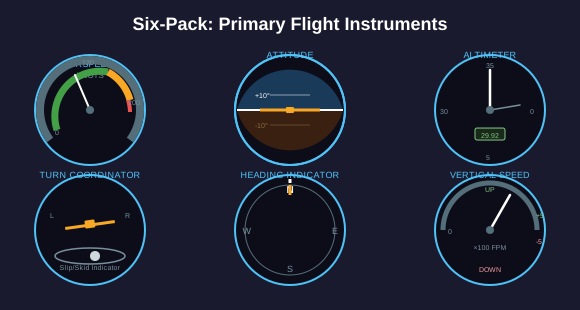
Every aircraft from a Cessna 172 to an Airbus A380 displays the same six core pieces of information, traditionally arranged in two rows of three (the 'six-pack'):
Airspeed indicator: Shows the aircraft's speed through the air (not over the ground). Driven by the pitot-static system: a forward-facing tube (pitot tube) measures ram air pressure, & static ports measure ambient pressure. The difference is dynamic pressure, which indicates airspeed.
Attitude indicator (artificial horizon): Shows the aircraft's pitch & bank attitude relative to the horizon. This is the most critical instrument for flight in clouds or at night when the natural horizon is invisible.
Altimeter: Shows altitude above mean sea level, based on atmospheric pressure measured by the static port. Pilots adjust the altimeter setting to account for local barometric pressure.
Turn coordinator: Shows the rate & quality of a turn: whether the aircraft is coordinated, slipping, or skidding.
Heading indicator (directional gyro): Shows the aircraft's magnetic heading. More stable than a magnetic compass in turbulence or turns.
Vertical speed indicator (VSI): Shows the rate of climb or descent in feet per minute.
Navigation
VOR (VHF Omnidirectional Range): Ground-based radio beacons that transmit radials: magnetic bearings from the station. Pilots track specific radials to navigate between VORs. This has been the backbone of airways navigation since the 1950s.
GPS: Satellite-based navigation now dominates. Modern GPS approaches can guide an aircraft to within 200 feet of a runway threshold in zero visibility.
IFR vs VFR: Visual Flight Rules (VFR) require visual reference to the ground & specific weather minimums (visibility, cloud clearance). Instrument Flight Rules (IFR) allow flight in clouds & low visibility using instruments & ATC guidance. IFR requires an instrument rating, an IFR-equipped aircraft, & a filed flight plan.
Flying Blind
When You Cannot See
Spatial disorientation is one of the leading causes of fatal general aviation accidents. The human vestibular system (inner ear) evolved for walking, not for flying. In clouds or at night without a visible horizon, your body will lie to you: you may feel level when you are in a 30-degree bank, or feel like you are climbing when you are descending.
John F. Kennedy Jr. died in 1999 when he flew his Piper Saratoga into haze over the ocean at night. He was not instrument rated. Without a visible horizon, he likely entered a graveyard spiral: a gradually steepening descending turn that feels like straight flight to the inner ear.
Weather Hazards for Pilots
Weather Kills Pilots
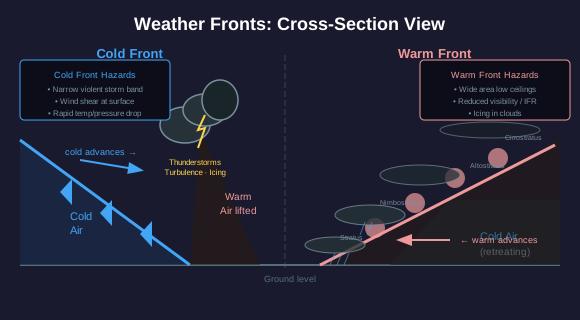
Weather is the single most common factor in fatal general aviation accidents. Not because weather is unpredictable: it is because pilots make bad decisions about it.
Fronts: A cold front pushes under warm air, creating a narrow band of intense weather: thunderstorms, wind shear, turbulence. Warm fronts slide over cold air, creating wide areas of low clouds, rain, & reduced visibility. Knowing what kind of front is approaching tells you what kind of hazards to expect.
Turbulence: Mechanical turbulence comes from wind flowing over terrain. Convective turbulence comes from thermal updrafts on hot days. Clear air turbulence (CAT) occurs at high altitude near jet streams with no visual warning. Wake turbulence from heavy aircraft can flip a small plane.
Icing: Structural icing occurs when supercooled water droplets freeze on contact with the aircraft. Ice on the wings destroys lift & increases drag. Ice on the propeller reduces thrust. Ice over the pitot tube disables the airspeed indicator. Most small aircraft are not certified for flight in known icing conditions.
Density altitude: Hot, humid, high-elevation air is thin. The aircraft performs as if it were at a higher altitude: longer takeoff roll, reduced climb rate, reduced engine power. A runway that is safe to use at sea level on a cool morning may be dangerously short at 5,000 feet elevation on a hot afternoon.
Go or No-Go
Aeronautical Decision-Making
Every flight begins with a go/no-go decision. Professional pilots use structured frameworks: PAVE (Pilot, Aircraft, enVironment, External pressures) & IMSAFE (Illness, Medication, Stress, Alcohol, Fatigue, Eating). These checklists exist because the most dangerous hazard in aviation is not thunderstorms or engine failures: it is a pilot who has decided to go before evaluating the risks.
Get-there-itis, the pressure to complete a flight despite deteriorating conditions, is the deadliest pattern in general aviation. The NTSB has investigated hundreds of fatal accidents where the pilot flew into known bad weather because they felt they had to reach their destination.
Where Aviation Takes You
Pilot Certificates
Private Pilot License (PPL): Minimum 40 hours flight time (national average is 60-70). Allows you to fly single-engine aircraft VFR, carry passengers, but not for compensation. Cost: $10,000-$15,000.
Instrument Rating: Additional training to fly in clouds & low visibility using instruments. Required for most professional flying & strongly recommended for safety.
Commercial Pilot License (CPL): Minimum 250 hours. Allows you to fly for compensation: banner towing, aerial survey, charter flights.
Airline Transport Pilot (ATP): Minimum 1,500 hours (1,000 for military, restricted ATP at 750 for certain programs). Required to serve as captain at an airline. This is the highest pilot certificate.
Other Aviation Careers
A&P Mechanic (Airframe & Powerplant): FAA-certificated aircraft maintenance technicians. 18-24 months of schooling or equivalent military experience. High demand, strong pay, & you never have to worry about the job market: aircraft always need maintenance.
Air Traffic Controller (ATC): Managed by the FAA. Must be hired before age 31. Competitive selection through the FAA's AT-SA aptitude test. High stress, high pay, mandatory retirement at 56. Starting salary around $40,000 during training, experienced controllers earn $100,000-$180,000.
Drone Pilot (Part 107): FAA Remote Pilot Certificate for commercial drone operations. Written test only, no flight hours required. Opens careers in aerial photography, surveying, inspection, agriculture, & real estate. The fastest-growing segment of aviation.
Military Pipeline: All branches operate aircraft. Military pilots receive world-class training at no cost in exchange for a service commitment (typically 10 years for pilots). Many airline pilots transition from military careers. Military maintainers & ATC personnel also transition well to civilian careers.
Synthesis
Putting It All Together
You now understand the four forces of flight, how pilots control an aircraft, how instruments keep them safe in the clouds, why weather is the deadliest hazard in general aviation, & the career paths available in the industry.
Aviation rewards people who think in systems: forces interact with controls, controls interact with instruments, instruments interact with weather, & weather interacts with decisions. The best pilots, mechanics, & controllers are not the ones with the fastest reflexes. They are the ones who think ahead.