Welcome
Welcome to CNC machining: one of the most in-demand trades in modern manufacturing.
CNC stands for Computer Numerical Control. It means a computer is reading a set of instructions & controlling the movement of a cutting tool or workpiece with extreme precision.
Before CNC, a machinist would turn handwheels to move a cutting tool across metal, watching dials and counting turns. A skilled manual machinist could hold tolerances of about plus or minus two thousandths of an inch. That is impressive: but it depends entirely on the person, and it is slow.
A CNC machine can hold tolerances of plus or minus one tenth of a thousandth of an inch (0.0001 inches), & it can do it on the thousandth part the same as the first. No fatigue. No variation.
CNC did not replace machinists. It gave them a more powerful tool. The machine does the cutting, but the machinist still decides how: what tool to use, how fast to spin it, how deep to cut, and what order to run the operations. Bad decisions still crash tools, scrap parts, and cost thousands of dollars.
This lesson covers the core knowledge every CNC operator & programmer needs: machine types, G-code, tooling, materials, quality control, & career paths.
Warm-Up
Quick Check-In
Let us see where you start from.
Major Machine Types
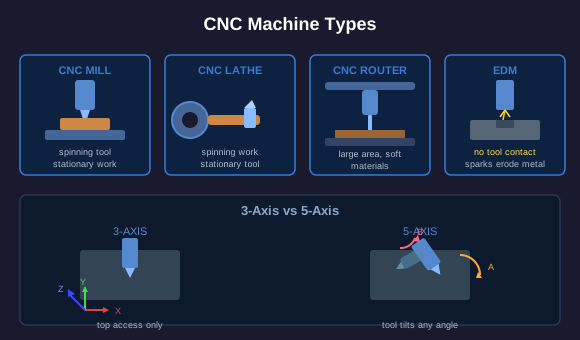
CNC Machine Types
Different jobs require different machines. Here are the major types you will encounter in a shop.
CNC Mill: The workhorse of most shops. A spinning cutting tool moves across a stationary workpiece to remove material. Mills can cut flat surfaces, pockets, slots, holes, and complex 3D contours. Most shops run vertical mills, where the spindle points down.
CNC Lathe (Turning Center): The workpiece spins while a stationary cutting tool removes material. Lathes make round parts: shafts, bushings, pins, threads, and anything with rotational symmetry. If the part is cylindrical, it probably came off a lathe.
CNC Router: Similar to a mill but built for softer materials and larger work areas. Routers cut wood, plastic, foam, and aluminum sheet. Common in sign-making, cabinetry, and composite fabrication.
EDM (Electrical Discharge Machining): No cutting tool touches the workpiece. Instead, electrical sparks erode material away. EDM can cut hardened steel and create shapes that are impossible with conventional cutting: tiny holes, sharp internal corners, and intricate die cavities.
3-Axis vs 5-Axis: A 3-axis mill moves the tool in X (left-right), Y (front-back), and Z (up-down). A 5-axis mill adds two rotational axes, allowing the tool to approach the workpiece from almost any angle. 5-axis machines cost more and are harder to program, but they can make complex aerospace and medical parts in a single setup instead of requiring multiple setups and fixtures.
Choosing the Right Machine
Matching the Machine to the Job
A machinist needs to look at a part & know which machine makes it most efficiently.
Coordinate Systems and Motion
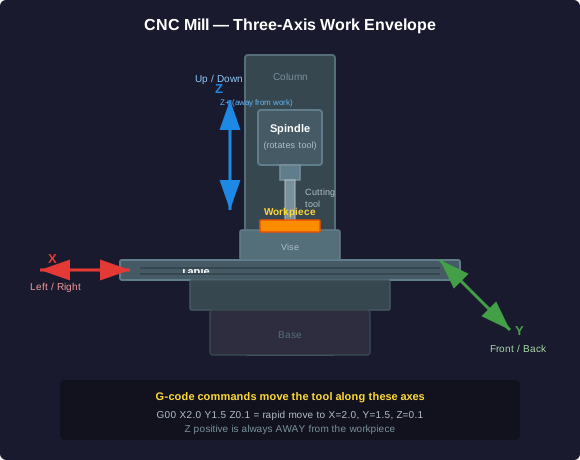
G-Code: The Language of CNC
Every CNC machine reads a program written in G-code: a simple language where each line tells the machine to do one thing: move here, spin the spindle, turn on coolant, change tools.
G-code uses a Cartesian coordinate system. On a mill:
- X = left & right
- Y = front & back
- Z = up & down (Z positive is always away from the workpiece)
Every program has a work offset: a point on the workpiece that the machine treats as X0 Y0 Z0. This is usually a corner or the center of the top face. The machinist sets this point by touching the tool to the workpiece and telling the controller where it is.
The most important motion commands:
- G00: Rapid move. The machine moves as fast as possible to a position. Used for repositioning, never for cutting. Moving at rapid into the material will crash the tool.
- G01: Linear feed move. The machine moves in a straight line at a controlled feed rate. This is your basic cutting move.
- G02: Clockwise arc. Cuts a circular arc in the clockwise direction.
- G03: Counterclockwise arc. Same as G02 but in the opposite direction.
M-codes control machine functions that are not motion:
- M03: Spindle on, clockwise
- M05: Spindle stop
- M08: Coolant on
- M09: Coolant off
- M06: Tool change
- M30: Program end and reset
Reading a G-Code Block
Reading G-Code
Here is a short G-code snippet. Each line is called a block.
G00 X0 Y0 Z1.0
G00 Z0.1
G01 Z-0.25 F10.0
G01 X3.0 F15.0
G00 Z1.0
The F value is the feed rate: how fast the tool moves through material, in inches per minute.
Tool Offsets
Tool Length & Work Offsets
Every cutting tool has a different length. A 6-inch end mill sticks out further from the spindle than a 2-inch drill. If the machine does not account for this difference, it will cut too deep or not deep enough.
This is solved with tool length offsets. The machinist measures each tool's length & enters it into the controller. When the program calls that tool, the machine adjusts all Z moves to compensate.
Getting a tool offset wrong is one of the most common causes of crashes. If the offset is too short, the tool plunges deeper than expected. If it is too long, the tool cuts air above the workpiece.
Work offsets (G54, G55, G56, etc.) tell the machine where the workpiece sits on the table. A machinist can set up multiple parts with different work offsets & run them in sequence without re-zeroing.
Cutting Tools
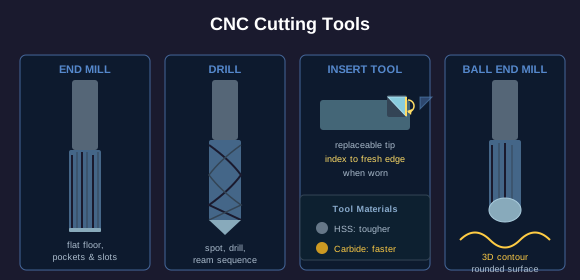
Cutting Tools & Their Jobs
A CNC machine is only as good as the tool in its spindle. Different operations require different tools.
End Mills: The most versatile milling tool. They cut on the bottom and the sides. A flat end mill leaves a flat floor. A ball end mill leaves a rounded surface, used for 3D contouring. End mills come in 2-flute, 3-flute, and 4-flute designs: more flutes means a smoother finish but requires faster feed rates to maintain proper chip load.
Drills: For making holes. Spot drills start a hole with a precise center. Twist drills bore the hole to depth. Reamers follow to bring the hole to an exact diameter with a smooth finish.
Inserts: Replaceable cutting tips that clamp into a tool holder. Common on lathes and face mills. When an insert edge wears out, you index it (rotate to a fresh edge) or replace just the insert, not the whole tool. This saves significant money in production.
Tool Materials: Most cutting tools are either high-speed steel (HSS) or carbide. Carbide is harder and can run at much higher speeds, but it is brittle and more expensive. Ceramic and diamond-coated tools exist for specialized high-speed applications.
Speeds and Feeds
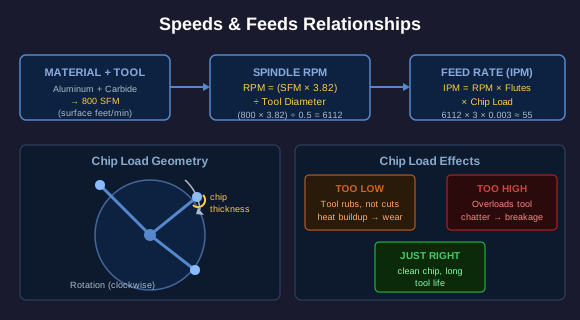
Speeds & Feeds: The Core Calculation
Speed (RPM) is how fast the spindle rotates. Feed (IPM: inches per minute) is how fast the tool moves through the material. Getting these right is the difference between a good cut and a broken tool.
The starting point is surface speed (SFM: surface feet per minute), which depends on the material being cut and the tool material. Aluminum with a carbide tool might run at 800 SFM. Mild steel with carbide might run at 400 SFM. Stainless steel might be 250 SFM.
RPM is calculated from SFM & tool diameter:
RPM = (SFM x 3.82) / Tool Diameter
Chip load is the thickness of material each flute removes per revolution. It is the fundamental unit of cutting. Too low a chip load means the tool rubs instead of cutting, generating heat & accelerating wear. Too high a chip load overloads the tool & can break it.
Feed rate comes from chip load:
Feed (IPM) = RPM x Number of Flutes x Chip Load
These are starting points. The machinist adjusts based on what they hear, see, & measure. A good cut sounds smooth. A bad cut screams, chatters, or makes the machine shudder.
Tolerances and GD&T
Tolerances: How Precise Is Precise Enough?
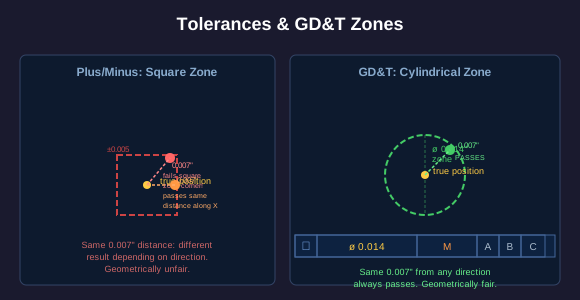
No part is made to a perfect dimension. Every dimension on a drawing has a tolerance: the acceptable range of variation.
A dimension might read 2.500 +/- 0.005 inches. This means the actual part can be anywhere from 2.495 to 2.505 inches and still pass inspection. That tolerance is plus or minus five thousandths: also called 'five thou.'
Tighter tolerances cost more. A part held to plus or minus 0.0005 inches (half a thou) requires better machines, sharper tools, slower feeds, temperature-controlled environments, & more careful inspection. The machinist's job is to hit the tolerance, not to chase perfection beyond what the drawing requires.
GD&T (Geometric Dimensioning & Tolerancing) goes beyond simple plus/minus. It controls the geometry of features:
- Flatness: How flat is a surface? A flatness of 0.001 means the entire surface must fit between two parallel planes 0.001 inches apart.
- Concentricity: How well do two cylindrical features share the same center axis?
- True Position: How close is a hole to where the drawing says it should be?
GD&T is its own language with its own symbols. Learning it takes time, but every machinist needs at least the basics.
Measurement and Inspection
Measuring What You Made
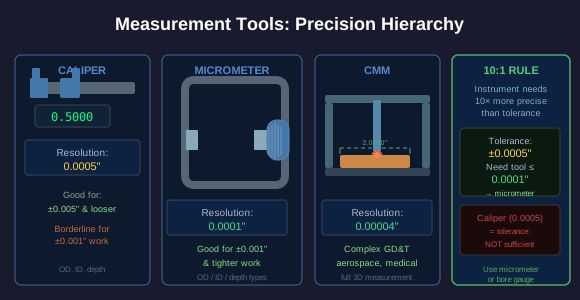
You cannot hit a tolerance if you cannot measure it.
Calipers: Measure inside diameters, outside diameters, depths, and steps. A digital caliper reads to 0.0005 inches. Good for tolerances of plus or minus 0.005 and looser.
Micrometers: More precise than calipers. An outside micrometer reads to 0.0001 inches. Used when tolerances are plus or minus 0.001 or tighter. Micrometers measure one thing well: you need different types for outside dimensions, inside bores, and depths.
CMM (Coordinate Measuring Machine): A computer-controlled probe that touches points on a part and builds a 3D measurement map. CMMs can verify complex GD&T requirements that no hand tool can check. They are expensive but standard in aerospace and medical manufacturing.
Gauge pins and gauge blocks: Precision ground to exact sizes. Used to verify hole diameters (go/no-go gauge pins) and to calibrate other instruments. A set of gauge blocks accurate to millionths of an inch costs thousands of dollars.
CNC Career Paths
Career Paths in CNC Machining
CNC machining offers multiple career tracks with different mixes of hands-on work & technical planning.
CNC Operator: Runs the machines. Loads material, sets tools, starts programs, monitors cuts, and inspects finished parts. Entry-level position, but a good operator who understands the process is worth their weight in carbide. Median pay around $40,000-$50,000, more in aerospace and medical.
CNC Setup Technician: Handles the complex part: fixturing, tool offsets, first-article inspection, and dialing in a new job. Once the setup tech has the process running, operators keep it going. Setup techs earn $50,000-$65,000 typically.
CNC Programmer: Writes the G-code, often using CAM (Computer-Aided Manufacturing) software that generates toolpaths from 3D models. Programmers decide cutting strategies, tool selections, and machining sequences. They need strong understanding of both the software and the physical cutting process. $55,000-$80,000 range.
Manufacturing Engineer: Designs the entire manufacturing process: which machines, what order of operations, what fixtures, what quality checks. They solve production problems and optimize for cost and quality. Typically requires a degree or extensive experience. $65,000-$95,000.
NIMS Certification: The National Institute for Metalworking Skills offers industry-recognized credentials in CNC milling, CNC turning, and other specialties. NIMS certification proves competency to employers and can accelerate career advancement.
Many machinists start as operators, earn NIMS credentials, move into setup or programming, & eventually lead departments or start their own shops. The path from operator to shop owner is well-traveled in this trade.
Your Path Forward
Thinking About Your Path
There is no single right entry point. Some people start in community college programs. Some go through apprenticeships at manufacturing companies. Some join the military & learn machining there. The common thread is hands-on time at the machine.
What Will You Remember?
Wrapping Up
Here is what you covered today:
- CNC machines use computer control to cut parts with thousandths-of-an-inch precision, but the machinist still makes the critical decisions
- Mills cut flat & complex shapes; lathes make round parts; routers handle large soft materials; EDM uses electrical sparks for hardened steel
- G-code is the language of CNC: G00 for rapid moves, G01 for cutting, G02/G03 for arcs, M-codes for machine functions
- Speeds & feeds are calculated from surface speed, tool diameter, chip load, & number of flutes
- Tolerances define acceptable variation; GD&T controls geometry; the right measurement tool must be more precise than the tolerance
- Career paths range from operator to manufacturing engineer, with NIMS certification as an industry credential
CNC machining is a trade where math, problem-solving, & hands-on skill all matter. The machines are getting more capable every year, but they still need people who understand the physics of cutting metal.