Welcome
Every building you have ever walked into: every house, school, hospital, warehouse, and skyscraper: was built by people who understood how to turn raw materials into a structure that stands up, keeps the weather out, and keeps the people inside safe.
Construction is one of the largest industries in the world. In the United States alone, it employs over 8 million people & generates more than $2 trillion in annual spending. It spans residential homes, commercial offices, industrial plants, heavy civil infrastructure like bridges & highways, & specialty work like marine & environmental construction.
Every project follows the same fundamental sequence: clear and prepare the site, build the foundation, erect the structure, close in the envelope, rough in the mechanical/electrical/plumbing systems, then finish the interior. Understanding that sequence: and why it cannot be rearranged: is the foundation of construction knowledge.
In this lesson, we will walk through how buildings come together from the ground up, covering foundations, framing, the building envelope, MEP systems, & the career paths that keep this industry running.
Warm-Up
Before we break ground, let us see what you already know about how buildings go up.
Soil, Footings, and Foundation Types
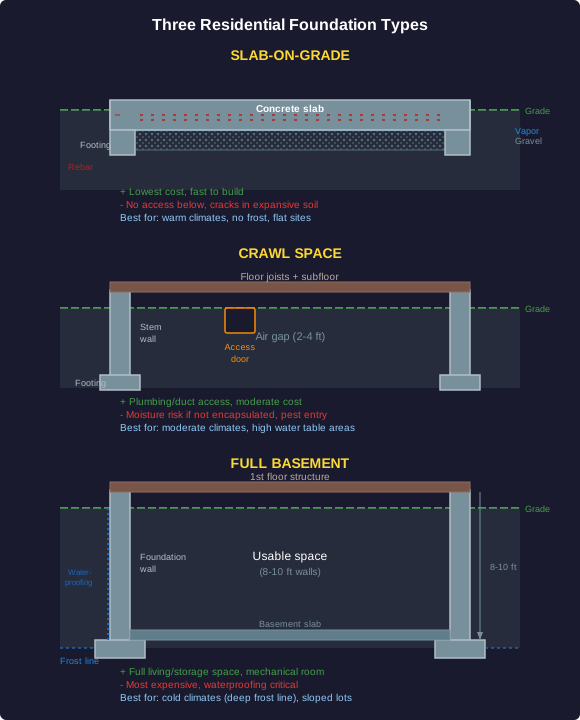
Everything Starts Below Grade
A building is only as strong as what it sits on. Before any concrete is poured, the soil must be evaluated. A geotechnical engineer drills test borings to determine the soil type, bearing capacity, water table depth, & any problem conditions like expansive clay or fill material.
Footings are the lowest structural element: wide, thick pads of reinforced concrete that spread the building's weight across a larger area of soil. Think of it like snowshoes: the wider the footing, the less pressure on any one square foot of ground. Residential footings are typically 16 to 24 inches wide and 8 to 12 inches thick. Commercial footings can be massive.
Three common foundation types for residential construction:
Slab-on-grade: A single layer of concrete poured directly on prepared ground. The footing and floor are one monolithic pour. Common in warm climates where frost is not a concern. Simple, economical, but no access to plumbing or utilities underneath once poured.
Crawl space: Short foundation walls (2 to 4 feet tall) supporting the floor structure above, with open space underneath. Allows access to plumbing and ductwork. Must be properly vented or encapsulated to prevent moisture problems.
Full basement: Foundation walls 8 to 10 feet tall, creating a usable below-grade space. Provides storage, mechanical room space, and potential living area. Most expensive option. Requires waterproofing and drainage systems to keep water out.
Concrete basics: Modern structural concrete is a mix of Portland cement, sand (fine aggregate), gravel (coarse aggregate), and water. The cement and water undergo a chemical reaction called hydration: concrete does not dry, it cures. Standard residential concrete is 3,000 to 4,000 PSI (pounds per square inch compressive strength). Steel reinforcing bar (rebar) is embedded in the concrete to handle tension forces, since concrete is strong in compression but weak in tension.
Choosing the Right Foundation
A builder is planning three different houses. House one is in south Texas where temperatures never drop below freezing, the budget is tight, & the lot is flat clay soil. House two is in Vermont where the frost line is 48 inches deep, the homeowner wants a workshop & storage below the house, & the lot slopes gently. House three is in coastal North Carolina with a high water table, moderate climate, & the homeowner wants easy access to plumbing for future bathroom additions.
Structural Skeleton
Wood vs Steel Framing
Framing is the structural skeleton of the building: the system of vertical and horizontal members that carries all loads down to the foundation.
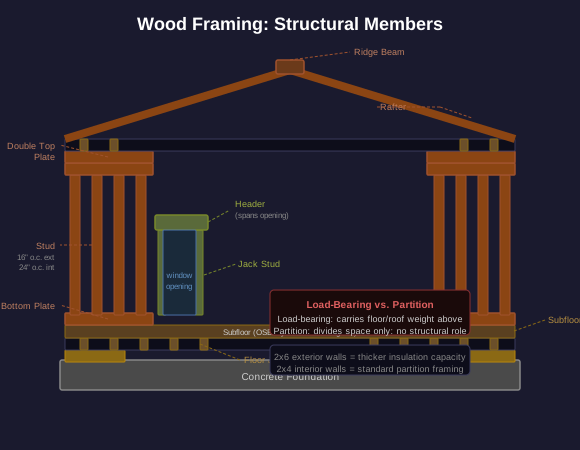
Wood framing (stick framing) dominates residential construction in North America. Standard lumber: 2x4s for interior walls, 2x6s for exterior walls (to fit thicker insulation), 2x8 through 2x12 for floor joists and rafters. Wood is lightweight, easy to cut and fasten with nails, and relatively inexpensive. A skilled crew can frame an entire house in one to two weeks.
Steel framing uses light-gauge steel studs & joists for commercial buildings & some residential projects. Steel does not rot, shrink, warp, or get eaten by termites. It is fire-resistant & dimensionally stable. However, steel framing requires screws instead of nails, conducts heat (thermal bridging), & costs more than wood.
Load-bearing walls carry the weight of the structure above them: roof, upper floors, and their own weight: down to the foundation. Removing or cutting into a load-bearing wall without proper support will cause structural failure. Non-load-bearing walls (partition walls) divide space but carry no structural load and can be removed freely.
Headers span openings in load-bearing walls: doors, windows, and pass-throughs. A header is a horizontal beam (typically doubled 2x lumber or an engineered LVL beam) that picks up the load from above the opening and transfers it to the jack studs on either side. The wider the opening, the larger the header must be. A 3-foot doorway might need a doubled 2x6 header; an 8-foot garage door opening needs a much deeper beam.
Floor systems consist of joists (horizontal members) spanning between bearing walls or beams, with plywood or OSB subflooring nailed & glued on top. Wall systems are built from studs spaced 16 or 24 inches on center, with top & bottom plates. Roof systems use rafters (stick-framed) or trusses (factory-built triangulated frames) to create the roof slope & support the roofing materials.
Structural Thinking
A homeowner wants to remove a wall between the kitchen & living room to create an open floor plan. The wall runs perpendicular to the floor joists above, which rest on top of it. The wall sits directly above a beam in the basement that runs to the foundation.
Keeping the Weather Out
The Building Envelope System
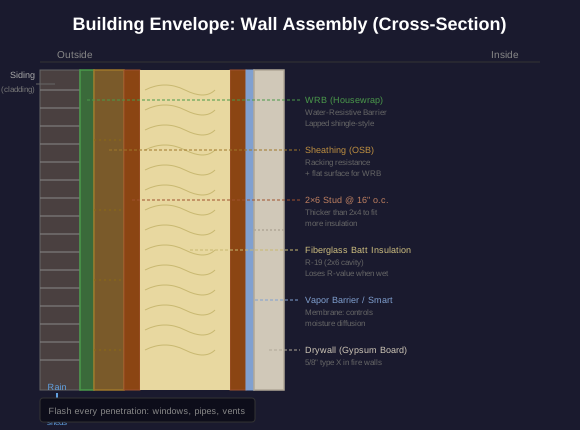
The building envelope is the boundary between inside and outside: walls, roof, windows, and doors working together to control water, air, heat, and vapor. A failure in the envelope means water intrusion, mold, energy loss, and structural decay.
Sheathing: Plywood or OSB (oriented strand board) panels nailed to the exterior of the framing. Sheathing provides racking resistance (keeps the frame from racking into a parallelogram in wind or earthquakes) and creates a flat surface for the weather barrier.
Water-Resistive Barrier (WRB): A membrane (housewrap like Tyvek, or fluid-applied products) installed over the sheathing. The WRB is the primary defense against bulk water penetration. It must be lapped shingle-style: upper layers overlap lower layers so water sheds downward. Every penetration (window, pipe, vent) must be flashed and sealed to the WRB.
Insulation: Controls heat transfer through the envelope. Common types: fiberglass batts (cheap, easy to install, loses performance when compressed or wet), spray foam (closed-cell provides insulation and air barrier in one layer, expensive), rigid foam boards (used on exterior of sheathing to reduce thermal bridging through studs), and blown cellulose (recycled paper, fills cavities well).
Windows & doors are the weakest points in the envelope. They are installed with flashing tape & sill pans that direct any water that gets behind the trim back out to the WRB. Improper window flashing is one of the top three causes of water damage in residential construction.
Roofing: The roof sheds water through overlapping layers. Asphalt shingles are the most common residential roofing material. They are installed over roofing felt or synthetic underlayment on plywood or OSB roof decking. Every layer overlaps the one below so water runs off without finding a path in.
Diagnosing an Envelope Failure
A homeowner notices water stains on the drywall below a second-floor window after heavy rain. There is no plumbing above the stain. The window itself does not appear to leak: the glass and frame are dry. But the drywall below and to the side of the window is damp and showing early signs of mold.
Mechanical, Electrical, and Plumbing
The Systems Inside the Walls
MEP stands for Mechanical, Electrical, and Plumbing: the three major building systems that make a structure livable. These trades work inside the walls, floors, and ceilings, and their coordination is one of the biggest challenges in construction.
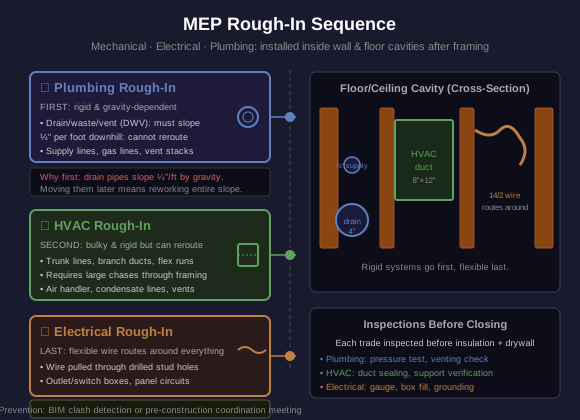
Rough-in sequence: After framing is complete but before insulation and drywall go in, the MEP trades install their systems inside the wall and floor cavities. The typical sequence is:
1. Plumbing rough-in goes first. Drain pipes run downhill by gravity & cannot be rerouted easily, so they get priority. Supply pipes, vent stacks, & gas lines are also run during this phase.
2. HVAC rough-in is next. Ductwork is bulky and inflexible: trunk lines and branch runs need large chases through floors and walls. The mechanical contractor coordinates with framing to ensure chases and soffits are built to accommodate the ducts.
3. Electrical rough-in is last. Wires are flexible & can be routed around pipes & ducts. The electrician pulls wire through drilled holes in studs & joists, installs outlet & switch boxes, & runs circuits back to the panel.
This sequence matters because you cannot easily move a 4-inch drain pipe to make room for a wire, but you can route a wire around a pipe. Rigid systems go first, flexible systems go last.
Inspections: Each trade's rough-in must pass inspection before walls are closed up with insulation and drywall. The building inspector checks that plumbing is properly vented and pressure-tested, electrical wiring meets code for wire gauge, box fill, and grounding, and HVAC ductwork is sealed and properly supported. Once the walls are closed, defects are hidden and expensive to fix.
Coordination Problem
A general contractor is building a two-story house. The plumber has finished rough-in on the first floor. The HVAC contractor shows up & discovers that a main trunk duct line needs to run through the same floor cavity where the plumber already installed a 3-inch drain line. The duct will not fit alongside the pipe in the available space. The electrician is scheduled to start tomorrow.
Construction Careers
Building a Career in Construction
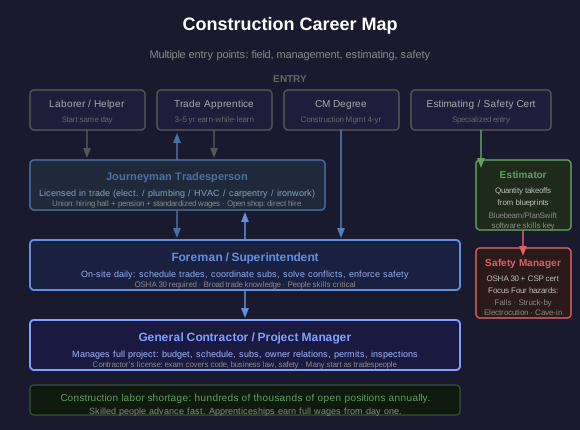
Construction offers a wide range of career paths, from hands-on trade work to project management and beyond. The industry faces a persistent labor shortage: hundreds of thousands of open positions go unfilled every year.
General Contractor (GC): The GC manages the entire project. They hire and schedule subcontractors, order materials, manage the budget, coordinate inspections, and ensure the project meets plans and code. A GC needs a contractor's license in most states, which requires passing an exam covering building code, business law, and safety. Many GCs start as tradespeople and work their way up.
Superintendent: The GC's on-site representative. The super is on the jobsite every day, managing the schedule, coordinating trades, solving problems, and ensuring quality. It is one of the most demanding roles in construction: you need deep knowledge of every trade, strong people skills, and the ability to make fast decisions under pressure.
Estimator: Estimates the cost of a project before it is built by performing quantity takeoffs (counting every piece of material from the blueprints) and applying unit costs for labor and materials. Accuracy is critical: an underestimate loses money, an overestimate loses the bid. Estimators need to read blueprints fluently and understand construction methods for every trade.
Safety and OSHA: OSHA (Occupational Safety and Health Administration) regulates construction safety. The OSHA 10-Hour card is a basic safety orientation required on most commercial jobsites. The OSHA 30-Hour card is required for supervisors and safety managers. Falls are the number one cause of death in construction: fall protection is mandatory above 6 feet. Trenching, scaffolding, electrical hazards, and struck-by incidents round out OSHA's Focus Four hazards.
Union vs Open Shop: Union construction operates through hiring halls where contractors request workers by trade and skill level. Union workers receive standardized wages, benefits, apprenticeship training, and pension plans. Open shop (non-union) contractors hire directly and set their own pay scales. Both paths can lead to successful careers. Union apprenticeships typically last 3 to 5 years and combine paid on-the-job training with classroom instruction.
Entry points: Trade apprenticeships (electrical, plumbing, HVAC, carpentry, ironwork), construction management degree programs, estimating certifications, and starting as a laborer and learning on the job are all viable paths into the industry.
Your Path Forward
Connect Construction to Your Future
You now understand the major phases of construction: from foundations to framing to envelope to MEP: and the coordination required to bring them together safely and on schedule.