Welcome
Every building you have ever been inside was wired by an electrician. The lights, the outlets, the appliances: all of it runs on a system of copper conductors, protective devices, and careful planning that most people never think about.
Residential electrical work is one of the most in-demand trades in the country. It pays well, it cannot be outsourced, and it requires real knowledge: not just muscle. A mistake in plumbing makes a mess. A mistake in electrical can kill someone.
This lesson covers the fundamentals of residential electrical systems: how power gets to a house, how it is distributed through circuits, what the wires & devices actually do, & how to work safely around electricity.
By the end, you will understand the system behind every light switch & outlet in your home.
Warm-Up
Before We Begin
Think about the last time you flipped a light switch or plugged something in.
Voltage, Current, and Resistance
The Three Building Blocks
Every electrical system runs on three measurable quantities:
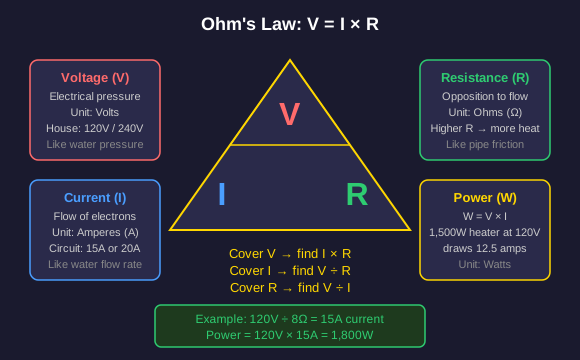
Voltage (V) is electrical pressure: the force that pushes electrons through a conductor. Think of it like water pressure in a pipe. In the US, residential outlets provide 120 volts. Large appliances like dryers and ranges use 240 volts.
Current (I) is the flow of electrons, measured in amperes (amps). Think of it as the volume of water flowing through the pipe. A typical household circuit carries 15 or 20 amps.
Resistance (R) is opposition to current flow, measured in ohms. Every wire, every device, every connection has some resistance. Resistance converts electrical energy into heat: which is how a toaster works, and also how electrical fires start.
Ohm's Law: V = I x R. Voltage equals current times resistance. If you know any two, you can calculate the third. This equation is the foundation of every electrical calculation you will ever do.
AC vs DC and Residential Power
Alternating Current
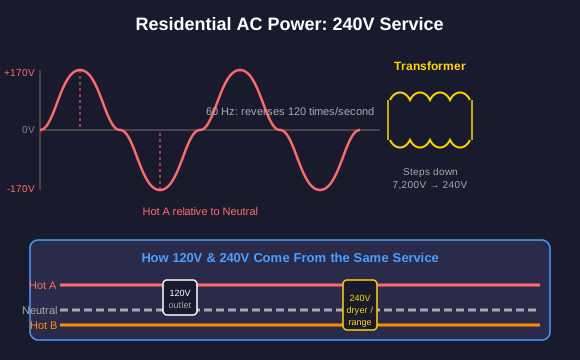
Residential power in the US is alternating current (AC) at 60 Hz: the current reverses direction 60 times per second. AC won the war against direct current (DC) over a century ago because it can be stepped up to high voltage for efficient long-distance transmission, then stepped back down for safe use in homes.
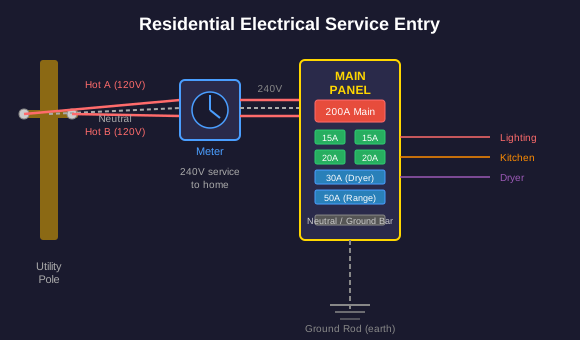
Your utility delivers 240 volts to your house via two hot legs, each carrying 120 volts relative to neutral. A standard outlet uses one hot leg & neutral to provide 120V. A 240V outlet uses both hot legs.
Watts (W) = Volts x Amps. A 1,500-watt space heater on a 120V circuit draws 12.5 amps. That matters because a standard 15-amp circuit can only safely deliver 80% of its rated capacity for continuous loads: that is 12 amps. One space heater nearly maxes out the circuit.
Main Breaker Panel
The Brain of the System
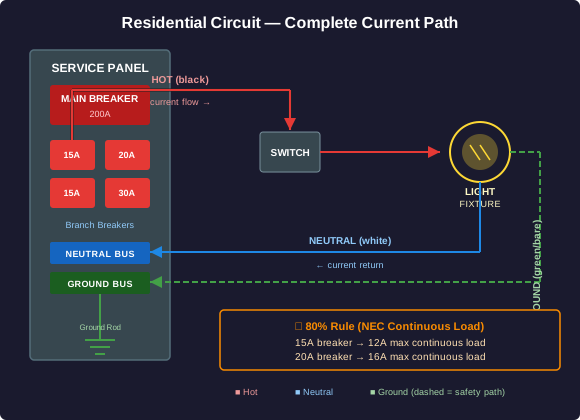
The service panel (breaker box) is where utility power enters your home & gets divided into individual branch circuits. Every wire in the house traces back to this panel.
The main breaker sits at the top. It is typically rated at 100, 150, or 200 amps & can disconnect all power to the house at once. Newer homes almost always have 200-amp service.
Below the main breaker are rows of branch circuit breakers. Each one protects a single circuit: a group of outlets, lights, or a dedicated appliance. Common ratings are 15 amps (for lighting and general outlets) and 20 amps (for kitchen, bathroom, and garage outlets).
Larger breakers: 30, 40, 50 amps: serve dedicated 240V circuits for dryers (30A), ranges (40-50A), and air conditioning units.
Grounding and the Neutral
The Most Misunderstood Concept
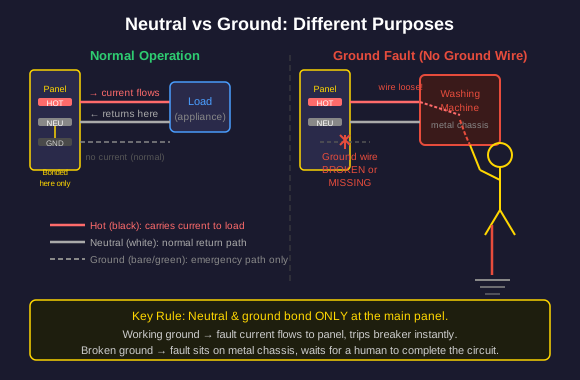
People confuse neutral and ground constantly. They are connected at one point: the service panel: but they serve different purposes.
The neutral (white wire) is the normal return path for current. Current flows out on the hot wire, through the load, & returns on the neutral. It carries current during normal operation.
The ground (bare or green wire) is the emergency path. It carries zero current during normal operation. It exists solely to provide a safe path to earth if something goes wrong: like a hot wire touching a metal appliance chassis.
Without a ground, a fault would energize the metal case of your washing machine. You touch it, current flows through you to the floor, and you get shocked: or worse. The ground wire gives that fault current an easy path back to the panel, which trips the breaker.
Neutral and ground are bonded together only at the main panel. Bonding them anywhere else creates parallel return paths and can put current on ground wires: a code violation and a safety hazard.
Wire Gauge and Ampacity
Choosing the Right Wire
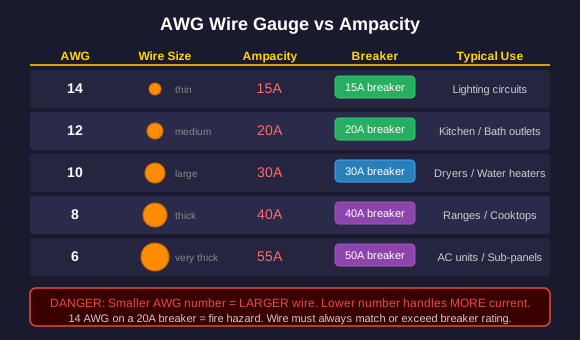
Wire size is measured using AWG (American Wire Gauge). The numbering is counterintuitive: smaller numbers mean larger wire. 14 AWG is thinner than 12 AWG, which is thinner than 10 AWG.
Each wire gauge has a maximum safe current capacity called its ampacity:
- 14 AWG: 15 amps (lighting circuits)
- 12 AWG: 20 amps (kitchen, bathroom, garage outlets)
- 10 AWG: 30 amps (dryers, water heaters)
- 8 AWG: 40 amps (ranges, cooktops)
- 6 AWG: 55 amps (large AC units, sub-panels)
Using undersized wire is a fire hazard. A 14 AWG wire on a 20-amp breaker will overheat before the breaker trips. The NEC requires that wire gauge always matches or exceeds the breaker rating.
NM-B Cable and Color Coding
What Is Inside the Walls
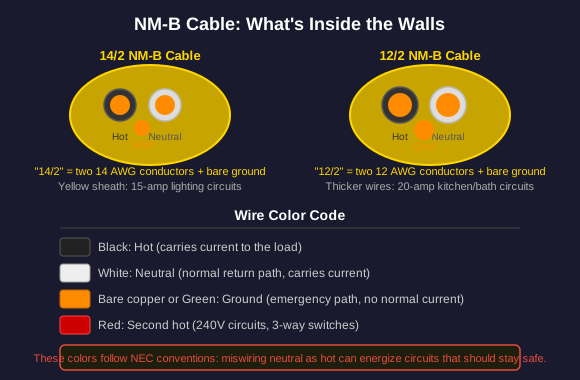
Most residential wiring uses NM-B cable (commonly called Romex, a brand name). It bundles multiple insulated conductors & a bare ground wire inside a plastic sheath.
The cable is labeled with its contents. 14/2 NM-B means two 14 AWG insulated conductors (hot and neutral) plus a bare ground. 12/3 NM-B means three 12 AWG insulated conductors (two hots and a neutral) plus a ground: used for 3-way switch circuits and split receptacles.
Wire Color Coding
- Black: hot (carries current to the load)
- White: neutral (return path for current)
- Bare copper or green: ground (safety/emergency path)
- Red: second hot (used in 240V circuits and 3-way switches)
- Blue and yellow: additional hots (typically in commercial conduit, rare in residential NM-B)
These colors are not suggestions. They are conventions that every electrician relies on. Miswiring a neutral as a hot can energize parts of a circuit that should be safe to touch.
Series vs Parallel Circuits
How Devices Are Connected
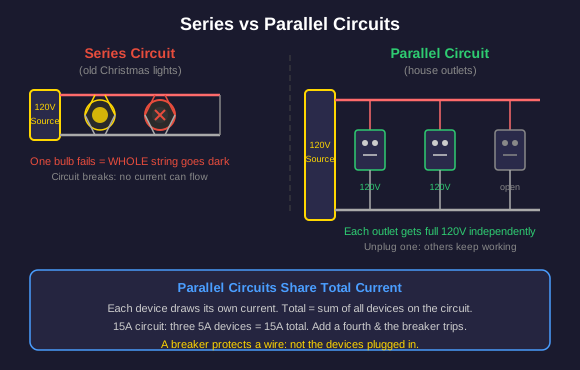
In a series circuit, devices are daisy-chained: current flows through one, then the next. If one device fails, the entire circuit goes dead. Old-style Christmas lights worked this way: one bulb burns out, the whole string goes dark.
In a parallel circuit, each device connects independently between the hot and neutral bus. If one device fails, the others keep working. This is how residential outlets work: every outlet on a circuit is wired in parallel.
That explains why you can unplug a lamp from one outlet & the other outlets on the same circuit still have power. Each outlet provides the full 120 volts regardless of what the other outlets are doing.
However, all devices on the circuit share the available current. Plug too many high-draw devices into outlets on the same 15-amp circuit and the breaker trips: not because any single device is too much, but because the total current exceeds the circuit rating.
Outlets, Switches, and Protective Devices
Protective Devices
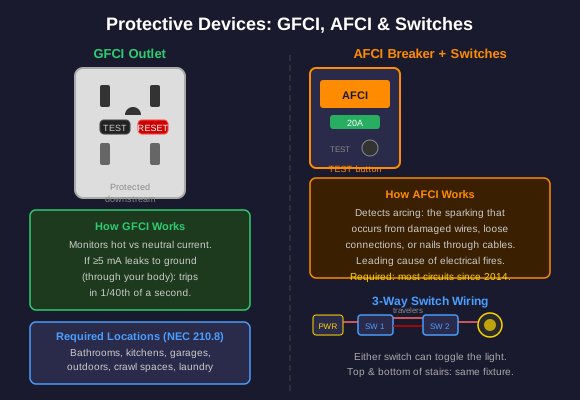
GFCI (Ground Fault Circuit Interrupter) outlets monitor the balance between hot and neutral current. If even 5 milliamps leaks to ground: through your body, for instance: the GFCI trips in 1/40th of a second. The NEC requires GFCI protection in bathrooms, kitchens, garages, outdoors, and anywhere near water.
AFCI (Arc Fault Circuit Interrupter) breakers detect dangerous arcing: the sparking that happens when a wire is damaged, a connection is loose, or a nail has pierced a cable in the wall. Arcing is a leading cause of electrical fires. Since 2014, the NEC has required AFCI protection on most residential branch circuits.
Switches
A single-pole switch controls a light from one location. It has two brass terminals & a ground. It simply opens & closes the hot wire.
A 3-way switch controls a light from two locations: like the top and bottom of a staircase. It uses two 3-way switches connected by traveler wires (the red and black in 14/3 or 12/3 cable). The switching logic flips which traveler carries current, allowing either switch to toggle the light.
UK Wiring Standards
UK vs US Supply
UK uses 230V single-phase at 50 Hz: versus US 120/240V split-phase at 60 Hz. Higher voltage means lower current for the same wattage, which affects wire sizing and device design throughout the system.
Wire Colors (Post-2004, Harmonised with EU)
- Brown: Live (equivalent to US black/hot)
- Blue: Neutral (equivalent to US white)
- Green/Yellow stripe: Earth (equivalent to US bare copper ground)
Old UK Colors (Pre-2004)
Still found in older homes: Red = Live, Black = Neutral, Green = Earth. An electrician working on older UK property must identify which color code applies before touching anything.
BS 1363 Fused Plug
UK plugs use the BS 1363 three-pin rectangular-pin standard. The defining feature: each plug contains its own fuse (3A for lamps and electronics, 13A for high-power appliances). This means every appliance carries its own overcurrent protection at the point of connection: before the socket. UK sockets have no fuse; the protection travels with the plug.
Consumer Unit
The UK equivalent of a breaker panel. Contains MCBs (Miniature Circuit Breakers) and RCDs (Residual Current Devices): equivalent to US GFCI. Modern UK installations use RCBOs (Residual Current Breaker with Overcurrent), which combine MCB and RCD into a single device, giving each circuit both overcurrent and residual current protection.
Ring Final Circuits
The Fundamental Difference: Radial vs Ring
US wiring uses radial circuits (home-run): cable runs from the panel to the first outlet, daisy-chains to the next, & terminates at the last. One path in, no path out.
UK wiring uses ring final circuits: cable leaves the consumer unit, loops through every socket outlet on the floor, and returns to the same MCB: forming a closed ring. Every outlet sits at a point on this loop with two cable feeds arriving from opposite directions.
Why the Ring Works
Each outlet has two cable feeds: one from each direction around the ring. Under load, current splits and flows both ways simultaneously. Result: lower impedance per path, better fault current capability, and smaller wire. 2.5mm² (roughly 13 AWG) can safely supply up to 13A per outlet on a ring circuit: wire that would be dangerously undersized on a US radial circuit.
Ring Circuit Specifications (BS 7671)
- MCB rating: Always 32A for a standard ring final circuit
- Cable: 2.5mm² twin-&-earth (equivalent to US NM-B, containing live, neutral, & bare earth)
- Floor area limit: 100m² per ring (no outlet count limit in BS 7671)
- Spurs: Permitted: a single socket can branch off the ring (a spur), but a spur off a spur is not allowed
Socket Outlets
UK socket outlets follow BS 1363: shuttered (tamper-resistant by design, built into the socket body: no separate child-safety insert required). Standard mounting height: 450mm from finished floor level.
Lighting Circuits
UK lighting circuits run radial (not ring). Typical rating: 6A or 10A MCB. Two wiring methods: junction box method (star topology from a central box) or loop-in method (cable loops through each ceiling rose in sequence). Both are code-compliant; loop-in is more common in modern construction.
Working Safely with Electricity
Electricity Will Kill You
This is not an exaggeration. 120 volts is more than enough to stop your heart. Electrical fatalities happen every year to both professionals & homeowners.
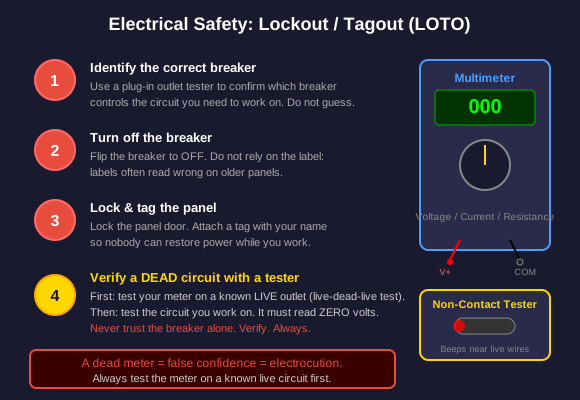
Lockout/Tagout (LOTO) is the most critical safety procedure. Before working on any circuit, turn off the breaker, lock the panel so nobody can turn it back on, & tag it with your name. Then verify the circuit is dead with a non-contact voltage tester or a multimeter. Never trust that a breaker is off just because you flipped it.
Meter usage is a core skill. A multimeter measures voltage, current, & resistance. A non-contact voltage tester (the pen-shaped device that beeps near live wires) is a quick first check. Always verify your meter works by testing a known live circuit before & after testing the circuit you are working on. A dead meter gives you false confidence.
More Safety Rules
- Never work on a live circuit unless you are specifically trained & authorized for live work.
- Treat every wire as live until you prove otherwise.
- Use insulated tools rated for electrical work.
- Wear safety glasses: wire ends are sharp and spring-loaded.
- Never stand in water or on a wet surface when working with electricity.
Electrician Career Path
From Apprentice to Master
Becoming an electrician follows a structured path:
Apprentice (4-5 years): You work under a journeyman, earning while you learn. Most apprenticeships require 8,000 hours of on-the-job training plus classroom instruction. You will learn NEC code, blueprint reading, motor controls, & every type of installation. Apprentice wages start around $15-20/hour & increase each year.
Journeyman Electrician: After completing your apprenticeship & passing the journeyman exam, you can work independently. Journeyman electricians earn $25-45/hour depending on location, with union electricians often earning more. You can work residential, commercial, or industrial.
Master Electrician: Requires additional experience (typically 2-4 more years as a journeyman) & passing the master exam. Master electricians can pull permits, run their own shops, & supervise other electricians.
The trade is not going away. Every new house, every renovation, every solar panel installation, every EV charger needs an electrician. The Bureau of Labor Statistics projects 6-11% job growth through the 2030s.