What Is Entrepreneurship?
Entrepreneurship is not about having a brilliant idea. It is about building something people will pay for: and surviving long enough to make it work.
At its core, entrepreneurship means taking a risk to create value. You identify a problem, build a solution, & convince people to exchange their money for it. That last part is harder than it sounds.
Types of Businesses
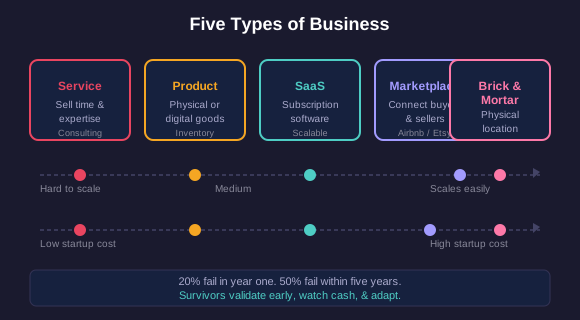
Not every business is a tech startup. Most businesses are not. Here are the main categories:
- Service businesses: you sell your time and expertise. Consulting, freelancing, plumbing, tutoring. Low startup cost, but hard to scale because revenue is tied to your hours.
- Product businesses: you sell physical or digital goods. Inventory, manufacturing, shipping. Higher upfront cost, but you can sell while you sleep.
- SaaS (Software as a Service): subscription software. High upfront development cost, but once built, each new customer costs almost nothing to serve. This is why investors love it.
- Marketplace businesses: you connect buyers and sellers and take a cut. Airbnb, Etsy, Uber. Extremely hard to start (chicken-and-egg problem) but extremely powerful once they hit critical mass.
- Brick-and-mortar: restaurants, retail stores, gyms. Physical location, local customer base, high overhead. The oldest form of business and still the most common.
Risk vs. Reward
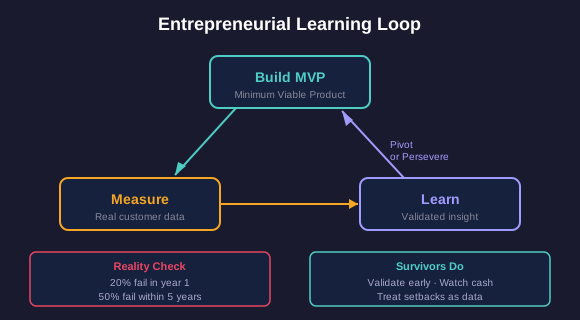
About 20% of new businesses fail in the first year. About 50% fail within five years. These are not reasons to avoid starting: they are reasons to prepare. The entrepreneurs who survive are not the ones with the best ideas. They are the ones who validate before they build, watch their cash, and adapt when reality disagrees with their plan.
Warm-Up
Your Entrepreneurial Lens
You do not need to have started a business to think like an entrepreneur. Every time you notice something inefficient, overpriced, or missing from the market, you are seeing an opportunity.
Identifying Real Problems
Start With the Problem, Not the Solution
The number one reason startups fail is not running out of money: it is building something nobody wants. They fall in love with their solution and never check if anyone actually has the problem.
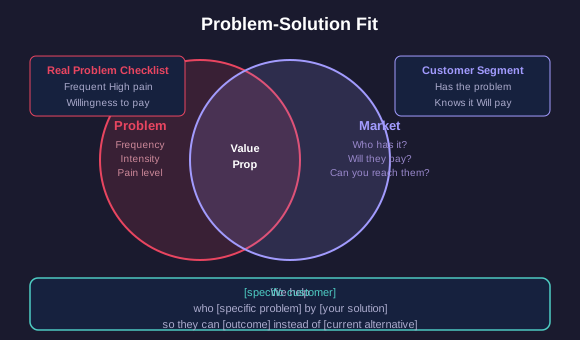
A real problem has three characteristics:
- Frequency: people encounter it regularly, not once in a lifetime
- Intensity: it causes real pain, not mild annoyance
- Willingness to pay: people would spend money to make it go away
A problem that scores high on all three is a goldmine. A problem that scores low on any one of them is a warning sign.
Value Proposition
Your value proposition is one sentence that explains why someone should buy from you instead of the alternative. The alternative is not just your competitors: it includes doing nothing, using a spreadsheet, or asking a friend.
A good value proposition has three parts: who you serve, what problem you solve, & why your solution is better than what they use now.
Customer Segments
Not everyone has your problem. And not everyone who has your problem will pay to solve it. Your customer segment is the specific group of people who have the problem, know they have it, & are willing to pay for a solution.
Early-stage entrepreneurs often make the mistake of saying their market is 'everyone.' If your market is everyone, your market is no one. The tighter you define your initial customer, the easier it is to find them, talk to them, & sell to them.
Value Proposition Practice
Building a Value Proposition
Consider these two pitches for the same product: a meal planning app:
- Pitch A: 'We help people eat healthier with our meal planning technology.'
- Pitch B: 'We help busy parents who spend 45 minutes every evening figuring out dinner cut that time to 5 minutes with a weekly meal plan personalized to their family's dietary restrictions & budget.'
Pitch B is specific. You know who it is for, what problem it solves, & how it is better than the current situation.
Revenue Streams and Cost Structure
How Businesses Make Money
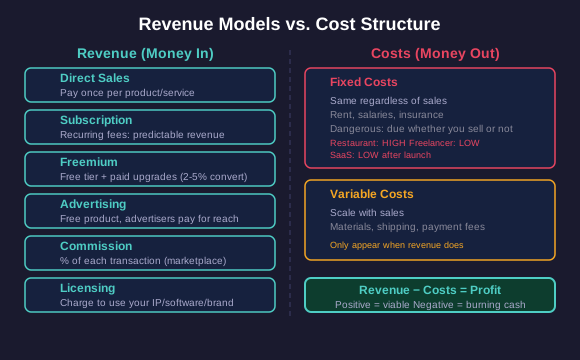
A business model answers one question: how do you make more money than you spend? Every business model has two sides: revenue (money in) and costs (money out).
Revenue Models
- Direct sales: customer pays once for a product or service. A bakery sells a cake. Simple, but you need to keep finding new customers.
- Subscription: customer pays recurring fees. Netflix, gym memberships, SaaS. Predictable revenue, but you must deliver ongoing value or they cancel.
- Freemium: basic product is free, premium features cost money. Spotify, Dropbox. Great for growth, but conversion rates are typically 2-5%.
- Advertising: product is free, advertisers pay to reach your users. Google, Instagram. Requires massive scale to generate meaningful revenue.
- Commission/marketplace: you take a percentage of each transaction. Etsy charges sellers, Uber takes a cut of each ride. You need both supply and demand.
- Licensing: you charge others to use your intellectual property. Software licenses, franchise fees, patents.
Cost Structure
- Fixed costs: expenses that stay the same regardless of sales. Rent, salaries, insurance. These are dangerous because they keep coming whether you sell anything or not.
- Variable costs: expenses that scale with sales. Materials, shipping, payment processing fees. These are safer because they only appear when revenue does.
A restaurant has high fixed costs (rent, staff, equipment) & moderate variable costs (ingredients). A freelance consultant has low fixed costs (laptop, internet) & almost no variable costs. The cost structure determines how much revenue you need just to survive.
Unit Economics
The Math That Decides If You Survive
Unit economics answers the question: do you make money on each individual sale?
Key metrics:
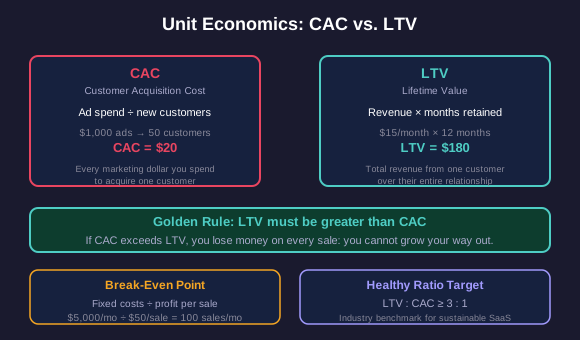
- CAC (Customer Acquisition Cost): how much you spend to get one new customer. If you spend $1,000 on ads and get 50 customers, your CAC is $20.
- LTV (Lifetime Value): how much total revenue one customer generates before they leave. If the average customer pays $15/month and stays 12 months, LTV is $180.
- The golden rule: LTV must be greater than CAC. If it costs you $20 to acquire a customer who only spends $10, you lose money on every sale. You cannot make that up with volume.
- Break-even point: the number of units (or customers) you need to cover all your fixed costs. If your fixed costs are $5,000/month and you make $50 profit per sale, you need 100 sales per month to break even.
Why This Matters
Many businesses look successful: growing revenue, adding customers: but are actually losing money on every transaction. They are subsidizing growth with investor money or savings. When the money runs out, they die. Unit economics tells you whether your business can ever be profitable, even at scale.
Talking to Customers
The Mom Test
Before you build anything, you need to talk to potential customers. But most people do this wrong. They pitch their idea and ask if people like it. Everyone says yes: your mom, your friends, strangers being polite. This tells you nothing.
The right approach (from Rob Fitzpatrick's book 'The Mom Test') is to ask about their life, not your idea:
- Bad question: 'Would you use an app that tracks your spending?' (Everyone says yes.)
- Good question: 'How do you currently track your spending? What is frustrating about that process?' (Reveals real behavior.)
- Bad question: 'Would you pay $10/month for this?' (Hypothetical money is not real money.)
- Good question: 'What have you tried to solve this problem? How much did you spend on it?' (Past behavior predicts future behavior.)
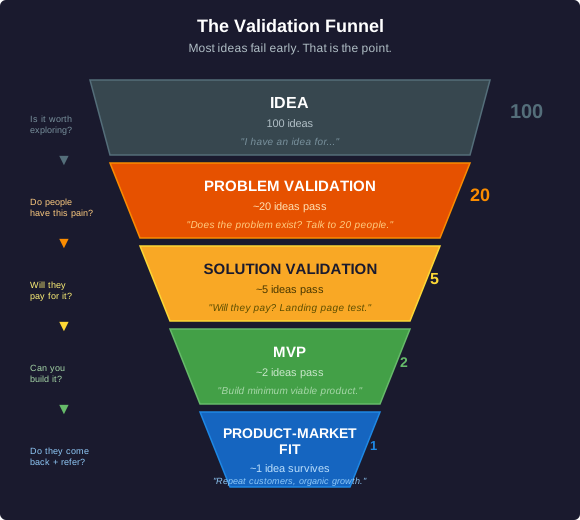
Talk to at least 20 potential customers before you write a line of code or spend a dollar on inventory.
Minimum Viable Product (MVP)
An MVP is the smallest version of your product that lets you test your core assumption. It is not a prototype. It is not version 1.0. It is the absolute minimum you need to learn whether customers will actually pay.
- Dropbox's MVP was a 3-minute video showing how the product would work. Signups exploded before they wrote any code.
- Zappos (online shoe store) started by photographing shoes at local stores & listing them online. When someone ordered, the founder went to the store & bought the shoes at full price. It lost money per sale, but it proved people would buy shoes online.
- A food truck is an MVP for a restaurant concept.
Pivoting
When your data says your original idea is wrong, you pivot: change direction while keeping what you have learned. Slack started as a video game company. Instagram started as a location check-in app called Burbn. YouTube started as a video dating site. Pivoting is not failure. Refusing to pivot when the evidence says you should: that is failure.
Validation Practice
Testing Your Assumptions
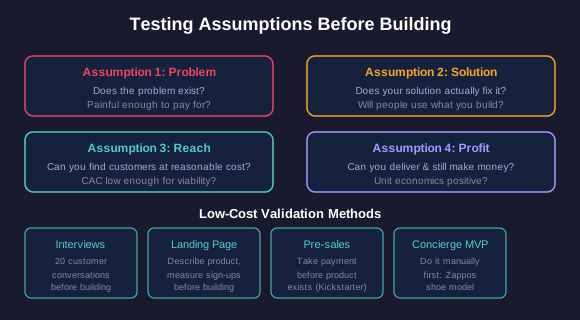
Every business idea rests on assumptions. The most dangerous ones are the ones you do not know you are making.
For a meal-kit delivery service, the hidden assumptions might be:
- People are frustrated enough with meal planning to pay a premium
- They will actually cook the meals instead of letting ingredients expire
- Delivery logistics will not eat all the profit margin
- Customers will reorder, not just try it once
Bootstrapping vs. Funding
Where the Money Comes From
You need money to start a business. How much depends on the type of business, but the source of that money shapes everything.
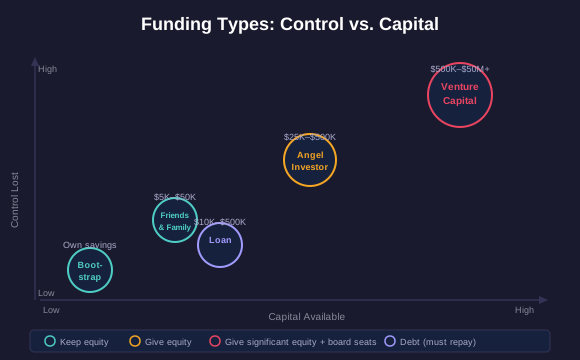
Bootstrapping: funding yourself from savings or revenue
- You keep 100% ownership & control
- You grow at the speed your revenue allows
- Most small businesses are bootstrapped
- Risk: if it fails, you lose your savings
Friends and family: the most common first round of outside funding
- Usually $5,000 to $50,000
- Terms are often informal, which causes problems later
- Risk: failed businesses destroy relationships
Angel investors: wealthy individuals who invest $25,000 to $500,000
- They typically get equity (ownership percentage)
- Often provide mentorship & connections
- Risk: you give up a piece of your company
Venture capital (VC): professional firms that invest $500,000 to $50,000,000+
- They expect exponential growth & a big exit (acquisition or IPO)
- VC-funded companies are less than 1% of all businesses but get 99% of the media attention
- Risk: you give up significant ownership & control. The board can fire you from your own company.
Loans: banks, SBA loans, microfinance
- You keep full ownership but take on debt
- Must be repaid regardless of whether the business succeeds
- Risk: personal liability, especially with personal guarantees
Cash Flow and Financial Statements
Cash Flow Is King
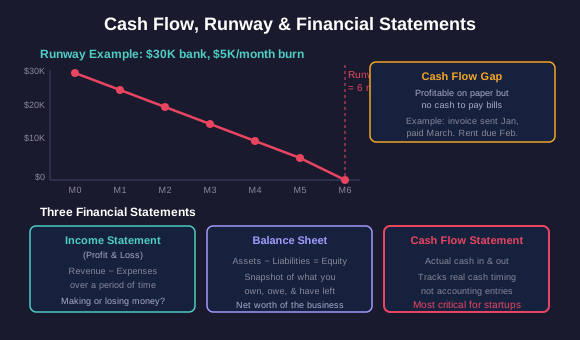
Profit & cash flow are not the same thing. A business can be profitable on paper & still die because it ran out of cash.
Example: you sell $10,000 worth of consulting in January. Your client pays in 60 days. Your rent, salary, & expenses are due in 30 days. You are profitable but you have no cash to pay your bills. We call this a cash flow gap, & it kills businesses every day.
Runway: how many months you can operate before you run out of money. If you have $30,000 in the bank and burn $5,000/month, your runway is 6 months. When runway hits zero, the business dies. Founders should always know their runway.
Three Financial Statements
Every business needs to understand three documents:
- Income statement (P&L): revenue minus expenses over a period. Tells you if you are making or losing money.
- Balance sheet: assets minus liabilities equals equity. A snapshot of what you own, what you owe, and what is left.
- Cash flow statement: tracks actual cash in and out. The most important for startups because it tells you when you will run out of money.
Pricing
Most new entrepreneurs underprice. They are afraid no one will pay, so they charge too little. This is dangerous for two reasons: (1) you cannot cover your costs, and (2) low prices signal low value. If a consultant charges $25/hour, you assume they are inexperienced. If they charge $250/hour, you assume they are an expert: even if they are the same person.
Price based on the value you deliver to the customer, not on what it costs you. If your software saves a company $100,000/year, charging $10,000/year is a bargain for them & great margin for you.
Business Structure and Legal Basics
Solo Founder vs. Co-Founder
About 80% of successful startups have more than one founder. Co-founders bring complementary skills (one builds, one sells), shared workload, & emotional support through the inevitable low points. But co-founder disputes are also one of the top reasons startups fail.
If you take a co-founder, get a written agreement covering: equity split, vesting schedule, roles, what happens if one person leaves, & decision-making authority. Do this before you start, not after there is money on the table.
Business Structures
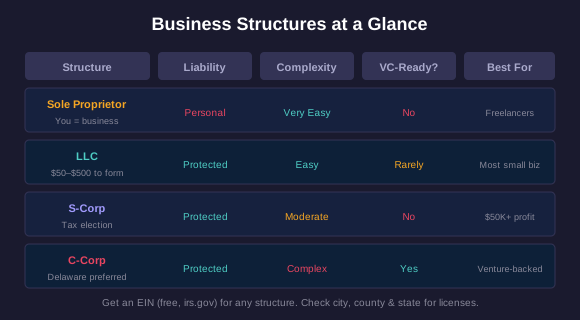
- Sole proprietorship: the simplest. You and the business are legally the same entity. Easy to set up, but you are personally liable for everything. If the business gets sued, your personal assets are at risk.
- LLC (Limited Liability Company): separates your personal assets from business liabilities. Flexible tax treatment. The most common choice for small businesses. Costs $50-$500 to form depending on the state.
- S-Corp: a tax election (not a separate structure) that can save money on self-employment taxes once you earn above roughly $50,000-$60,000 in profit. More paperwork than an LLC.
- C-Corp: required for venture capital funding. Double taxation (corporate tax plus personal tax on dividends). Complex, but necessary for companies seeking institutional investment.
Licenses & Permits
Most businesses need some combination of: a business license (city/county), a state tax ID, an EIN (federal tax ID, free from the IRS), & industry-specific permits (food handling, professional licenses, building permits). Requirements vary wildly by location & industry. Check your city, county, & state websites before launching.
Failure and Learning
The Failure Rate Is Real
About 50% of businesses fail within 5 years. That sounds grim, but context matters:
- Many 'failures' are people who tried, learned, & started a better business the second time
- Failure rate drops dramatically for experienced entrepreneurs: second-time founders succeed more often
- The cost of failure varies enormously. A failed side project that cost you $2,000 & 6 months is a cheap education. A failed venture that cost you $500,000 & your marriage is a catastrophe.
- The biggest risk factor is not having the wrong idea: it is running out of cash before finding the right one
What Separates Winners
The entrepreneurs who succeed long-term tend to share a few traits:
- They validate before they build
- They watch their cash obsessively
- They talk to customers constantly
- They pivot when the data says to
- They keep their fixed costs low until they find product-market fit
- They treat setbacks as information, not as verdicts