The Triangle: Architecture's Strongest Shape
Every Building Is Applied Geometry
Architecture is geometry made physical. Every beam, arch, & column embodies geometric principles discovered thousands of years ago.
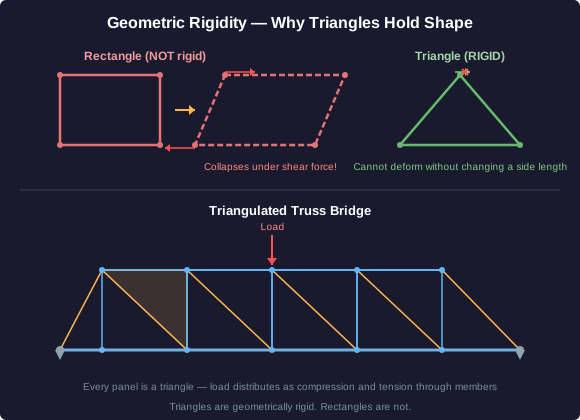
The triangle is the strongest shape in structural engineering, & the reason is purely geometric: a triangle is rigid. If you fix the lengths of all three sides, there is exactly one shape the triangle can take. It cannot deform without changing a side length.
A rectangle, by contrast, is not rigid. Push on one corner and it collapses into a parallelogram: all four side lengths stay the same, but the shape changes completely. This is why you never see a pure rectangular frame holding up a bridge. You see triangulated trusses.
This principle: that triangles cannot deform: is the foundation of every truss bridge, geodesic dome, and steel-frame skyscraper.
Golden Ratio in Design
The Golden Ratio: φ ≈ 1.618
The golden ratio appears throughout architecture & design. A rectangle whose sides are in the ratio φ (approximately 1.618 to 1) has a remarkable property: if you cut off a square from one end, the remaining rectangle is also a golden rectangle. You can repeat this forever, spiraling inward.
The Parthenon in Athens (447 BC) has facade proportions close to φ. Le Corbusier built his entire Modulor system of architectural proportions around the golden ratio & the human body. The UN Headquarters in New York uses Modulor proportions.
Whether the golden ratio is inherently beautiful or we just recognize it because we have been told to look for it is debatable. What is not debatable is that it gives architects a systematic way to create proportional harmony: every subdivision relates to the whole.
Structural Rigidity
Consider two bridge designs: a simple beam bridge (a flat slab supported at both ends) & a triangulated truss bridge (the kind with the distinctive crisscross pattern of steel members).
Triangle Meshes
Every 3D Model Is Made of Triangles
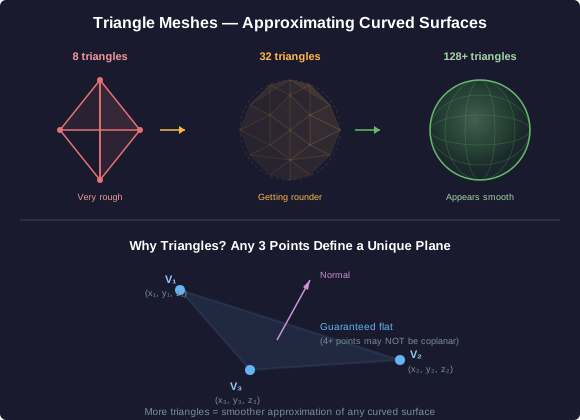
When you see a character in a video game or a building in an animated film, you are looking at thousands: sometimes millions: of tiny triangles stitched together into a mesh.
Why triangles? Because of a fundamental geometric property: any three points in space define a unique plane. Three points are always coplanar: they always form a flat surface. Four or more points might not lie on the same plane, which means a quadrilateral face could be warped or twisted, creating rendering artifacts.
A sphere in a game is really an approximation: 8 triangles give you a rough octahedron, 32 give you something rounder, 128 looks smooth to the eye. The more triangles, the smoother the surface: but the more work the graphics card has to do. This triangle-count trade-off is one of the central problems in real-time 3D graphics.
Matrix Transformations
Moving Objects with Math
Every object in a 3D scene needs to be positioned, rotated, and scaled. Then the entire 3D world needs to be projected onto your flat 2D screen. All of this is done with matrix transformations: multiplying coordinates by matrices.
Translation: Move an object: add an offset to every vertex position.
Rotation: Spin an object: multiply each vertex by a rotation matrix (sines and cosines).
Scale: Resize an object: multiply each coordinate by a scale factor.
Projection: Flatten 3D to 2D: the perspective transform that makes distant objects look smaller.
A modern video game running at 60 frames per second computes millions of these matrix multiplications every single frame. GPUs (graphics processing units) exist specifically because CPUs were too slow for this much parallel geometry. A GPU is, at its core, a massively parallel matrix multiplication engine.
Why Triangles?
This is one of the most fundamental design decisions in all of computer graphics.
Data as Points in Space
Machine Learning Operates in Geometric Space
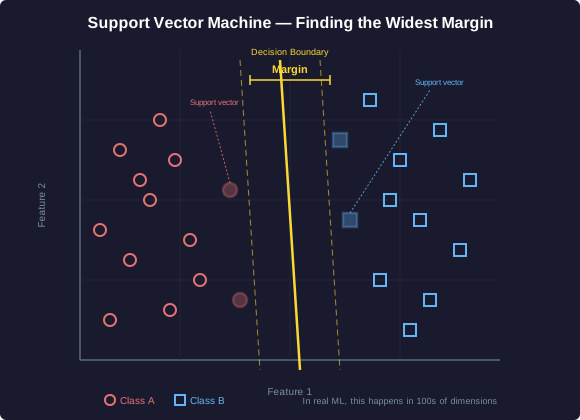
Every machine learning model that works with data is, at its core, doing geometry. Each data point is a point in N-dimensional space, where N is the number of features (variables) describing it.
A house described by square footage, number of bedrooms, & distance to downtown is a point in 3D space. A medical image described by 10,000 pixel values is a point in 10,000-dimensional space. The math works the same way regardless of the number of dimensions.
Classification is finding geometric boundaries that separate classes. A support vector machine (SVM) literally finds the hyperplane that separates two classes of data with the widest possible margin: the widest 'street' between them. The nearest data points to this boundary are called support vectors, and they are the only points that actually determine where the boundary goes.
Word Embeddings and Vector Arithmetic
Words as Points in Space
One of the most striking applications of geometry in machine learning is word embeddings. Systems like Word2Vec & modern language models map every word to a point in a high-dimensional space (typically 300 to 1,000 dimensions).
Words with similar meanings end up near each other geometrically. 'Dog' is close to 'puppy' & 'canine.' 'France' is close to 'Germany' & 'Spain.'
Even more remarkable: the directions in this space encode relationships. The famous example:
vector('king') - vector('man') + vector('woman') ≈ vector('queen')
This is pure vector geometry. The direction from 'man' to 'king' is approximately the same as the direction from 'woman' to 'queen': both encode the concept of 'royalty.' The machine learning model discovered this geometric structure from reading text, without anyone teaching it what royalty means.
Hyperplanes and Margins
Support vector machines are one of the clearest examples of geometry in machine learning.
Great Circles and GPS
The Shortest Path on a Sphere Is Not a Straight Line
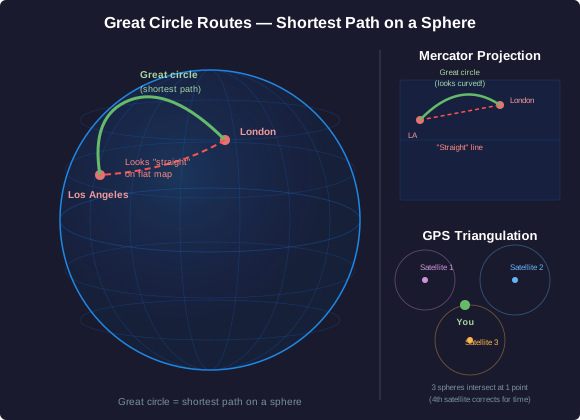
On a flat surface, the shortest path between two points is a straight line. On a sphere, the shortest path is a great circle arc: a curve along a circle whose center is the center of the sphere.
This is why flights from New York to Tokyo fly over the Arctic. On a flat Mercator map, this route looks absurdly curved northward. But the map is distorted: it stretches the poles to fill a rectangle. On the actual sphere of the Earth, the Arctic route is shorter.
Every line of longitude is a great circle. The equator is a great circle. But lines of latitude (except the equator) are NOT great circles: they are smaller circles, and flying along them is not the shortest path.
GPS triangulation uses spherical geometry differently. Each GPS satellite broadcasts its position and the time. Your receiver calculates the distance to each satellite (using the speed of light). One satellite gives you a sphere of possible positions. Two satellites give you the circle where two spheres intersect. Three satellites give you two points: one is usually absurd (deep in space), so you get your position. A fourth satellite corrects for clock errors.
Why Flights Curve on Maps
Airlines & pilots do not fly curved routes to waste fuel. They fly the shortest possible path.
Geometric Dimensioning and Tolerancing
GD&T: How Close to Perfect Is Close Enough?
No manufactured part is geometrically perfect. A shaft specified as 25.000 mm will come off the lathe as 25.007 mm or 24.993 mm. The question is: how much deviation is acceptable?
Geometric Dimensioning and Tolerancing (GD&T) answers this with geometric precision. Instead of just saying '25 mm plus or minus 0.013 mm,' GD&T defines a tolerance zone: a geometric region within which all points on the actual surface must lie.
The tolerance zone might be a cylinder (for a shaft), a pair of parallel planes (for a flat surface), or a cone (for a tapered feature). The shape of the zone depends on what matters functionally: roundness, flatness, perpendicularity, concentricity.
This is pure applied geometry. A machinist reading a GD&T drawing is interpreting geometric constraints: is this surface within 0.01 mm of a perfect plane? Is this hole's axis within 0.05 mm of perpendicular to the datum surface? Every tolerance is a geometric question.
Stress Concentration and Geometry
Why Geometry Determines Where Things Break
When force flows through a material, it follows geometric paths. A smooth, uniform cross-section distributes stress evenly. But any geometric discontinuity: a hole, a notch, a sharp corner: concentrates stress at that point.
The stress concentration factor depends entirely on geometry. A small circular hole in a plate under tension experiences 3x the nominal stress at its edges. A sharp V-notch can concentrate stress by 5x, 10x, or more, depending on the angle.
This is why aircraft windows are oval, not rectangular. The De Havilland Comet: the world's first commercial jet airliner: had square windows. In 1954, two Comets broke apart in flight. Investigation revealed that metal fatigue cracks initiated at the sharp corners of the windows, where stress concentrated to levels far beyond what the aluminum could withstand over repeated pressurization cycles.
The fix was geometric: round the corners. An oval window distributes stress smoothly around its perimeter with no sharp concentration points. Every commercial aircraft since has used oval or rounded-rectangle windows. Geometry killed 56 people. Geometry also provided the solution.
Comet Disasters
The De Havilland Comet disasters changed aircraft design forever.
Connecting the Threads
The Universal Language
Look at what we have covered:
Architecture uses the same rigid triangles that stiffen 3D meshes in video games.
Computer graphics uses the same matrix transformations that robotics uses to position mechanical arms.
Machine learning uses the same hyperplanes that separate design spaces in engineering optimization.
Navigation uses the same spherical geometry that architects use when designing domes & planetariums.
Engineering uses the same stress analysis that biomechanics uses to understand bone fractures.
The geometry is the same. The applications are different. A triangle is rigid whether it is holding up a bridge or rendering a dragon. A hyperplane separates classes whether it is classifying emails as spam or optimizing an airfoil shape.
This is what makes geometry one of the most powerful tools in applied mathematics: it provides a visual, spatial, and rigorous way to reason about problems across every field of science and engineering.
Your Takeaway
We have explored geometry in architecture, computer graphics, machine learning, navigation, & engineering.