Geometry of Fields
Fields Are Geometric
Every agricultural field is a geometric shape: & that shape determines how efficiently you can plant, irrigate, harvest, & drain it.
The two dominant field shapes in mechanized agriculture are rectangular & circular.
Rectangular fields are the historic default. Plows, planters, & combines move in straight lines. Headland turns are simple. The US Public Land Survey System divided the country into a grid: each township is 6 miles × 6 miles (36 square miles), divided into 36 sections of 1 square mile each. One section = 640 acres.
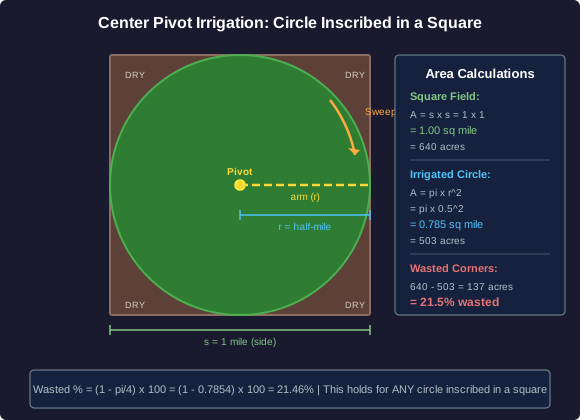
Circular fields emerged with center pivot irrigation in the 1950s. A motorized arm anchored at the center sweeps a circle, watering everything the arm can reach. From the air, the Great Plains look like a checkerboard of green circles in brown squares.
Center Pivot Geometry
The Circle-in-a-Square Problem
A typical center pivot arm is a half-mile long (2,640 feet), inscribing a circle inside a square-mile section.
The irrigated circle has area = π × r² = π × (½)² = 0.785 square miles (about 503 acres).
The full section is 640 acres. The four dry corners account for 640 − 503 = 137 acres: roughly 21.5% of the field is wasted.
This ratio is universal: for any circle inscribed in a square, the wasted fraction is (1 − π/4) = 21.46%. It does not depend on the size of the field.
Some farmers install corner systems: extensions that swing out to water the corners. Others plant dryland crops (wheat, sunflower) in the corners & irrigated crops (corn, alfalfa) in the circle.
Following the Curves of the Land
Contour Farming & Terracing
Flat land is easy geometry: rectangles & circles. But much of the world's farmland is on slopes, & slopes create a geometry problem: water runs downhill.
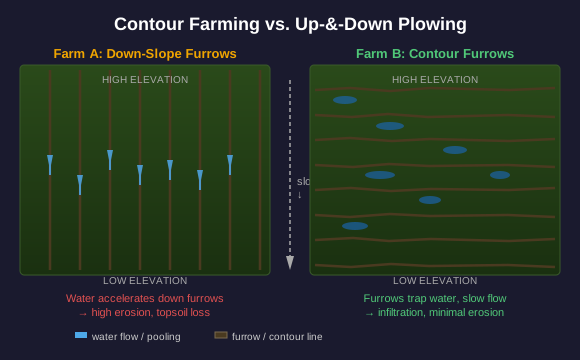
When you plow straight up & down a hill, every furrow becomes a channel. Rainwater collects in those channels, accelerates downhill, & carries topsoil away. This is rill erosion: & it can strip inches of topsoil in a single storm.
Contour farming solves this by plowing across the slope: following the contour lines of the terrain. Each furrow acts as a small dam, catching water & letting it soak in rather than run off.
Contour lines are lines of equal elevation: the same curves you see on a topographic map. When a farmer plows along a contour, every point in that furrow is at the same height. Water has no downhill direction to flow along the furrow, so it pools & infiltrates.
Terracing takes contour farming further. On steep slopes (>8% grade), terraces are cut into the hillside: flat geometric steps, like a staircase for crops. Each terrace is a level platform bordered by a riser. The geometry converts a continuous slope into discrete flat surfaces.
Why Contour Lines Work
Consider two farms on a 5% slope: the land drops 5 feet for every 100 feet of horizontal distance.
Farm A plows straight downhill. Farm B plows along contour lines (across the slope).
Both receive the same 2-inch rainstorm.
Geometric Grids for Planting
Row Spacing & Plant Spacing
When you plant a field, you are creating a geometric grid. Two numbers define it: row spacing (distance between rows) & plant spacing (distance between plants within a row).
The standard calculation for plants per acre:
plants per acre = 43,560 ÷ (row spacing × plant spacing)
where both spacings are in feet. The number 43,560 is the number of square feet in one acre.
For example: corn planted in 30-inch rows (2.5 ft) with 8-inch plant spacing (0.667 ft):
plants per acre = 43,560 ÷ (2.5 × 0.667) = 43,560 ÷ 1.667 = 26,130 plants per acre
Square vs. Triangular Spacing
Square spacing places plants at the corners of squares. Simple, easy to cultivate in two directions.
Equilateral triangle spacing (also called offset or staggered rows) shifts every other row by half the plant spacing. This fits approximately 15.5% more plants per acre than square spacing at the same minimum plant-to-plant distance.
Why? In square spacing, the diagonal distance between plants is d × √2 ≈ 1.414d: wasted space. In triangular spacing, every plant is equidistant from its six neighbors, packing the area more efficiently. This is the same reason hexagonal honeycomb is the most efficient way to tile a plane.

Calculating Plant Populations
A soybean farmer is considering two planting configurations:
Option A: 15-inch rows (1.25 ft), 3-inch plant spacing (0.25 ft): standard square grid.
Option B: Same 15-inch rows, same 3-inch plant spacing, but with equilateral triangle (offset) spacing: every other row shifts by 1.5 inches.
Slope, Grade, and Water Flow
Drainage Geometry
Water flows downhill. The geometry of how quickly it flows is determined by the slope, which farmers & engineers express as grade (percent slope).
Grade = (rise ÷ run) × 100
A 2% grade means the ground drops 2 feet for every 100 feet of horizontal distance. A 1% grade drops 1 foot per 100 feet.
Surface Drainage
For surface water to drain properly, fields need a minimum grade of 1-2%. Below 1%, water pools in low spots. Above 5-8%, erosion becomes a serious problem. The sweet spot for most cropland is 1-3%.
Tile Drainage
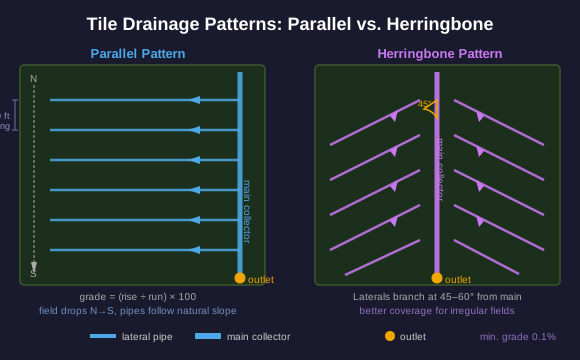
In flat, wet regions (the US Corn Belt, Netherlands), farmers install tile drainage: networks of perforated pipes buried 3-4 feet deep. Water seeps through the soil, enters the perforations, & flows through the pipes to an outlet.
Two common geometric patterns:
- Parallel pattern: Pipes run parallel across the field, connecting to a main collector pipe at one end. Simple geometry, works on uniform slopes.
- Herringbone pattern: Lateral pipes branch off a central main at 45-60° angles, like the bones of a fish. Better coverage for irregularly shaped fields or fields with a central low area.
Tile spacing depends on soil type: 30-50 feet apart in clay soils (water moves slowly), 80-100+ feet in sandy soils (water moves fast). The buried pipes themselves are laid at a minimum grade of 0.1%: just enough to keep water flowing to the outlet.
Designing Drainage
A farmer has a 40-acre field that is 1,320 feet × 1,320 feet (a quarter of a quarter-section). The field slopes uniformly from north to south.
The north edge is at elevation 102 feet. The south edge is at elevation 100 feet.
They want to install parallel tile drainage running north-to-south, with pipes spaced 60 feet apart.
Agricultural Geometry — Summary
What You Have Learned
Agriculture is applied geometry at landscape scale:
- Field layout: Rectangular fields for straight-line machinery, circular fields for center pivot irrigation. The circle-in-a-square wastes 21.5% of area: a geometric constant.
- Contour farming: Rotating furrows 90° relative to the slope converts drainage channels into infiltration barriers. Terracing creates geometric steps on steep terrain.
- Plant spacing: The formula plants/acre = 43,560 ÷ (row × plant spacing) governs crop density. Triangular spacing packs ~15% more plants than square spacing at the same minimum distance: hexagonal close-packing.
- Drainage: Grade = rise/run. Surface drainage needs 1-2% minimum. Tile drainage uses parallel or herringbone pipe patterns at 0.1%+ grade. Pipe spacing depends on soil permeability.
Every decision a farmer makes, where to plow, how close to plant, where to lay pipe, is a geometry problem. The geometry is not complex, but getting it wrong costs topsoil, water, & yield.