Welcome
Every pilot is a practical geometer. You may not draw proofs on a chalkboard, but you solve geometric problems every time you fly: calculating how wind will push you off course, how steeply to bank in a turn, how to descend on a precise 3-degree slope to a runway you cannot yet see.
This lesson covers the geometry that pilots use every day: vectors, bank angles, turn radius, approach geometry, & radio navigation. These are not abstract concepts. They are the math that keeps aircraft on course, on glide path, & alive.
We start with vectors: because in aviation, direction matters as much as speed.
Wind Triangle
Vectors in Aviation
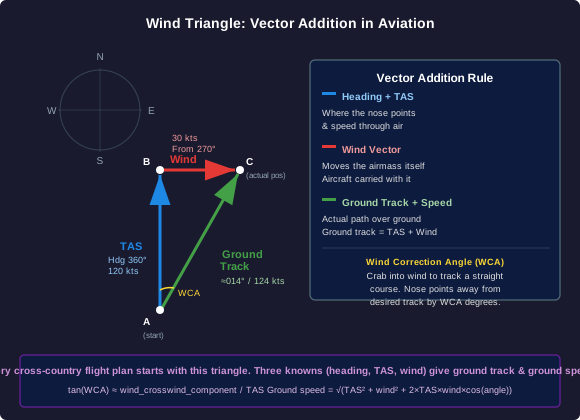
A pilot's airspeed indicator reads 120 knots. But the aircraft may be moving over the ground at 100 knots: or 140 knots: depending on the wind. The instrument measures speed through the air, not speed over the ground.
This is a vector problem. The aircraft has a velocity vector through the air (heading + airspeed). The wind has its own velocity vector. The aircraft's actual path over the ground: the ground track: is the vector sum of these two.
The wind triangle has three sides:
- Heading + True Airspeed (TAS): Where the nose points & how fast through the air
- Wind direction + Wind speed: Where the wind comes from & how fast
- Track + Ground speed: The actual path over the ground & the actual speed along it
If you fly a heading of 360° (due north) at 120 knots with a wind from 270° (due west) at 30 knots, you are pushed east. Your ground track is roughly 014° and your ground speed is about 124 knots. The angle between your heading and your track is the wind correction angle: the amount you would need to crab into the wind to maintain a straight course.
Every cross-country flight plan starts with this triangle. Get it wrong & you miss your destination.
Headwind and Crosswind Components
Breaking Wind Into Components
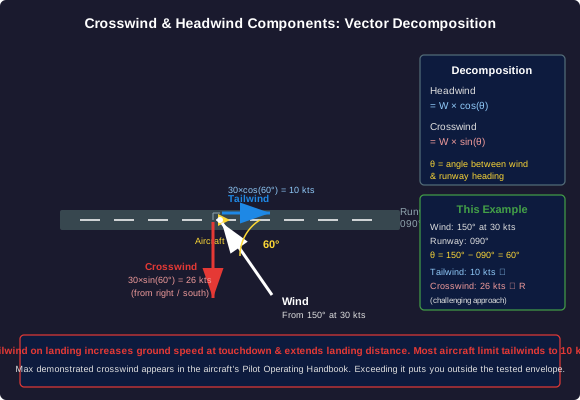
Wind rarely comes straight from ahead or directly from the side. A pilot must decompose the wind vector into two components relative to the runway or flight path:
Headwind component = wind speed × cos(angle between wind & runway)
Crosswind component = wind speed × sin(angle between wind & runway)
If the wind is 30 knots at 30° off the runway heading, the headwind component is 30 × cos(30°) = 26 knots & the crosswind component is 30 × sin(30°) = 15 knots.
Every aircraft has a maximum demonstrated crosswind component: typically 15 to 25 knots for small aircraft. Exceeding it does not mean a landing is impossible, but it means the manufacturer has not tested it, and you are in uncharted territory.
How Aircraft Turn
Turning Is Geometry
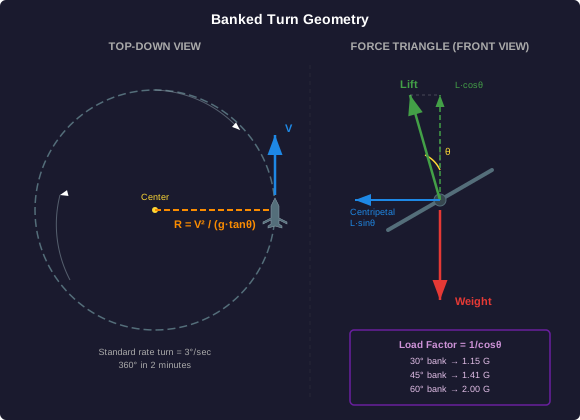
An aircraft does not turn like a car. It turns by banking: tilting its wings so that a component of the lift vector pulls it horizontally around a curve. The geometry of this turn is a circle, and the radius of that circle depends on only two things: the aircraft's velocity and the bank angle.
Turn radius formula:
R = V² / (g × tan(bank angle))
where R is the turn radius, V is the velocity (in consistent units), g is gravitational acceleration (9.8 m/s² or 32.2 ft/s²), & the bank angle gets measured from wings-level.
What this formula tells you:
- Faster aircraft need wider turns (R increases with V²)
- Steeper bank angles give tighter turns (tan increases, R decreases)
- But steeper bank = more G-force on the aircraft & passengers
A standard rate turn is 3° per second: a full 360° turn takes exactly 2 minutes. Air traffic control depends on this standard. At typical small-aircraft speeds (~120 knots), a standard rate turn requires about 15-20° of bank.
Turn Radius in Practice
Why Turn Radius Matters
Turn radius is not just theory: it determines whether you can fit your turn inside the available airspace. A fighter jet at 200 knots in a 60° bank turns in a radius of about 600 meters. An airliner at 250 knots in a 25° bank needs a turn radius of about 3.5 km.
This is why approach procedures have specific speed limits: if you fly too fast, you physically cannot make the turns on the published approach without exceeding the bank angle limits.
3-Degree Glide Path
Precision Approach Geometry
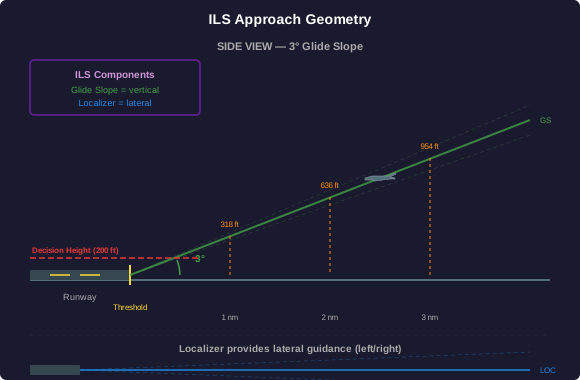
Landing an aircraft is one of the purest applied geometry problems in aviation. A precision approach: an Instrument Landing System (ILS): guides the pilot along two intersecting planes to a specific point on the runway.
Glide slope: A radio beam angled upward at 3° from the runway threshold. This defines the vertical path. Simple trigonometry gives you the altitude you should be at any distance from the runway:
Altitude = distance × tan(3°)
Since tan(3°) ≈ 0.0524, for every nautical mile from the threshold, you should be about 318 feet higher. This is one of the most useful numbers in aviation:
- 1 nm out: 318 feet
- 2 nm out: 636 feet
- 3 nm out: 954 feet
- 5 nm out: 1,590 feet
Localizer: A radio beam aligned with the runway centerline. It provides lateral guidance: left or right of centerline. Together with the glide slope, it defines a line in 3D space from the sky to the runway.
Decision height: The altitude (typically 200 feet above the runway for a Category I ILS) at which the pilot must see the runway or execute a missed approach. Below decision height with no runway in sight, you go around. No exceptions.
Glide Path Math
Rate of Descent
Maintaining a 3° glide slope is not just about altitude at a given distance: you also need the correct rate of descent. If you are descending too fast, you will go below the glide path. Too slow, and you will fly above it.
The required descent rate depends on your ground speed. A useful rule of thumb:
Rate of descent (ft/min) ≈ ground speed (knots) × 5
So at 120 knots ground speed, you need about 600 ft/min descent rate. At 140 knots, about 700 ft/min.
Lines, Circles, and Fixes
Navigation as Geometry
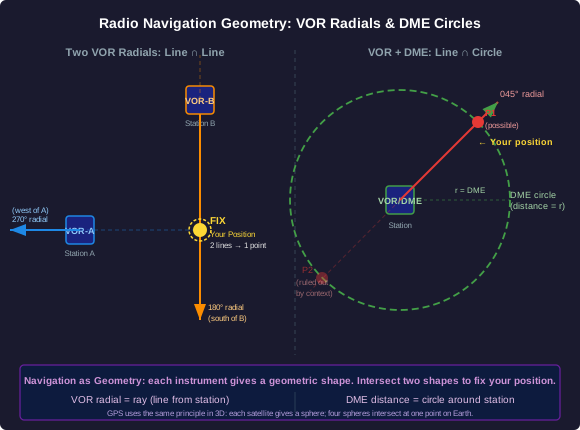
Before GPS, pilots navigated using geometry. The tools were simple: radio stations on the ground that gave you lines & circles.
VOR (VHF Omnidirectional Range): A ground station that broadcasts 360 radials: magnetic bearings radiating outward like spokes on a wheel. Your VOR receiver tells you which radial you are on. A radial is a geometric ray from the station. If you are on the 090° radial, you are due east of the station.
DME (Distance Measuring Equipment): Tells you how far you are from a station. A DME reading defines a circle centered on the station with you somewhere on its circumference.
A VOR radial is a line. A DME reading is a circle. Knowing one radial puts you on a line. Knowing one DME puts you on a circle. Neither alone tells you exactly where you are.
Cross-radials: Tuning two VOR stations gives you two lines (two radials). Two lines that are not parallel intersect at exactly one point: that is your position. This is called a fix.
GPS: Works on the same principle but in three dimensions. Each satellite broadcasts its position and a time signal. The receiver calculates the distance to each satellite (a sphere, not a circle). Three spheres intersect at two points: one is in space, one is on Earth. Four satellites add a fourth sphere that resolves timing errors. Same geometry, higher dimension.
Finding Your Position
Geometric Position Fixing
In practice, VOR navigation is about understanding the geometry of intersections. A pilot flying an airway (a defined route between VORs) uses cross-radials from other stations to verify position & report to ATC.
Even with GPS as primary navigation, pilots must understand VOR geometry: it is the backup system, and it appears on every instrument approach plate.