Triangle on Top of Every Building
Every gable roof is a triangle. The geometry of that triangle: its rise, run, and hypotenuse: determines everything: how the roof sheds water, how much material you need, and the angle you cut every rafter.
Pitch is the ratio of vertical rise to horizontal run. A 6/12 pitch means the roof rises 6 inches for every 12 inches of horizontal run. A 12/12 pitch is a 45-degree roof. A 4/12 pitch is a gentle slope.
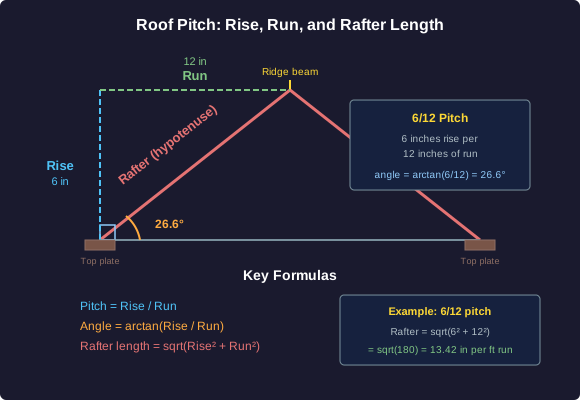
The rafter is the hypotenuse of a right triangle. If you know the rise and run, you know the rafter length: that is the Pythagorean theorem applied to every roof in the world.
Converting pitch to angle: angle = arctan(rise / run). A 6/12 pitch gives arctan(6/12) = arctan(0.5) = 26.57 degrees. That angle is what you set on your speed square to mark every plumb cut & seat cut on the rafter.
Calculate a Roof Angle
A building has a 24-foot span (12 feet of run on each side of the ridge) & uses a 9/12 pitch.
Hip Rafters and Compound Angles
Common rafters run perpendicular to the ridge beam: their geometry is a simple right triangle. But a hip rafter runs diagonally from the corner of the building to the ridge. It sits at a compound angle.
A hip rafter's run is longer than a common rafter's run because it travels diagonally across the plan. For a square-cornered building, the hip run = common run × sqrt(2). That is the diagonal of a square.
The hip rafter pitch is always shallower than the common rafter pitch. If the common rafters are 9/12, the hip rafter is 9/16.97 (because 12 × sqrt(2) = 16.97). The hip angle = arctan(9/16.97) = 27.9 degrees.
This compound geometry is why hip roofs are harder to frame than simple gables: every cut on a hip rafter involves two angles, not one.
Rise, Run, and the Stringer
The Geometry of Stairs
Every staircase is a right triangle. The stringer: the diagonal board that supports the treads: is the hypotenuse. The total rise (floor to floor height) and total run (horizontal distance) define the triangle.
Building codes constrain the geometry tightly:
- Unit rise (each step height): 7 to 7-3/4 inches (IRC residential code)
- Unit run (each tread depth): minimum 10 inches
- Rise + run rule: unit rise + unit run should be between 17 & 18 inches (a carpenter's rule of thumb for comfortable stairs)
- Headroom: minimum 6 feet 8 inches measured vertically from the stair nosing to any overhead obstruction
To calculate the number of risers: divide total rise by your target unit rise. Round to a whole number. Then recalculate the exact unit rise = total rise / number of risers.
Example: total rise = 108 inches (9 feet floor to floor). Target unit rise = 7.5 inches. 108 / 7.5 = 14.4, so use 14 risers. Exact unit rise = 108 / 14 = 7.714 inches. Number of treads = risers - 1 = 13 (the top floor is the last 'tread').
Design a Staircase
A two-story house has a floor-to-floor height of 9 feet 4 inches (112 inches). The stairwell opening allows a maximum horizontal run of 12 feet.
Winder Stairs and Pie-Slice Treads
Turning Corners Without a Landing
When a staircase needs to turn but space is too tight for a landing, builders use winder treads: pie-shaped treads that fan out around a corner.
The geometry: each winder tread is a sector of a circle. The narrow end (at the inside corner) must be at least 6 inches wide (code minimum). The tread depth measured at the walk line (12 inches from the narrow side) must meet the same minimum as straight treads: typically 10 inches.
A 90-degree turn typically uses three winder treads (each spanning 30 degrees) or two winders plus a small landing. A 180-degree turn (switchback) uses six winders or a combination of winders & a half-landing.
Winder stairs are more challenging to build and more hazardous to use than straight stairs: the narrow end of each tread gives less foot room at the inside of the turn. That is why codes restrict their geometry carefully.
Why Arches Work
The Geometry of Load Transfer
An arch converts downward vertical loads into compressive forces that flow along its curve to the supports. Unlike a beam, which resists loads through bending (and develops tension on the bottom face), an arch in pure compression has no tension: and masonry, stone, and concrete are all strong in compression but weak in tension.
That explains why arches have been used for thousands of years in stone & brick construction: they work with the material's strength, not against it.
The shape of the arch determines how well it handles different loading patterns. Different curves handle different loads optimally.
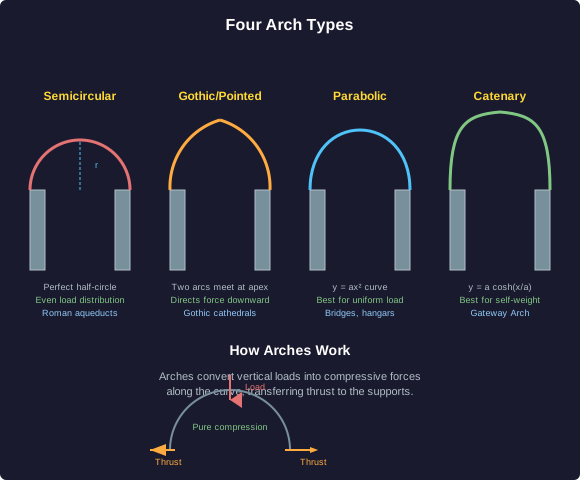
Four Arch Shapes
Semicircular arch: a perfect half-circle. The simplest to construct (just swing a compass from the center point). Distributes load evenly. Used by the Romans for aqueducts, bridges, and the Colosseum. Its limitation: the height is always exactly half the span.
Gothic/Pointed arch: formed by two circular arcs that meet at a point above the center. Can be taller than it is wide. Directs more force downward (less horizontal thrust), which allows thinner walls. This is why Gothic cathedrals could have enormous windows: the pointed arches reduced the outward push on the walls.
Parabolic arch: follows the curve y = ax². Optimal for carrying a uniform distributed load (like a bridge deck with even traffic). The parabola ensures that the line of thrust follows the arch centerline exactly under uniform load.
Catenary arch: the curve formed by a hanging chain (inverted). Follows y = a × cosh(x/a). Optimal for carrying its own self-weight. The Gateway Arch in St. Louis is a weighted catenary: its shape ensures pure compression under its own weight with no bending.
Catenary & Self-Weight
The catenary curve is the shape a chain or cable takes when it hangs freely under its own weight. Mathematically, it is y = a × cosh(x/a), where 'a' is a constant that depends on the chain's weight per unit length & the horizontal tension.
If you flip a hanging chain upside down, you get a catenary arch. This arch is in pure compression under its own weight: it is the exact inverse of the pure tension in the hanging chain.
The Gateway Arch in St. Louis (630 feet tall) is a weighted catenary. Eero Saarinen and engineer Hannskarl Bandel designed it so that the arch's cross-section varies: thicker at the base, thinner at the top: and the catenary equation was modified to account for this varying weight distribution.
Squaring Corners on the Jobsite
Geometry in the Dirt
Before a single footer is dug, the building must be laid out on the site with exact geometry. The tools are simple: string lines, batter boards, tape measures, and stakes: but the precision required is high.
Batter boards are horizontal boards mounted on stakes, set back from the building corners. String lines stretched between batter boards mark the foundation lines. By adjusting where the string attaches to the batter board, the builder can fine-tune the layout without disturbing the stakes.
Squaring a corner uses the 3-4-5 triangle: the simplest Pythagorean triple. Measure 3 feet along one string line from the corner, 4 feet along the other string line, and if the diagonal is exactly 5 feet, the corner is 90 degrees. For greater accuracy, use multiples: 6-8-10, 9-12-15, or 12-16-20.
Verifying a rectangle uses diagonal measurements. In a true rectangle, both diagonals must be equal. If they are not, the layout is a parallelogram & needs adjustment. This check catches errors that the 3-4-5 method at individual corners might miss.
Laser levels project a horizontal reference plane of light. A rotating laser establishes a level line around the entire site, allowing the builder to check elevations at any point. Before laser levels, builders used a water level: a long tube filled with water, relying on the fact that water seeks its own level.
3-4-5 Method
The 3-4-5 triangle works because 3² + 4² = 5² (9 + 16 = 25). This is the Pythagorean theorem: if the hypotenuse of a right triangle equals the square root of the sum of the squares of the other two sides, the angle is exactly 90 degrees.
On a construction site, you work with tape measures. You mark 3 feet on one leg, 4 feet on the other, & check that the diagonal is 5 feet. If the diagonal is too long, the angle is greater than 90 degrees (obtuse). If too short, the angle is less than 90 degrees (acute).
Geometry Speaks a Builder's Language
What You Have Learned
Every section of this lesson comes back to the same tools: right triangles, the Pythagorean theorem, trigonometric functions, & curves defined by mathematical equations.
- Roofs are right triangles. Pitch is rise/run. Rafter length is the hypotenuse. Angles come from arctan.
- Stairs are right triangles. The stringer is the hypotenuse. Rise & run are constrained by code.
- Arches are curves chosen to match thrust lines under specific load patterns: circles, parabolas, & catenaries.
- Site layout uses the Pythagorean theorem to square corners & verify rectangles.
The math is not abstract: it is cut into every rafter, routed into every stringer, and stretched across every building site. Carpenters, masons, and builders have been applied geometers for thousands of years.