Every Cut Defines a Geometric Shape
Classical Knife Cuts
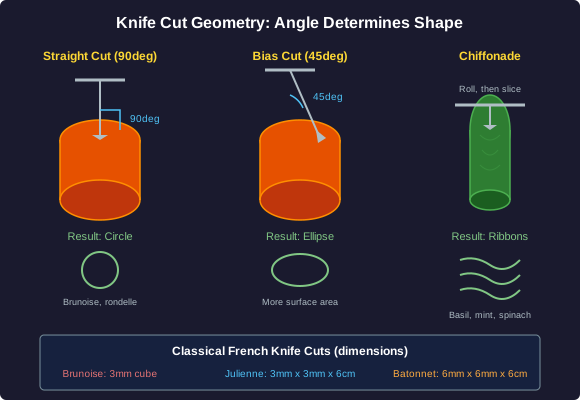
In professional kitchens, knife cuts are not artistic choices: they are geometric specifications. Every classical French cut has exact dimensions, because uniform geometry ensures uniform cooking.
A 3mm cube & a 1cm cube placed in the same pot will cook at very different rates. The smaller cube has a much higher surface-to-volume ratio, so heat penetrates faster. Uniform cuts mean uniform doneness.
The fundamental cuts:
- Brunoise: 3mm × 3mm × 3mm cube. The finest standard dice.
- Julienne: 3mm × 3mm × 6cm matchstick. Length is 20× the width.
- Batonnet: 6mm × 6mm × 6cm stick. A julienne scaled up by 2× in cross-section.
- Small dice: 6mm cube. The batonnet cut into cubes.
- Medium dice: 12mm cube. Double the small dice.
- Large dice: 2cm cube.
Notice the geometric progression: 3mm → 6mm → 12mm → 20mm. Each step roughly doubles the previous.
Angle Changes Shape
The Bias Cut & the Chiffonade
A straight cut (90° to the food) through a cylinder like a carrot produces a circle. But change the angle, & the geometry changes.
A bias cut (45° angle) through a cylinder produces an ellipse. The ellipse has a longer major axis than the circle's diameter: more surface area exposed to heat, browning, and flavor absorption. This is why Asian stir-fry recipes call for bias-cut vegetables.
The chiffonade is a different geometric operation entirely. You stack leaves (basil, mint, spinach), roll them into a tight cylinder, then slice perpendicular to the cylinder axis. The result: thin ribbons that unfurl into elegant strips. You are cutting cross-sections of a multi-layered cylinder.
Geometry of the bias cut ellipse: if the carrot has diameter d & you cut at angle θ from vertical, the ellipse has minor axis = d & major axis = d / sin(θ). At 45°, the major axis is d / sin(45°) = d × √2 ≈ 1.414d. The cross-section area increases by the factor 1/sin(θ).
Geometry of the Plate
Composition Rules
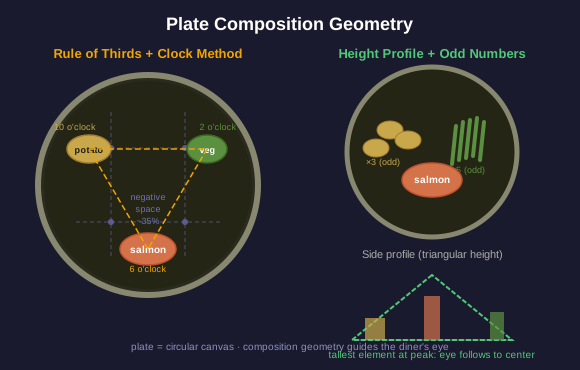
A dinner plate is a circular canvas, & plating follows geometric composition rules borrowed from visual art.
Rule of thirds: Divide the plate into a 3×3 grid (the same grid photographers use). Place the focal point: the protein, the hero ingredient: at one of the four grid intersections, not at the center. Off-center placement creates visual tension and interest.
The clock method: Protein at 6 o'clock (nearest the diner), starch at 10 o'clock, vegetables at 2 o'clock. This creates a triangular composition: the three elements form the vertices of a triangle on the circular plate.
Odd numbers: Arrange elements in groups of 3 or 5, not 2 or 4. Odd groupings create asymmetry, which the eye reads as dynamic & natural. Even groupings feel static & formal.
Height: Building upward creates a triangular profile when viewed from the side. The tallest element at center, shorter elements radiating outward. This profile guides the eye to the peak.
Negative space: The uncovered white (or dark) area of the plate is as important as the food. Professional plating uses 30-40% negative space. Overcrowding the plate destroys the composition geometry.
Designing a Plate
You are plating a dish with three components: seared salmon (protein), roasted fingerling potatoes (starch), & sauteed asparagus (vegetable). The plate is a standard 10.5-inch dinner plate.
Scaling Recipes Changes Geometry
Pan Area & Volume
Baking is chemistry constrained by geometry. When you scale a recipe or switch pans, the geometry changes: and so does everything about how the batter bakes.
Pan area formulas:
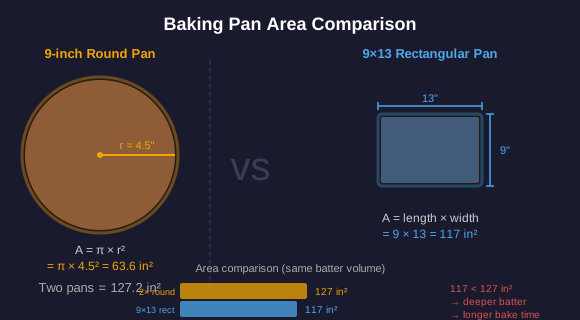
- Round pan: A = π × r²
- Rectangular pan: A = length × width
- Square pan: A = side²
The classic pan swap: switching from a 9-inch round pan to an 8-inch square pan.
- Round 9-inch: A = π × 4.5² = 63.6 in²
- Square 8-inch: A = 8² = 64 in²
Nearly identical! This is why baking guides say a 9-inch round and an 8-inch square are interchangeable: the batter depth will be almost the same, so the baking time stays the same.
But doubling a recipe is different. If you double the batter and put it in the same pan, the volume doubles but the surface area stays the same. The batter is deeper, so heat must penetrate farther from the outside in. Baking time increases: and if you do not adjust temperature downward, the outside burns before the center sets.
Pan Geometry Problem
A recipe calls for two 9-inch round cake pans. You only have one 9-inch × 13-inch rectangular pan.
The recipe makes enough batter for both round pans combined.
Surface Area, Volume, and Cooking Speed
Why Geometry Controls Cooking Time
Heat enters food through its surface and must conduct inward to the center. The geometry of the food: specifically the surface-to-volume ratio: determines how fast this happens.
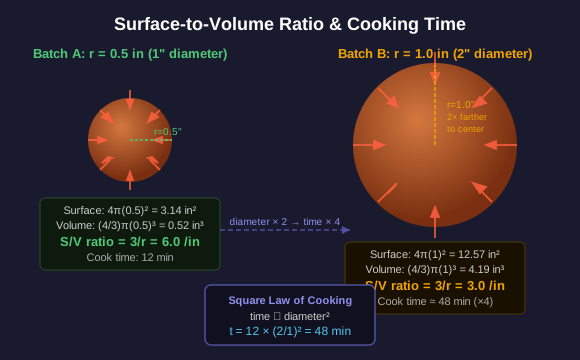
For a sphere (or roughly spherical food like a meatball):
- Surface area = 4π r²
- Volume = (4/3)π r³
- Surface-to-volume ratio = 3/r
As radius increases, the ratio drops. A meatball twice as large has only half the surface-to-volume ratio: heat penetrates proportionally slower.
For a slab (like a steak), the thickness is what matters. If you double the thickness:
- Volume doubles (proportional to thickness)
- Top & bottom surface area stays the same
- Surface-to-volume ratio drops by half
This is why a 1-inch steak cooks in 8-10 minutes but a 2-inch steak needs 15-20 minutes: it is not linear, because conductive heat transfer through the interior follows diffusion equations where time scales roughly as thickness squared.
The square law of cooking: cooking time is approximately proportional to the square of the thickness. Double the thickness → roughly 4× the cooking time. This is why thick roasts need low-and-slow cooking: high heat would char the outside long before the center reaches temperature.
Geometry of Cooking Time
A chef is making two batches of meatballs from the same recipe.
Batch A: 1-inch diameter meatballs (r = 0.5 inches)
Batch B: 2-inch diameter meatballs (r = 1 inch)
Culinary Geometry: Summary
What You Have Learned
The kitchen is a geometry workshop:
- Knife cuts are geometric specifications: dimensions in millimeters. Uniform geometry ensures uniform cooking. The cut angle determines the cross-section shape: 90° gives circles, 45° gives ellipses, and the bias cut area scales as 1/sin(θ).
- Plating follows composition geometry: rule of thirds, clock method (triangular placement), odd-number groupings, height profiles, & negative space. The plate is a circular canvas with mathematical rules.
- Baking depends on pan area (π×r² for round, l×w for rectangular). A 9-inch round & 8-inch square have nearly identical areas. Doubling a recipe changes the depth, which changes the surface-to-volume ratio & baking time.
- Heat transfer follows the surface-to-volume ratio (3/r for spheres). Cooking time scales roughly as the square of thickness: double the size, quadruple the time. This governs every decision about portion size, cut thickness, and oven temperature.
Precision in the kitchen starts with precision in geometry.