Trigonometry of EMT Conduit
Conduit Bending Is Applied Trigonometry
Electrical metallic tubing (EMT) is bent into precise shapes to route wiring through buildings. Every bend is a geometric operation with exact mathematical relationships.
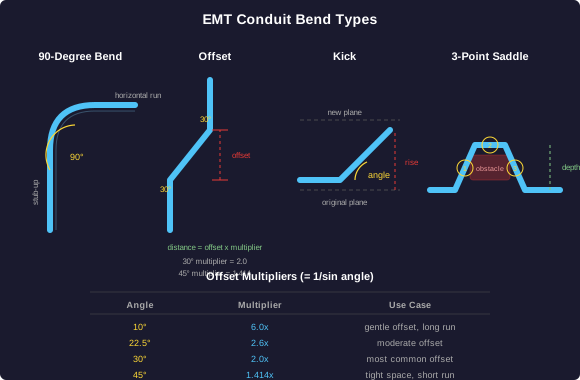
90-degree bend (stub-up): The simplest bend: a right angle. You measure the stub-up height (vertical distance) and subtract the take-up of the bender shoe to find the bend mark.
Offset bend: Two matched bends that shift the conduit from one plane to a parallel plane. Used to go around obstacles or transition between surfaces. The geometry is pure trigonometry.
The offset multiplier is the key formula: distance between bends = offset height × multiplier
The multiplier = 1/sin(bend angle):
- 10° bends: multiplier = 6.0 (gentle slope, long distance)
- 22.5° bends: multiplier = 2.6
- 30° bends: multiplier = 2.0 (most common)
- 45° bends: multiplier = 1.414 (= √2, tight offset)
Why 1/sin(angle)? Draw the offset triangle: the offset height is the side opposite the bend angle, & the distance between bends is the hypotenuse. By definition, sin(angle) = opposite/hypotenuse, so hypotenuse = opposite/sin(angle).
Shrinkage: An offset 'eats' conduit length. The conduit path through the offset is longer than a straight run. You must add shrinkage to your measurements: shrinkage per inch of offset is approximately 3/16" for 30° bends, 3/8" for 45° bends.
Saddle bends: A 3-point saddle uses three bends to go over an obstacle and return to the original plane: like a bridge. A 4-point saddle uses four bends for a wider obstacle. The center bend is typically twice the angle of the two outer bends.
Calculating an Offset
You need to run EMT conduit along a wall, but a 6-inch-diameter pipe is in the way. You need an offset to clear the pipe with 1 inch of clearance on each side: so the total offset height is 8 inches. You decide to use 30-degree bends.
Volumetric Geometry of Junction Boxes
Box Fill: Every Wire Has a Volume
The National Electrical Code (NEC Article 314.16) requires that junction boxes have enough internal volume for all conductors, devices, clamps, & grounds. Overfilling a box creates heat buildup & makes connections unreliable.
The geometry is simple: every component occupies a code-defined volume. The total volume of all components must not exceed the box's capacity.
Volume allowances (based on the largest conductor in the box):
- Each current-carrying conductor: 1 × volume allowance
- All internal cable clamps combined: 1 × volume allowance
- All equipment grounding conductors combined: 1 × volume allowance
- Each device (switch, receptacle): 2 × volume allowance
Volume allowance by wire gauge:
- 14 AWG: 2.00 in³ per conductor
- 12 AWG: 2.25 in³ per conductor
- 10 AWG: 2.50 in³ per conductor
Common box volumes:
- Single-gang: 18 in³
- Double-gang: 34 in³
- 4" square × 1.5" deep: 21 in³
- 4" square × 2.125" deep: 30.3 in³
Box fill calculation is pure volumetric geometry: sum the required volumes, compare to available volume. If required > available, use a bigger box.
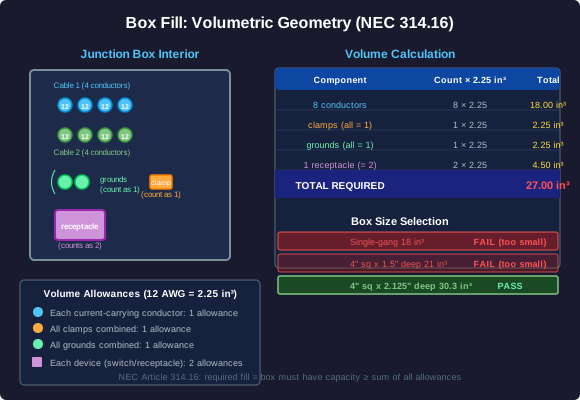
Box Fill Calculation
A junction box contains: 4 current-carrying 12 AWG conductors entering from one cable, 4 more 12 AWG conductors from a second cable, internal cable clamps, 2 equipment grounding conductors, & 1 single receptacle (device). All conductors are 12 AWG (2.25 in³ allowance).
Geometry Shapes the Field
Electromagnetic Fields Follow Geometric Laws
Electric and magnetic fields are not abstract: they have geometric shapes determined by the physical arrangement of charges and currents.
Electric fields: Point charges create radial fields that spread outward in all directions, falling off as 1/r² (inverse square law). Two parallel plates create a uniform field between them: straight, parallel field lines. The geometry of the conductors shapes the field.
Magnetic field of a straight wire: A current-carrying wire generates a magnetic field that forms concentric circles around the wire. The right-hand rule: wrap your right hand around the wire with your thumb pointing in the current direction: your fingers curl in the direction of the magnetic field. Field strength falls off as 1/r (inverse of distance).
Magnetic field of a solenoid (coil): Wind wire into a helix, and the circular magnetic fields of each turn reinforce inside the coil to create a nearly uniform, straight field: like a bar magnet. Outside the coil, the field curves from one end to the other. The geometry of the winding concentrates and directs the field.
Transformers exploit shared geometry: Two coils wound around the same iron core share their magnetic geometry. Current in the primary coil creates a magnetic field in the core; that changing field induces voltage in the secondary coil. The voltage ratio equals the turns ratio: V₂/V₁ = N₂/N₁. No electrical connection: pure geometric coupling through shared magnetic field.
Practical consequence: Wire routing matters. Parallel power conductors carrying high current create magnetic fields that can induce noise in nearby signal wires. The fix is geometric: twist signal pairs (fields cancel) or increase distance (field falls off as 1/r).

Why Transformers Work
A transformer has a primary coil with 100 turns & a secondary coil with 500 turns, wound on the same iron core. The primary receives 120V AC.
Geometric Constraints in Wire Routing
Wire Routing: Geometry Meets Code
Routing wires & conduit through a building is a geometric problem constrained by physics & electrical code.
Horizontal and vertical only: NEC and standard practice require wires in walls to run horizontally or vertically: never diagonally. Why? So future workers can predict where wires are. A wire running from a junction box always goes straight up, straight down, or straight sideways. Diagonal runs are invisible death traps for anyone drilling into a wall.
Junction box at every direction change: Every time a conduit run changes direction by more than a total of 360° of bends, you must install a pull box. Wires cannot be pulled around too many bends: friction increases geometrically with each bend.
Conduit fill: NEC Article 344.22 limits how many wires can fit inside a conduit. The fill percentages are based on cross-sectional area geometry:
- 1 wire: 53% of conduit cross-sectional area
- 2 wires: 31% of conduit cross-sectional area
- 3+ wires: 40% of conduit cross-sectional area
Why percentages, not counts? Because wire cross-sections are circles, & circles do not pack perfectly. There is always wasted space between round wires inside a round conduit. The fill percentages account for this geometric packing inefficiency plus space needed to pull wires without damage.
Calculating fill: Compare total wire cross-sectional area to the allowed fill area. 3/4" EMT has an internal area of 0.533 in². At 40% fill (3+ wires), that is 0.213 in² available. Each 12 AWG THHN wire has an area of 0.0133 in². Maximum wires = 0.213 / 0.0133 = 16 wires.
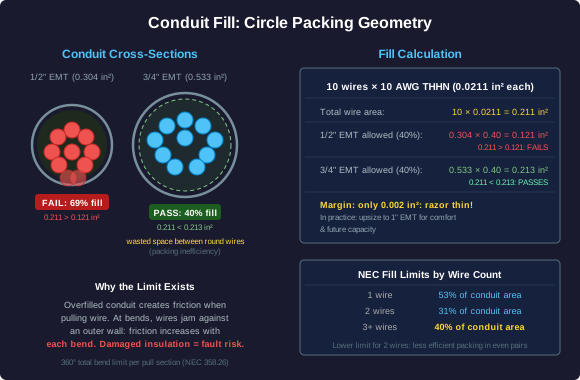
Conduit Fill Calculation
You need to run 10 conductors of 10 AWG THHN wire through a conduit. Each 10 AWG THHN wire has a cross-sectional area of 0.0211 in². You have two conduit options: 1/2" EMT (internal area = 0.304 in²) or 3/4" EMT (internal area = 0.533 in²).