Why Duct Shape Matters
Duct Sizing: Area, Perimeter, & Friction
Every HVAC duct is a tube that carries conditioned air from the air handler to the rooms it serves. The airflow capacity of a duct depends on one thing: cross-sectional area.
CFM = Area x Velocity: that is the fundamental equation. CFM is cubic feet per minute. Area is the cross-section of the duct in square feet. Velocity is the speed of air in feet per minute.
But area is not the whole story. The perimeter of the duct determines how much surface the air rubs against. More perimeter means more friction, which means more pressure drop, which means the blower has to work harder.
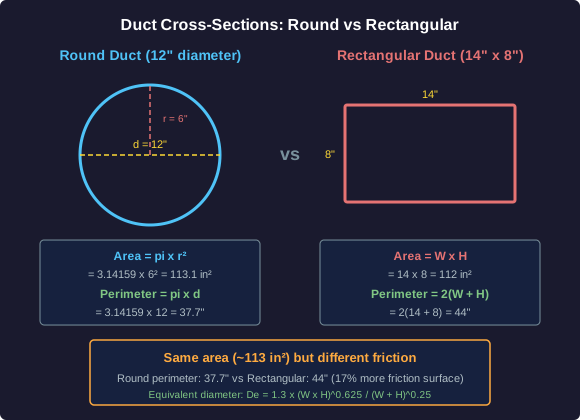
A 12-inch round duct has a cross-sectional area of pi x 6² = 113.1 square inches. Its perimeter is pi x 12 = 37.7 inches.
A 14" x 8" rectangular duct has an area of 14 x 8 = 112 square inches: nearly identical. But its perimeter is 2(14 + 8) = 44 inches: 17% more friction surface for the same airflow capacity.
This explains why round ducts are more efficient. The circle has the lowest perimeter-to-area ratio of any shape. In HVAC terms: round ducts produce less friction loss per CFM delivered.
Calculating Duct Area
A residential HVAC system needs to deliver 400 CFM to a bedroom. The design velocity is 600 feet per minute.
Throw, Spread, and the Coanda Effect
How Air Moves Through a Room
Once conditioned air leaves the duct, it enters the room through a register or diffuser. The geometry of how that air moves determines whether the room is comfortable or has hot & cold spots.
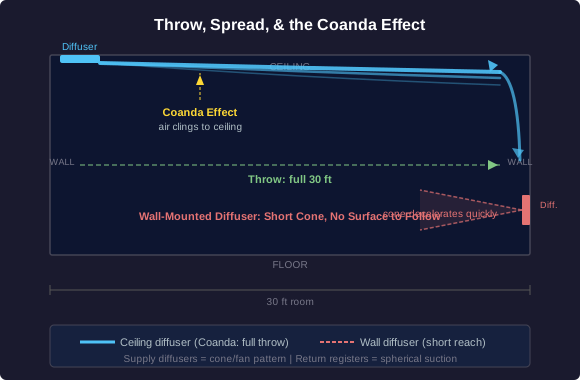
Throw is the distance air travels from the diffuser before its velocity drops below 50 FPM (feet per minute). A ceiling diffuser in a 20-foot room needs enough throw to reach the far wall.
Spread is the width of the air pattern. A linear slot diffuser creates a flat, wide pattern. A round ceiling diffuser creates a radial pattern.
Supply registers create conical or fan-shaped air patterns: air pushes outward in a defined geometric shape.
Return registers create spherical suction zones: air is pulled in from all directions equally. This is why return registers can be placed almost anywhere in a room.
The Coanda effect: Moving air tends to follow nearby surfaces. Air blown across a ceiling will cling to it, traveling much farther than air blown into open space. This is why ceiling-mounted diffusers work so well: the air hugs the ceiling, travels across the room, then drops down the far wall. The geometry of the ceiling becomes part of the air distribution system.
Understanding Air Distribution
A conference room is 30 feet long with a ceiling-mounted diffuser at one end. The supply air exits the diffuser at 700 FPM.
Fins, Tubes, and Surface Area
Heat Transfer Is a Surface Area Problem
The evaporator coil in an air conditioner or heat pump is where heat actually transfers between the air & the refrigerant. The rate of heat transfer depends on three things: the temperature difference, the thermal conductivity of the material, & the surface area.
You cannot easily change the temperature difference (that is set by the refrigerant cycle) or the conductivity (copper & aluminum are already excellent conductors). So HVAC engineers maximize surface area.
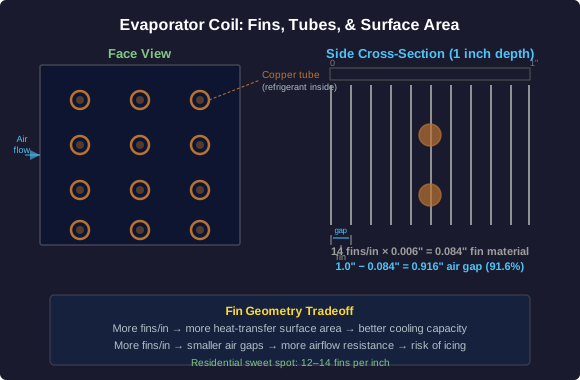
An evaporator coil is made of copper tubes with thin aluminum fins pressed onto them. The fins are thin sheets: typically 0.006 inches thick: spaced at 8 to 20 fins per inch.
More fins per inch = more surface area = more heat transfer. But there is a geometric tradeoff: more fins also means narrower air passages between them, which increases air resistance & reduces airflow.
At 8 fins per inch, airflow is easy but surface area is limited. At 20 fins per inch, surface area is enormous but the coil chokes airflow. Most residential systems use 12-14 fins per inch as the sweet spot.
This is a pure geometry problem: how do you pack the maximum surface area into a given volume while maintaining enough open cross-section for air to pass through?
Surface Area Tradeoff
A residential evaporator coil has fins spaced at 14 fins per inch. Each fin is 0.006 inches thick. The coil face is 20 inches wide & 18 inches tall.
Air Properties as Geometry
The Psychrometric Chart: A Geometric Map of Air
The psychrometric chart is one of the most important tools in HVAC. It looks complicated, but it is really just a geometric representation of air properties.
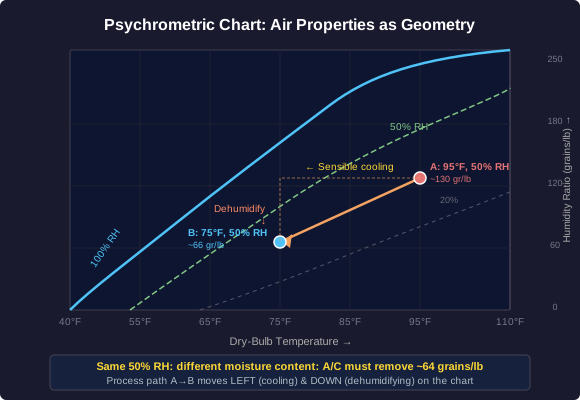
X-axis: Dry-bulb temperature: what a regular thermometer reads.
Y-axis (right side): Humidity ratio: the actual mass of water vapor per mass of dry air (grains of moisture per pound of dry air).
Curved lines: Relative humidity. The 100% RH curve is the saturation line: air cannot hold more moisture beyond this curve. Lower RH curves arc below it.
Every point on the chart represents a unique air state. If you know any two properties (dry-bulb temperature, wet-bulb temperature, relative humidity, dew point, enthalpy), you can locate the exact point & read all other properties.
HVAC processes are geometric paths on this chart:
- Sensible heating (furnace): Move right along a horizontal line: temperature increases, humidity ratio stays constant.
- Sensible cooling (above dew point): Move left along a horizontal line.
- Cooling and dehumidifying (typical A/C): Move left AND down: temperature drops and moisture condenses out.
- Humidifying: Move up: adding moisture at constant temperature.
- Evaporative cooling (swamp cooler): Move left and up along a constant wet-bulb line: temperature drops but humidity increases.
Tracing HVAC Processes
Consider a summer day: outdoor air is 95 degrees F dry-bulb, 50% relative humidity. You want to condition this air to 75 degrees F, 50% relative humidity for indoor comfort.