Optimizing the Floor Plan
Warehouse Layout: Geometry of Storage & Movement
A warehouse is a geometric optimization problem. Every square foot is either storage (racks holding product) or movement (aisles for people & forklifts). The tradeoff is fundamental: wider aisles mean easier movement but less storage. Narrower aisles mean more storage but you need specialized (& expensive) equipment.
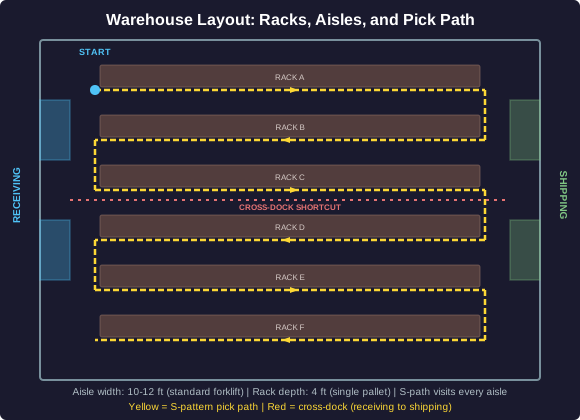
Standard aisle widths:
- Conventional forklift: 11-13 feet (the forklift needs room to turn with a pallet)
- Reach truck: 8-10 feet (arms extend to reach into racks)
- Very narrow aisle (VNA): 5-6 feet (specialized turret truck, expensive but maximizes storage)
Pick path strategies: the geometric route a worker follows to collect items:
- S-pattern (serpentine): Enter every aisle, travel its full length, exit the other end. Simple but visits every aisle even if only one item is needed there.
- Largest gap: Only enter an aisle if it has items to pick. Skip aisles with no picks. Within an aisle, turn around at the largest gap between picks instead of traveling the full length.
- Cross-dock: For items going straight from receiving to shipping: bypass storage entirely. A cross-dock layout places receiving and shipping docks on opposite sides, with a clear path between them.
Storage Density Calculation
A warehouse is 200 feet wide & 400 feet long (80,000 square feet total). The current layout uses conventional forklifts with 12-foot aisles. Racks are 4 feet deep (single pallet depth) on each side of every aisle. The layout alternates: rack, aisle, rack, aisle.
Each rack-aisle-rack unit is: 4 (rack) + 12 (aisle) + 4 (rack) = 20 feet wide.
Cube Utilization and Bin Packing
Stacking: 3D Geometry in Every Trailer
A standard pallet in North America is 48 inches by 40 inches (GMA pallet). This is the fundamental unit of logistics geometry.
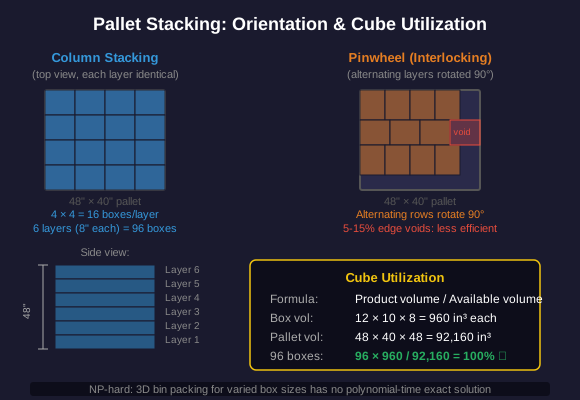
Cube utilization measures how efficiently you fill a space: actual product volume divided by available volume. A trailer that is full by weight but half-empty by volume has poor cube utilization. A trailer packed to the ceiling has excellent cube utilization.
Column stacking: each layer is identical, boxes directly on top of each other. Structurally weak but uses space efficiently.
Interlocking (pinwheel) stacking: alternating layers are rotated 90 degrees. Much more stable but creates voids at the edges, wasting 5-15% of the pallet footprint.
Container loading is the real geometric challenge: fitting rectangular boxes of various sizes into a 40-foot shipping container (inside dimensions approximately 39'5" x 7'8" x 7'10"). This is 3D bin packing: one of the classic NP-hard problems in computer science. No algorithm can guarantee the optimal solution in reasonable time for large instances.
In practice, logistics companies use heuristic approaches: largest items first, fill floor area before stacking height, group items by destination for unloading efficiency.
Pallet Loading Efficiency
You need to load boxes that are 12 inches long, 10 inches wide, & 8 inches tall onto a standard 48" x 40" pallet. The maximum stack height is 48 inches.
Why Route Optimization Gets Hard
The Traveling Salesman Problem (TSP)
Suppose you must visit 10 customers and return to your depot. What is the shortest route? This is the Traveling Salesman Problem: one of the most studied problems in mathematics and computer science.
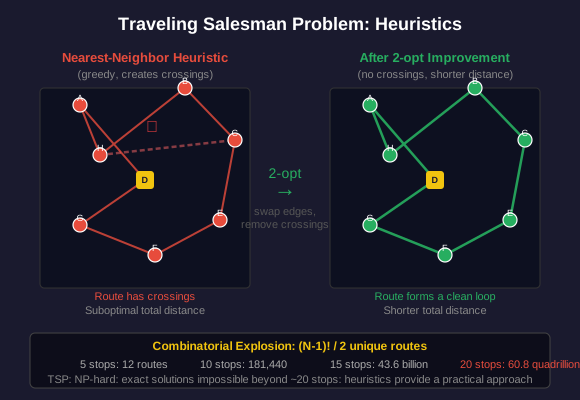
The difficulty is combinatorial explosion. For N stops, there are (N-1)!/2 unique routes (dividing by 2 because clockwise & counterclockwise are the same distance).
- 5 stops: 12 routes: check them all in milliseconds
- 10 stops: 181,440 routes: still manageable for a computer
- 15 stops: 43.6 billion routes: takes hours
- 20 stops: 60.8 quadrillion routes: takes centuries
- 50 stops: more routes than atoms in the observable universe
TSP is NP-hard: no known algorithm can solve it in polynomial time. As N grows, exact solutions become impossible and we must use heuristics: algorithms that find good (but not guaranteed optimal) solutions quickly.
Common heuristics:
- Nearest neighbor: From the current location, always go to the closest unvisited stop. Fast but often produces routes with ugly crossings.
- Convex hull insertion: Start with the outermost stops (the convex hull: the geometric boundary). Then insert interior stops one at a time where they add the least distance.
- 2-opt improvement: Take a completed route & try swapping pairs of edges. If removing two edges & reconnecting differently makes the route shorter, keep the swap. Repeat until no improvement is found.
Heuristics vs Exact Solutions
A delivery company has 12 stops today. Their driver uses the nearest-neighbor heuristic: at each point, drive to the closest unvisited stop.
Zones, Density, and the Vehicle Routing Problem
Last-Mile Delivery: Where Geometry Meets Economics
The last mile: from distribution center to the customer's door: accounts for 40-50% of total shipping cost. It is the most geometrically constrained part of the supply chain.
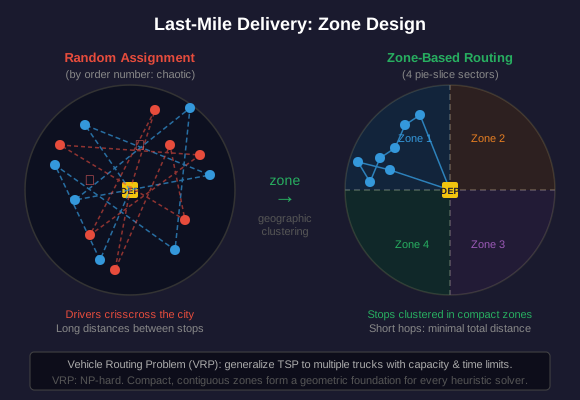
Radial routes from a depot: Delivery trucks fan out from a central distribution center. Each truck's route should cover a compact geographic zone: no two trucks should crisscross each other's territory.
Delivery density determines everything. In a dense urban area, a truck might make 150 deliveries in an 8-hour shift. In rural areas, the same truck might manage 20-30. The geometric reason: urban stops are close together (short drive between stops) while rural stops are far apart.
Zone-based routing divides the service area into geographic clusters. Each zone is assigned to one vehicle. Good zones are compact (roughly circular or square) & contiguous (no gaps or isolated pockets). The goal: minimize the total distance while keeping each route under the time/capacity limit.
The Vehicle Routing Problem (VRP) generalizes TSP to multiple vehicles. Given a depot, N customers, & K trucks (each with capacity & time constraints), assign customers to trucks & sequence each truck's route to minimize total distance. VRP is also NP-hard.
A well-designed zone map creates routes where each driver's path forms a compact geometric shape: a rough circle or lobe extending from the depot. If you see a route that crisscrosses itself or overlaps with another driver's zone, the routing is inefficient.
Zone Design
A delivery company operates from a depot in the center of a city. They have 4 drivers & 200 deliveries spread across a roughly circular service area with a 10-mile radius.