Shape of a Reactor Core
Geometry Inside a Nuclear Reactor
A nuclear reactor core is a carefully arranged geometric structure. The overall shape is a cylinder: typically about 3-4 meters in diameter and 3-4 meters tall for a pressurized water reactor (PWR). Inside that cylinder, fuel rods are arranged in a repeating lattice pattern.
Each fuel rod is a thin tube (about 1 cm diameter) filled with uranium oxide pellets. Rods are grouped into fuel assemblies: bundles of rods held in a fixed geometric pattern. The arrangement of these assemblies determines the reactor's neutron economy: how efficiently neutrons from one fission event cause the next.
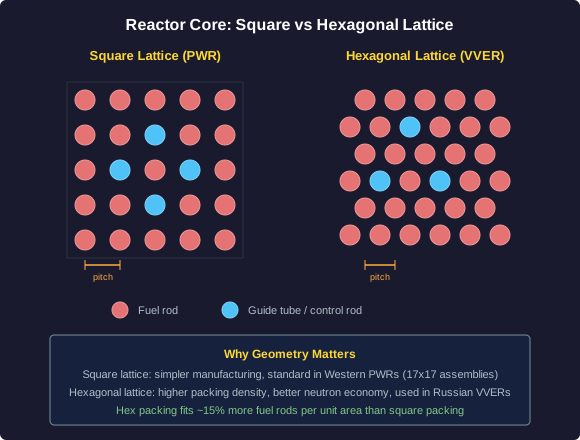
Two lattice geometries dominate commercial reactor design:
- Square lattice (PWR, Western design): Fuel rods arranged in a square grid. A typical PWR fuel assembly is a 17×17 array = 289 positions, with about 264 fuel rods & 25 guide tubes for control rods. The square lattice is simpler to manufacture & analyze.
- Hexagonal lattice (VVER, Russian design): Fuel rods arranged in a triangular/hexagonal grid. Hexagonal packing is geometrically more efficient: it fits about 15% more rods per unit area than square packing. This gives better neutron economy (more fuel per moderator volume) but is harder to manufacture.
Why Hexagonal Packing Packs Denser
In a square lattice with pitch p (center-to-center distance), each rod 'occupies' a square area of p². In a hexagonal lattice with the same pitch p, each rod occupies an area of p² × sqrt(3)/2.
The ratio of hexagonal to square packing density is: (p² / (p² × sqrt(3)/2)) = 2/sqrt(3) = 1.155. That is, hexagonal packing fits about 15.5% more rods in the same total area.
Where Neutrons Are: Flux Shape
Neutron Flux as Geometry
The neutron flux: the number of neutrons passing through a unit area per unit time: is not uniform across the reactor core. It has a characteristic geometric shape determined by the boundary conditions of the diffusion equation.
For a bare (unreflected) cylindrical reactor:
- Axially (top to bottom): the flux follows a cosine shape. Peak at the center, dropping to zero at the extrapolated boundaries above & below. Mathematically: phi(z) = phi_max × cos(pi × z / H_e), where H_e is the extrapolated height.
- Radially (center to edge): the flux follows a zeroth-order Bessel function (J₀). Peak at the center, dropping to zero at the extrapolated radius. Mathematically: phi(r) = phi_max × J₀(2.405 × r / R_e), where R_e is the extrapolated radius & 2.405 is the first zero of J₀.
The combined 3D flux distribution is the product: phi(r,z) = phi_max × J₀(2.405r/R_e) × cos(pi × z/H_e).
Power Peaking
Because flux peaks at the center & drops toward the edges, the center fuel rods produce much more power than the edge rods. The power peaking factor is the ratio of peak power density to average power density.
For a bare cylinder, the radial peaking factor from the Bessel function is about 2.32, & the axial peaking factor from the cosine is about 1.57. The total peaking factor is 2.32 × 1.57 = 3.64.
This means the hottest fuel rod produces 3.64 times the power of the average rod. Since the reactor's total power output is limited by the hottest rod (which must not exceed the fuel temperature limit), a peaking factor of 3.64 means you can only extract about 1/3.64 = 27% of the theoretical maximum power.
Distance and Material: Two Defenses
The Geometry of Radiation Protection
Radiation protection uses two geometric principles: the inverse square law (distance) & exponential attenuation (material shielding).
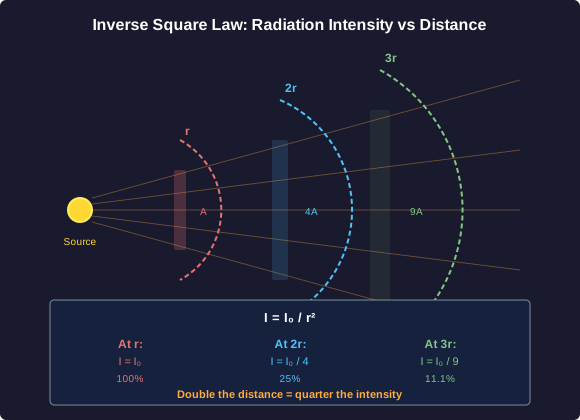
Inverse square law: Radiation from a point source spreads out over an ever-increasing sphere. At distance r, the radiation passes through a sphere of area 4 pi r². At distance 2r, the sphere has area 4 pi (2r)² = 16 pi r²: four times larger. The same radiation spread over four times the area gives one-quarter the intensity.
Mathematically: I = I₀ / r². Double the distance, quarter the dose. Triple the distance, one-ninth the dose.
Exponential attenuation: When radiation passes through a material, it is absorbed or scattered exponentially: I = I₀ × e^(-mu × x), where mu is the linear attenuation coefficient & x is the thickness.
The half-value layer (HVL) is the thickness that halves the radiation intensity. For gamma rays in lead, the HVL is about 1.2 cm. In concrete, it is about 6 cm. In water, about 18 cm.
Shielding Calculation
A radiation source produces a dose rate of 1000 mrem/hr at 1 meter. The regulatory limit for a controlled area boundary is 2 mrem/hr.
Buildup Factor
When the Simple Formula Is Not Enough
The exponential attenuation formula I = I₀ × e^(-mu × x) assumes narrow beam geometry: radiation traveling in a straight line through the shield, with any scattered photon counted as removed.
In reality, some scattered photons still reach the detector. The buildup factor B accounts for this: I = B × I₀ × e^(-mu × x), where B >= 1.
Buildup factors depend on the shield material, the radiation energy, and the number of mean free paths (mu × x). For thick shields, B can be 5-10 or more: meaning the actual dose is 5-10 times higher than the narrow-beam formula predicts.
This is a geometric effect: in a thick shield, photons have multiple scattering opportunities. Each scatter changes the photon's direction but does not always remove it from the beam. The more material the photon traverses, the more scattered photons accumulate on the detector side.
Why Shape Determines Critical Mass
The Surface-to-Volume Problem
A nuclear chain reaction sustains itself when each fission event produces, on average, at least one neutron that goes on to cause another fission. Neutrons that reach the surface of the fissile material and escape are lost: they do not contribute to the chain reaction.
The competition between neutron production (proportional to volume: more material, more fissions) and neutron leakage (proportional to surface area: more surface, more escapes) determines whether the mass is critical.
The critical mass is the minimum mass of fissile material needed to sustain a chain reaction. It depends on the material (U-235, Pu-239), the density, the enrichment, and critically: the geometry.
A sphere has the minimum surface-to-volume ratio of any shape: S/V = 3/r. This means a sphere leaks the fewest neutrons per unit of fissile material. The critical mass of a sphere of pure Pu-239 is about 10 kg. Flatten that sphere into a thin disk with the same mass, and it goes subcritical: the disk's larger surface-to-volume ratio means too many neutrons escape.
Geometry Controls in Criticality Safety
Preventing Accidental Criticality
In nuclear fuel processing, criticality safety relies heavily on geometry controls: using physical shapes that make criticality impossible regardless of how much fissile material is present.
Favorable geometries (inherently safe shapes):
- Thin slabs: maximum thickness limited so the surface-to-volume ratio is too high for criticality. Fissile solutions stored in flat-bottomed tanks.
- Thin cylinders (pipes): maximum diameter limited. Fissile solutions processed through narrow-bore piping.
- Small spheres: maximum volume limited. Storage containers with volume restrictions.
- Annular tanks: ring-shaped containers where the inner void ensures no dimension allows sufficient neutron multiplication.
The principle: if the geometry guarantees that the surface-to-volume ratio exceeds the critical threshold, no amount of fissile material in that geometry can go critical. Geometry controls count as more reliable than mass limits because you cannot accidentally change the shape of a pipe.
Geometry as the Language of Nuclear Engineering
What You Have Learned
Geometry is not an abstraction in nuclear engineering: it is the primary tool for controlling the most powerful energy source humans have harnessed.
- Core geometry: Square & hexagonal lattices determine fuel packing density & neutron economy. The 15% advantage of hexagonal packing translates directly to reactor efficiency.
- Flux distribution: Cosine & Bessel function shapes determine power peaking. Reflectors flatten the distribution geometrically, nearly doubling usable power output.
- Shielding: The inverse square law & exponential attenuation are geometric relationships that protect workers & the public. Distance squared & half-value layers are the radiation engineer's primary tools.
- Criticality: Surface-to-volume ratio determines whether a mass of fissile material can sustain a chain reaction. The sphere is the most dangerous shape. Thin slabs & narrow pipes are the safest. Geometry controls prevent accidental criticality.
Every reactor design, every shielding calculation, every criticality safety analysis begins with geometry. The physics is complex. The geometry is the key that unlocks it.