Welcome
Spaceflight is geometry. Every orbit is a conic section: a shape you get by slicing a cone with a plane. The trajectory of every satellite, every planet, every comet is one of four curves: circle, ellipse, parabola, or hyperbola. Which one depends on how fast the object is moving.
This lesson covers the geometry that mission planners use to design trajectories, change orbits, align orbital planes, and park spacecraft at gravitational equilibrium points. These are not approximations or simplifications: Kepler's laws and Newtonian gravity give exact geometric solutions that have guided every space mission in history.
We start with the most important shape in orbital mechanics: the ellipse.
Anatomy of an Elliptical Orbit
Kepler's First Law
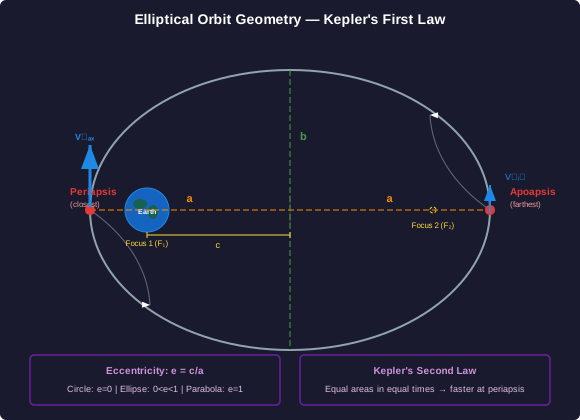
Johannes Kepler discovered in 1609 that planets orbit the Sun in ellipses, with the Sun at one focus. This was revolutionary: for centuries, astronomers had assumed orbits were circles (or combinations of circles). Kepler showed that the geometry was simpler but less symmetric.
The geometry of an ellipse:
- Semi-major axis (a): Half the longest diameter. This determines the orbital period & total energy.
- Semi-minor axis (b): Half the shortest diameter.
- Foci (F₁, F₂): Two special points inside the ellipse. The central body (Earth, Sun) sits at one focus. The other focus is empty.
- Eccentricity (e): Measures how elongated the ellipse is. e = c/a, where c is the distance from center to focus.
- e = 0: perfect circle
- 0 < e < 1: ellipse
- e = 1: parabola (escape trajectory)
- e > 1: hyperbola (flyby trajectory)
- Periapsis: The point on the orbit closest to the central body (for Earth orbits: perigee)
- Apoapsis: The point farthest from the central body (for Earth orbits: apogee)
Kepler's Second Law adds a crucial constraint: a line from the central body to the orbiting object sweeps out equal areas in equal times. This means the object moves fastest at periapsis & slowest at apoapsis. The geometry of the ellipse dictates the speed at every point.
Eccentricity and Speed
Connecting Shape to Speed
The ISS orbits Earth in a nearly circular orbit: eccentricity about 0.0005. Halley's Comet orbits the Sun with eccentricity 0.967: an extremely elongated ellipse. At perihelion (closest to the Sun), Halley's Comet moves at 54.5 km/s. At aphelion (farthest), it crawls at 0.9 km/s. Same orbit, same object, but the geometry forces a 60:1 speed ratio.
Hohmann Transfer Ellipse
Changing Orbits Geometrically
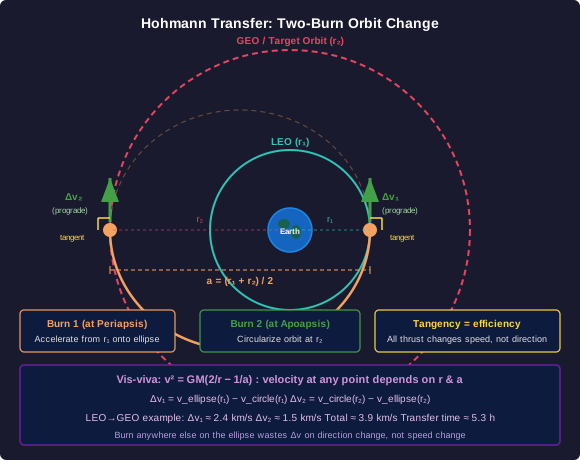
A spacecraft in a circular orbit cannot simply point itself at a higher orbit and fire its engines. Orbital mechanics does not work that way. Instead, the spacecraft must follow a specific geometric path: a transfer orbit: that connects the two circular orbits.
The Hohmann transfer (proposed by Walter Hohmann in 1925) is the most fuel-efficient two-burn transfer between coplanar circular orbits. Its geometry is elegant: the transfer orbit is an ellipse whose periapsis touches the inner orbit & whose apoapsis touches the outer orbit.
The two burns:
1. Burn 1 (at periapsis): Fire engines prograde (forward) to accelerate from the inner circular orbit onto the transfer ellipse. The spacecraft now follows the elliptical path outward.
2. Burn 2 (at apoapsis): When the spacecraft reaches the outer orbit altitude, fire engines prograde again to accelerate from the transfer ellipse onto the outer circular orbit.
Why does this work geometrically? The transfer ellipse is tangent to both circular orbits: it touches each one at exactly one point. This means the spacecraft's velocity at the burn points is aligned with the circular orbit, so all the engine thrust goes into changing speed (not direction). Maximum efficiency.
The cost: A Hohmann transfer to a much higher orbit takes time. A transfer from low Earth orbit (LEO) to geostationary orbit (GEO) takes about 5.3 hours. A transfer to the Moon takes about 3 days.
Transfer Orbit Geometry
Beyond Hohmann
The Hohmann transfer is optimal for modest orbit changes. But for very large orbit changes: say, from LEO to an orbit 15 times higher: a bi-elliptic transfer can actually be more fuel-efficient, even though it uses three burns and takes much longer. The geometry involves two transfer ellipses: one that overshoots the target orbit, and one that comes back down to it.
This is counterintuitive: going farther than you need to, then coming back, uses less fuel than going directly. The reason is deep in the geometry of orbital energy: the Oberth effect means that burns at high velocity (close to a massive body) are more efficient than burns at low velocity (far from a massive body).
Third Dimension
Leaving the Plane
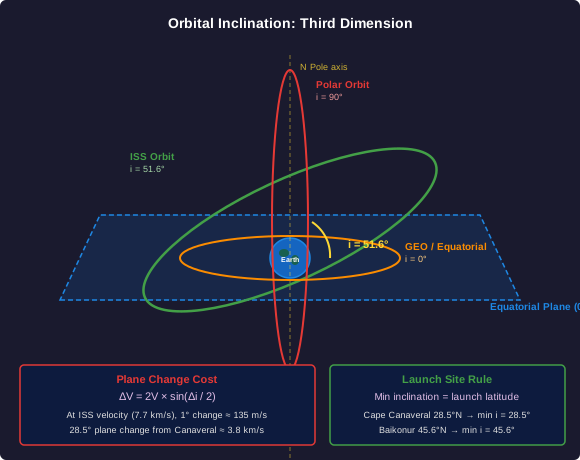
So far we have worked in two dimensions: orbits as ellipses in a flat plane. But real orbits exist in three-dimensional space, and the orientation of the orbital plane matters enormously.
Orbital inclination is the angle between the orbital plane & the equatorial plane. It ranges from 0° (equatorial orbit, same plane as the equator) to 90° (polar orbit, passing over both poles) to 180° (retrograde equatorial orbit, orbiting opposite to Earth's rotation).
The ISS has an inclination of 51.6°. This means its orbital plane is tilted 51.6° from the equator. As Earth rotates beneath it, the ISS passes over every point on Earth between latitudes 51.6°N & 51.6°S.
Changing inclination is enormously expensive. In-plane maneuvers (like Hohmann transfers) change the size & shape of the orbit. Plane changes rotate the entire orbit in 3D space. The velocity change required for a plane change is:
ΔV = 2V × sin(Δi/2)
where V is the orbital velocity & Δi is the inclination change in degrees. Even a small inclination change requires a large ΔV because you must redirect the entire orbital velocity vector, not just increase or decrease its magnitude.
At ISS orbital velocity (7.7 km/s), a 1° inclination change costs about 135 m/s of ΔV. A 28.5° change (from Cape Canaveral's latitude to equatorial) costs about 3.8 km/s: nearly half the ΔV needed to reach orbit in the first place.
Launch Site Advantage
Why Launch Sites Are Where They Are
When a rocket launches due east, it gets a free velocity boost from Earth's rotation. At the equator, Earth's surface moves at about 465 m/s eastward. At Cape Canaveral (28.5°N), it is about 408 m/s. At Baikonur (45.6°N), about 325 m/s.
But there is a geometric constraint: a rocket launched due east from Cape Canaveral enters an orbit with an inclination equal to the launch site's latitude: 28.5°. To reach an equatorial orbit (inclination 0°) from Cape Canaveral, you must perform a 28.5° plane change: which is extremely expensive.
This explains why the European Space Agency launches from Kourou, French Guiana (latitude 5.2°N) & why China built Wenchang at 19.6°N. Every degree of latitude you save at the launch site is a degree of inclination change you do not have to pay for in orbit.
Five Special Points
Gravitational Geometry
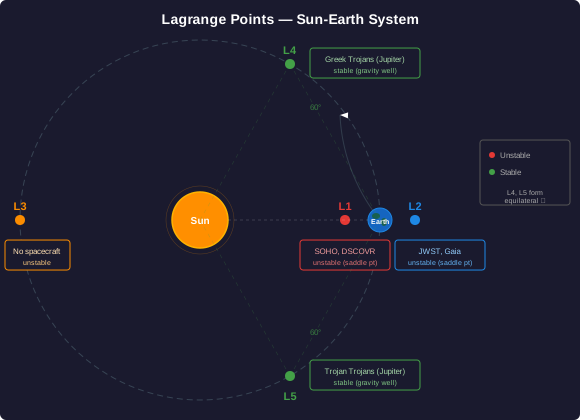
In any two-body gravitational system (like the Sun & Earth), there are exactly five points where the gravitational pull of both bodies, combined with the centrifugal force of orbiting, creates a net zero force. A small object placed at one of these points can remain stationary relative to both bodies. These are the Lagrange points, discovered mathematically by Joseph-Louis Lagrange in 1772.
The five points:
L1: Between the Sun and Earth, about 1.5 million km from Earth. The Sun's gravity pulls you sunward, Earth's gravity pulls you earthward, and the centrifugal force from orbiting pushes you outward. At L1, these balance. SOHO and DSCOVR observe the Sun from here.
L2: Beyond Earth from the Sun, about 1.5 million km out. Here the combined gravity of Sun and Earth (both pulling sunward) balances the centrifugal force. JWST orbits here: it keeps the Sun, Earth, and Moon all behind its sunshield.
L3: On the opposite side of the Sun from Earth. Theoretically interesting but practically useless: too far for communications and blocked by the Sun.
L4 and L5: At the vertices of equilateral triangles formed by the Sun, Earth, and the Lagrange point. L4 is 60° ahead of Earth in its orbit, L5 is 60° behind. These are the only stable Lagrange points: objects placed here naturally return when displaced.
Stability: L1, L2, and L3 are unstable: like balancing a ball on top of a hill. A small push and the object drifts away. Spacecraft at L1 and L2 must perform regular station-keeping burns. L4 and L5 are stable: like a ball in a bowl. Displaced objects oscillate around the point. Jupiter's L4 and L5 points have collected thousands of Trojan asteroids over billions of years.
Geometry of Equilibrium
Why Equilateral Triangles?
The fact that L4 and L5 sit at the vertices of equilateral triangles is not arbitrary: it is a deep result of gravitational geometry. The proof involves showing that at 60° ahead or behind the smaller body, the gravitational gradient creates a Coriolis-force well that traps objects.
The practical applications are significant. NASA's Lucy mission is visiting Jupiter's Trojan asteroids at L4 & L5. The LISA Pathfinder mission tested gravitational wave detection technology at Sun-Earth L1. Every major space telescope since Herschel (2009) has been placed at L2.