Slope for Gravity Drainage
Grade: The Geometry of Gravity Flow
Unlike supply pipes (which use pump pressure), drain-waste-vent (DWV) pipes rely on gravity. The pipe must slope downward from every fixture to the sewer: and the slope must be precisely controlled.
Grade is the ratio of rise (vertical drop) to run (horizontal distance), expressed as inches of drop per foot of run.
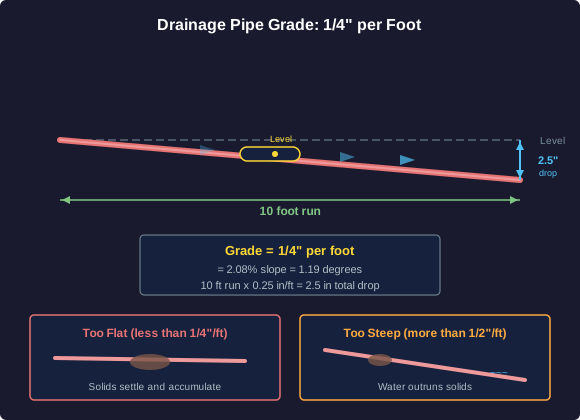
Standard grades by pipe size:
- Pipes 3 inches & smaller: 1/4 inch per foot (2.08% slope, 1.19 degrees)
- Pipes 4 inches & larger: 1/8 inch per foot (1.04% slope, 0.60 degrees)
Why not steeper? This surprises most people. If the pipe is too steep, water accelerates and outruns the solid waste. The solids get left behind, dry out, and clog the pipe. A properly graded pipe maintains self-scouring velocity: fast enough to carry solids but slow enough that water and solids travel together.
Why not flatter? If the grade is too shallow, neither water nor solids have enough velocity. Solids settle & accumulate until the pipe is blocked.
The sweet spot is narrow: between about 1 & 4 feet per second flow velocity.
Calculating Grade
You are running a 2-inch drain line from a bathroom sink to the main stack. The horizontal run is 14 feet.
Angles and Flow Paths
Pipe Fittings: Geometry Defines Flow
Every change in direction requires a fitting, & every fitting is defined by its geometry.
Standard fitting angles:
- 90-degree elbow (quarter bend): changes direction by a right angle
- 45-degree elbow (eighth bend): changes direction by 45 degrees
- 22.5-degree bend (sixteenth bend): a gentle change
- Wye (Y-junction): joins two pipes at a 45-degree angle
- Tee (T-junction): joins two pipes at a 90-degree angle
DWV vs pressure fittings: this is where geometry matters most:
- DWV (drain-waste-vent) fittings use long-sweep curves. A long-sweep 90 has a gradual radius: solids and wastewater can follow the curve without piling up at the turn. The inside radius is typically 1.5 times the pipe diameter.
- Pressure fittings (supply lines) can use short-radius turns because the water is under pressure & will be pushed around the corner regardless.
In DWV work, a standard 90-degree elbow is actually prohibited for horizontal-to-horizontal changes of direction in drainage. You must use either a long-sweep 90 or two 45-degree elbows with a short piece of pipe between them.
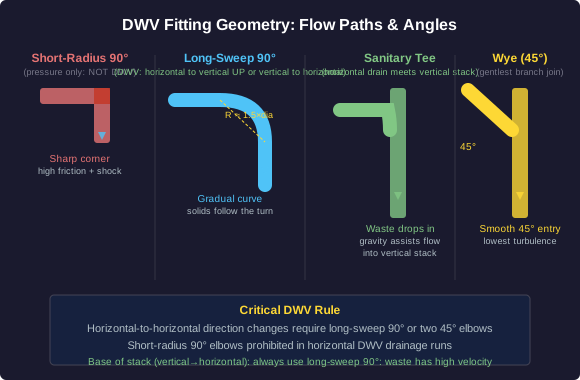
Choosing the Right Fitting
You need to connect a horizontal kitchen drain to a vertical stack (going downward). Then at the bottom of the stack, you need to change from vertical back to horizontal to run to the main sewer line.
Trigonometry in the Field
Pipe Offsets: Where Trigonometry Meets Plumbing
When a pipe needs to move sideways to get around an obstacle (a beam, another pipe, ductwork), the plumber creates an offset using two fittings of the same angle.
The offset is a Z-shaped detour: the pipe angles to one side, runs diagonally (the travel), then angles back to the original direction.
The geometry is a right triangle:
- Offset = the perpendicular distance the pipe moves sideways (the side opposite the angle)
- Travel = the diagonal length of pipe between the two fittings (the hypotenuse)
- Spread = the horizontal distance consumed by the offset (the adjacent side)
The relationship: offset = travel x sin(angle). Rearranged: travel = offset / sin(angle).
For common fitting angles, plumbers memorize multipliers:
- 45-degree fittings: travel = offset x 1.414 (because 1/sin(45) = sqrt(2) = 1.414)
- 22.5-degree fittings: travel = offset x 2.613 (because 1/sin(22.5) = 2.613)
- 60-degree fittings: travel = offset x 1.155 (because 1/sin(60) = 1.155)
The 45-degree offset is by far the most common. Every plumber has 1.414 burned into their memory.
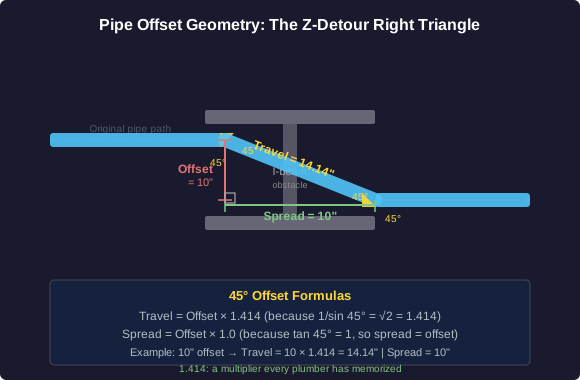
Calculating an Offset
You are running a 3-inch drain line horizontally at 48 inches above the floor. A steel I-beam crosses perpendicular to your path, & you need to drop the pipe 10 inches to clear under it, then come back up to the original height.
Diameter, Area, and Manning's Equation
Pipe Sizing: How Geometry Determines Capacity
Supply pipes are sized by flow rate (gallons per minute) & pressure. But drain pipes are sized by a unit system called Drainage Fixture Units (DFU).
Each plumbing fixture is assigned a DFU value based on how much it can discharge:
- Lavatory (bathroom sink): 1 DFU
- Bathtub: 2 DFU
- Shower: 2 DFU
- Kitchen sink: 2 DFU
- Toilet (water closet): 3-4 DFU
- Washing machine: 2 DFU
DFU totals map to minimum pipe diameters through code tables. More DFU = more potential flow = larger pipe needed.
The underlying geometry: Manning's equation calculates flow in partially filled pipes. It uses the hydraulic radius: a purely geometric property defined as the cross-sectional area of the flowing water divided by the wetted perimeter (the part of the pipe wall touching water).
A half-full pipe has the best hydraulic radius for its diameter. This is the design condition for drainage: DWV pipes are sized to run approximately half full at peak flow.
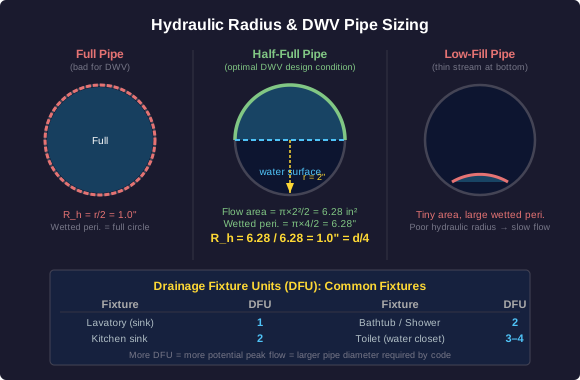
Hydraulic Radius
Consider a 4-inch diameter drain pipe running exactly half full.