How Many Ways Can It Move?
Degrees of Freedom: The Geometry of Motion
A degree of freedom (DOF) is one independent way an object can move. Understanding DOF is the first step in understanding how robots interact with space.
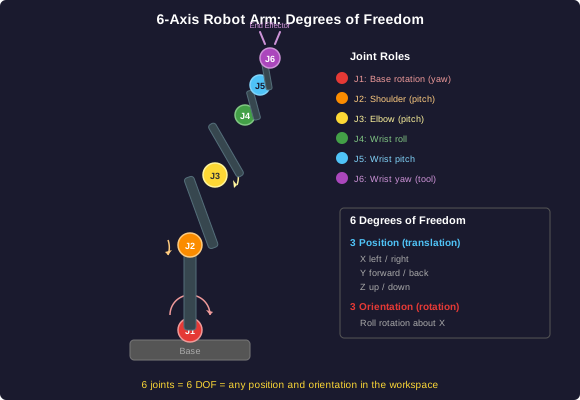
Position in 3D space requires 3 DOF: x (left/right), y (forward/back), z (up/down). A point in space has 3 DOF.
Orientation adds 3 more: roll (rotation about the forward axis), pitch (rotation about the side axis), yaw (rotation about the vertical axis). A rigid body in space has 6 DOF: 3 position + 3 orientation.
Robot arms & DOF:
- A 6-axis articulated arm (like an industrial robot) has 6 joints, each adding 1 DOF. With 6 DOF, the end effector can reach any position and orientation within the workspace: it has full spatial freedom.
- A 4-axis SCARA robot has 4 DOF: it can position anywhere in a plane and rotate, but cannot tilt its tool. Good for pick-and-place on flat surfaces.
- A 3-axis Cartesian/gantry robot has 3 DOF: it can position anywhere in a box-shaped volume but cannot orient its tool at all. Good for 3D printers.
More than 6 DOF: A 7-axis robot is redundant: it has more DOF than needed for full spatial positioning. The extra DOF lets it reach around obstacles, like a human arm reaching behind something. Redundancy is a geometric advantage.
DOF and Task Requirements
A factory needs a robot for three different tasks: (A) dispensing glue along a 3D curved path on an automotive body panel, (B) picking chips from a conveyor belt & placing them on a flat circuit board, & (C) welding a complex 3D joint from multiple angles.
Two Directions of Robot Geometry
Kinematics: Geometry in Motion
Kinematics is the study of motion without considering forces. In robotics, it is pure geometry: the relationship between joint angles and end effector position.
Forward kinematics (FK): Given all joint angles → calculate the end effector's position & orientation. This is the 'easy' direction.
For a 2-link planar arm: if joint 1 is at angle θ₁ & joint 2 is at angle θ₂, with link lengths L₁ & L₂, the end effector is at:
- x = L₁ cos(θ₁) + L₂ cos(θ₁ + θ₂)
- y = L₁ sin(θ₁) + L₂ sin(θ₁ + θ₂)
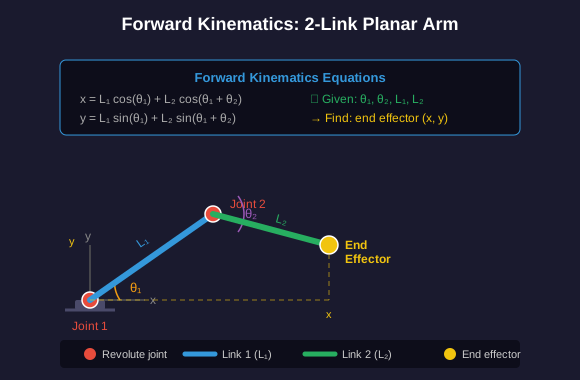
For a 6-axis arm, FK uses a chain of homogeneous transformation matrices: each joint contributes a 4×4 matrix encoding rotation and translation. Multiply all six matrices together to get the end effector pose. It is mechanical but always produces a unique answer.
Inverse kinematics (IK): Given a desired end effector position & orientation → calculate the joint angles that achieve it. This is the 'hard' direction.
IK is hard because:
- Multiple solutions: A 6-axis arm can often reach the same point in multiple configurations (elbow up vs. elbow down, wrist flipped vs. not). There may be 8 or more valid solutions.
- No solutions: If the target is outside the workspace, no joint angles work.
- Singularities: At certain poses, two joint axes align and the robot loses a DOF: like gimbal lock. Near singularities, small Cartesian movements require huge joint velocities.
Inverse Kinematics: Why Is It Hard?
Consider a simple 2-link planar arm with L₁ = L₂ = 1 meter. The end effector needs to reach the point (1.0, 1.0).
The distance from the base to the target is sqrt(1² + 1²) = sqrt(2) ≈ 1.414 m. Since L₁ + L₂ = 2 m > 1.414 m, the point is reachable.
Shape of Reachability
Workspace: The Geometric Volume a Robot Can Reach
The workspace envelope is the set of all points the end effector can reach. Its shape depends entirely on the robot's geometry.

Articulated arm (6-axis): The workspace is roughly a hollow sphere. The outer boundary is at maximum reach (all links extended). The inner boundary exists because the arm cannot fold back on itself enough to reach points too close to the base. Cross-section looks like a donut (torus).
SCARA: The workspace is a cylinder. The arm sweeps horizontally (generating a circular cross-section) and the Z-axis moves vertically. The result is a flat cylindrical volume: wide reach horizontally, limited vertically.
Cartesian/Gantry: The workspace is a rectangular box. Each axis moves linearly along one dimension. Simple, predictable, easy to program: but bulky because the robot must be as large as its workspace.
Singularities in the workspace: At certain poses, the robot loses a DOF. A fully extended articulated arm (at the outer boundary of its workspace) is in a singularity: it cannot move the end effector further outward. Wrist singularities occur when two wrist joint axes align. At a singularity, the Jacobian matrix loses rank, and the robot's effective DOF temporarily decreases.
Dexterous workspace vs. reachable workspace: The reachable workspace is where the end effector can reach in at least one orientation. The dexterous workspace is where it can achieve any arbitrary orientation. The dexterous workspace is always a subset of the reachable workspace: and often much smaller.
Choosing a Robot by Workspace
A factory cell has three stations arranged in an L-shape. Station A is to the left, Station B is directly ahead, Station C is to the right and slightly elevated (300 mm higher). The robot must pick parts from A, perform an operation at B, and place finished parts at C: all from a single mounting position.
Configuration Space: The Robot's Abstract Geometry
Configuration Space: Where Motion Planning Lives
Configuration space (C-space) is one of the most powerful geometric abstractions in robotics. Instead of thinking about the robot's physical shape, represent its entire state as a single point in an N-dimensional space.
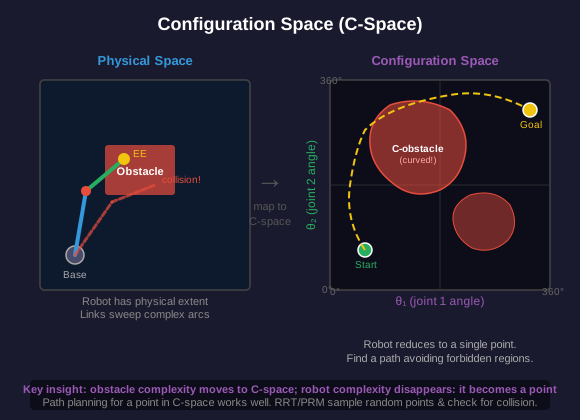
For a robot with N joints, C-space has N dimensions: one axis per joint angle. Every possible pose of the robot is a single point in C-space. A motion (sequence of poses) is a curve through C-space.
Obstacles in C-space: A physical obstacle in the real world becomes a forbidden region in C-space. If placing the robot at joint angles (θ₁, θ₂, ..., θN) would cause a collision, that point is inside a C-space obstacle. The shape of C-space obstacles is complex: a simple box in the real world becomes a weirdly shaped region in C-space.
Path planning = finding a collision-free curve: Given a start configuration (point in C-space) & a goal configuration (another point), find a continuous curve connecting them that does not enter any forbidden region.
Algorithms:
- A* (grid-based): Discretize C-space into a grid, search for shortest path. Works well in low dimensions (2-3 DOF) but grid size explodes exponentially with dimension.
- RRT (Rapidly-Exploring Random Tree): Build a tree of random samples in C-space, growing toward unexplored regions. Works in high dimensions (6+ DOF). Not optimal but fast at finding feasible paths.
- PRM (Probabilistic Roadmap): Pre-compute a graph of random collision-free configurations, then search the graph. Good for repeated queries in the same environment.
The geometric insight: a 6-DOF robot's path planning problem is a curve-through-6D-space problem. The dimensionality makes exact solutions infeasible: probabilistic methods (RRT, PRM) are the practical approach.
Configuration Space Thinking
A 2-link planar arm (2 DOF) operates in a room with a single rectangular obstacle. Joint 1 ranges from 0° to 360°, joint 2 ranges from 0° to 360°. The configuration space is a 2D square: θ₁ on one axis, θ₂ on the other.