Geometry of Joint Preparation
Groove Weld Geometry
Before two pieces of metal can be welded together in a full-penetration butt joint, the edges must be prepared: beveled: to create a groove that the weld metal can fill.
The geometry of this groove determines everything: how much weld metal is needed, how deep the fusion penetrates, how strong the joint will be, & how much the workpiece will distort.
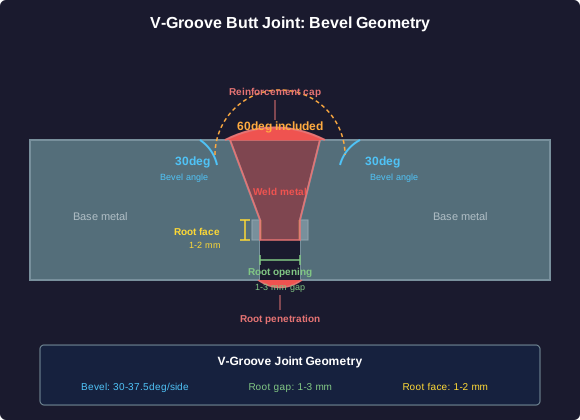
Key dimensions of a V-groove butt joint:
- Bevel angle: The angle ground into each plate edge, typically 30° to 37.5° per side.
- Included angle: The total angle of the groove (both bevels combined). For a symmetric V-groove with 30° bevels, the included angle is 60°.
- Root opening: The gap between the two plates at the bottom of the groove, typically 1-3 mm. This gap allows the arc to penetrate through to the back side.
- Root face: A small flat landing left at the bottom of the bevel, typically 1-2 mm. This prevents the arc from blowing through the gap.
Groove Profiles
V-Groove, J-Groove, U-Groove
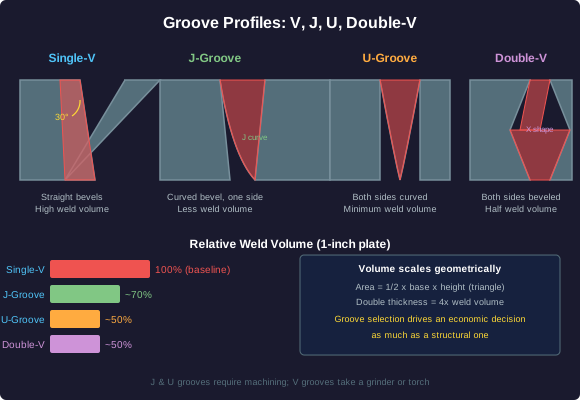
The V-groove is the simplest: straight bevels on each side meeting at the root. Easy to cut with a grinder or torch. But the wide-open V shape requires a lot of weld metal to fill: especially on thick plates.
The J-groove replaces the straight bevel with a curved profile (shaped like the letter J in cross-section). The curve reduces the volume of the groove while maintaining root access. Used on plates 1 inch & thicker.
The U-groove curves both sides (like a U in cross-section). Least weld metal required, but hardest to machine. Used on thick, high-value joints: pressure vessels, nuclear piping.
Single-V vs. Double-V: On thin plates (up to about 3/4 inch), you bevel from one side only: a single-V. On thicker plates, you bevel from both sides: a double-V (the cross-section looks like an X). The double-V uses about half the weld metal of a single-V at the same thickness, and it balances the welding heat between both sides, reducing distortion.
Weld volume scales geometrically: For a V-groove, the cross-sectional area of the groove is roughly a triangle. Area of a triangle = ½ × base × height. As plate thickness doubles, both base and height double, so the weld volume quadruples. This is why thick-plate welding is expensive: the cost is geometric, not linear.
Calculating Weld Volume
A welder is preparing a single-V butt joint on two 1-inch thick plates. Each plate is beveled at 30° per side (60° included angle). The root opening is 2 mm (about 0.08 inches), & the root face is 2 mm (0.08 inches).
The joint is 12 inches long.
Legs, Throats, and Triangles
Fillet Weld Geometry
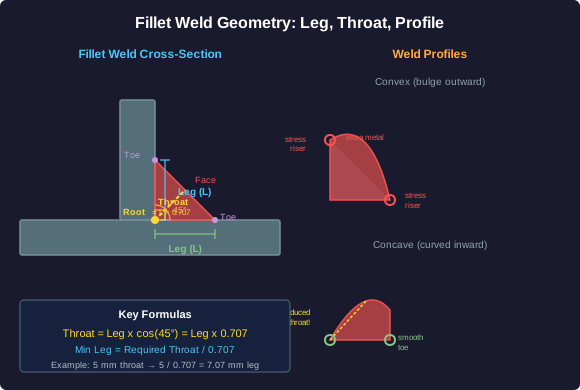
A fillet weld joins two surfaces at an angle: most commonly a T-joint or a lap joint at 90°. The fillet weld cross-section is approximately a right triangle.
Key dimensions:
- Leg size: The length of each side of the triangle that touches the base metals. For a standard equal-leg fillet, both legs are the same length.
- Throat thickness: The perpendicular distance from the root (inner corner) to the face (hypotenuse) of the weld. For an equal-leg fillet weld, throat = leg × cos(45°) = leg × 0.707.
The throat is what matters for strength: it is the thinnest cross-section through the weld, and that is where failure occurs under load.
Example: A 3/8-inch fillet weld has a theoretical throat of 3/8 × 0.707 = 0.265 inches.
Convex vs. Concave Profiles
A convex fillet weld bulges outward beyond the flat hypotenuse. It has more weld metal (more material) but creates stress concentrations at the toes (where the weld meets the base metal) due to the abrupt geometric transition.
A concave fillet weld curves inward. It has less weld metal (lighter, cheaper) and creates a smoother geometric transition at the toes: less stress concentration. But the throat is thinner than the theoretical calculation, so the weld may be weaker.
The ideal profile is flat to slightly convex: enough throat for strength, smooth enough toes for fatigue resistance.
Throat Thickness and Weld Strength
A structural engineer specifies a fillet weld with a minimum throat thickness of 5 mm on a T-joint.
Thermal Shrinkage and Geometric Distortion
Why Welding Causes Distortion
Welding deposits molten metal at temperatures above 1,500°C. As the weld cools, it shrinks: and that shrinkage pulls on the surrounding base metal, causing the workpiece to warp.
The distortion patterns are geometric & predictable:
- Longitudinal shrinkage: The weld bead shortens along its length as it cools. A 10-foot weld might shrink 1-3 mm in length.
- Transverse shrinkage: The weld pulls the two plates together across the joint. A V-groove butt weld might pull the plates 2-5 mm closer than the original fit-up.
- Angular distortion: The top of the weld (the wide part of the V-groove) has more weld metal than the root. More metal means more shrinkage on the top side. The result: the plates rotate upward toward the weld, creating a V-shaped deformation. The angle of distortion depends on the groove geometry & the number of passes.
Prevention Strategies
Every prevention strategy is geometric:
- Balanced welding sequence: Alternate weld passes between both sides of a double-V joint to equalize shrinkage forces.
- Pre-bending (pre-setting): Before welding, bend the plates in the opposite direction of the expected angular distortion. After welding shrinkage, the plates pull flat.
- Back-stepping: Instead of welding in one continuous pass from left to right, weld short segments in the reverse direction. This distributes heat more evenly & reduces cumulative longitudinal shrinkage.
- Welding sequence planning: On complex assemblies, weld from the center outward (not from one end to the other) to allow shrinkage to distribute symmetrically.

Predicting and Preventing Distortion
A fabricator is making a T-joint by fillet welding a vertical plate to a horizontal base plate. The fillet weld runs along both sides of the vertical plate: a double-sided fillet weld.
If they weld one side completely first & then the other side, the base plate will bow upward on the first-welded side due to angular distortion.
Geometric Precision Before the Arc Strikes
Fit-Up: The Geometry Before Welding
The quality of a weld is largely determined before the welder strikes an arc. Fit-up is the geometric alignment of the joint before welding, & it has tight tolerances.
Critical fit-up dimensions:
- Root opening: The gap between the two pieces at the root of the joint. Specified ±1 mm for most code work. Too narrow: the arc cannot penetrate through. Too wide: the weld metal falls through.
- Misalignment (hi-lo): When the surfaces of the two plates are not flush: one is offset vertically from the other. Maximum allowable: typically 1.5 mm or 10% of plate thickness, whichever is less.
- Angular misalignment: When the two plates are not in the same plane: they meet at an angle other than intended. Maximum: typically 5° for most code work.
Every Defect Has a Geometric Signature
- Lack of penetration: Root opening too tight: the arc could not reach the back side. The geometric result: unfused metal at the root, a hidden crack-like defect.
- Excessive reinforcement: Too much weld metal built up above the plate surface. The geometric result: a stress riser at the toes of the weld cap.
- Undercut: A groove melted into the base metal next to the weld toe, not filled by weld metal. The geometric result: a notch that concentrates stress: like a scratch on glass, it becomes the starting point for cracks.
- Porosity: Gas bubbles trapped in the weld metal. The geometric result: spherical voids that reduce the effective throat thickness.
Diagnosing Geometric Defects
A weld inspector examines a completed V-groove butt weld & finds the following:
1. The weld reinforcement cap is 5 mm above the plate surface (maximum allowed is 3 mm).
2. There is a 1 mm deep groove along the left toe of the weld.
3. X-ray reveals a line of unfused metal at the root of the joint.
Welding Geometry: Summary
What You Have Learned
Welding is applied geometry with structural consequences:
- Bevel geometry: V-groove, J-groove, U-groove profiles. Bevel angle, root opening, root face. Weld volume scales as the square of plate thickness: doubling thickness quadruples the weld metal needed.
- Fillet geometry: Throat = leg × 0.707. The throat: not the leg: determines weld strength because it is the minimum cross-section through the weld. Convex profiles add metal but create stress at the toes.
- Distortion geometry: Longitudinal shrinkage, transverse shrinkage, angular distortion. Every prevention method (pre-bending, alternating sequence, back-stepping) is a geometric countermeasure to unbalanced thermal contraction.
- Fit-up tolerances: Root opening ±1 mm, hi-lo ≤ 1.5 mm, angular misalignment ≤ 5°. Every weld defect has a geometric signature: notches, voids, and unfused planes concentrate stress.
The geometry is precise because the consequences of getting it wrong are structural failure. A 1 mm undercut or a 2 mm misalignment can be the difference between a joint that lasts decades & one that cracks under its first load cycle.