Welcome
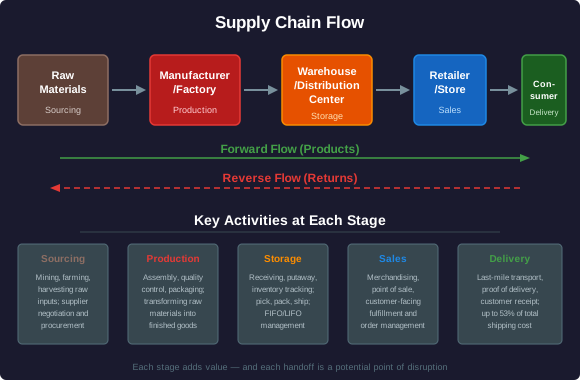
Every product you own traveled a supply chain to reach you. The coffee in your cup moved through farms, processing plants, shipping containers, distribution centers, & delivery trucks before it hit the shelf.
Logistics is the science & practice of moving goods from origin to destination: efficiently, reliably, & at the lowest possible cost. Supply chain management is the broader discipline of coordinating every link in that chain: raw materials, manufacturing, warehousing, transportation, & final delivery.
This is not a niche field. It is the backbone of the global economy. Every company that makes or sells physical goods depends on logistics. When supply chains work, nobody notices. When they break, the world notices fast.
In this lesson, we will cover how warehouses operate, how goods move by truck, rail, ship, & air, how companies forecast demand & manage inventory, how technology is transforming the field, & where the career opportunities are.
Why Supply Chains Matter
The Invisible Network
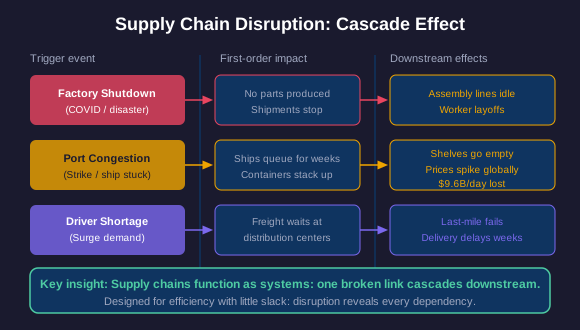
In 2020 & 2021, the COVID-19 pandemic exposed just how fragile global supply chains can be. Factories shut down in Asia. Container ships backed up at ports for weeks. Trucking capacity could not keep pace with surging e-commerce demand. Store shelves went empty: not because goods did not exist, but because they could not move.
Semiconductor shortages shut down auto assembly lines. Lumber prices tripled. A single container ship, the Ever Given, blocked the Suez Canal for six days in March 2021 & held up an estimated $9.6 billion in trade per day.
These were not random failures. They were cascading disruptions in a system designed for efficiency with very little slack. The lesson the world learned: supply chains are systems, & systems have dependencies. One broken link can paralyze everything downstream.
Warm-Up
Before we dig into the mechanics, let's see what you already know or have noticed.
Inventory Management and Warehouse Operations
Where Goods Wait
A warehouse is not just a building full of stuff. It is a carefully engineered system for receiving, storing, organizing, & shipping inventory as efficiently as possible.
Inventory management is the practice of tracking what you have, where it is, & how much you need. The goal is balance: enough stock to fill orders without so much that you waste money on storage & risk items going obsolete.
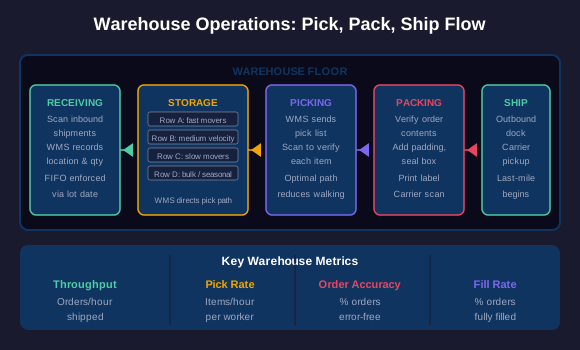
FIFO (First In, First Out): The oldest inventory gets shipped first. Critical for perishable goods like food, medicine, & chemicals. The first pallet received is the first pallet picked.
LIFO (Last In, First Out): The newest inventory gets used first. Less common in physical warehousing but used in accounting & in situations where stacking makes the newest items most accessible.
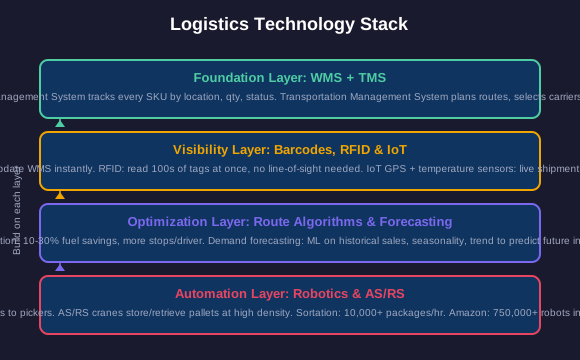
Warehouse Management System (WMS): Software that tracks every item in the warehouse by location, quantity, & status. A WMS directs workers to the right bin, optimizes pick paths to minimize walking, manages receiving & putaway, & generates shipping labels. Without a WMS, a large warehouse is chaos.
Pick, Pack, Ship: The core fulfillment workflow. A picker retrieves items from storage locations (picking). A packer verifies the order, adds protective packaging, & seals the box (packing). The package is labeled & handed off to a carrier (shipping). In high-volume operations, each step is a separate station with dedicated workers.
Warehouse Decisions
A regional grocery distribution center receives shipments of dairy products, canned goods, & seasonal holiday decorations. The dairy products expire within two weeks. The canned goods have a two-year shelf life. The holiday decorations sell only during a six-week window each year.
Modes of Transport
Moving Goods Across Distance
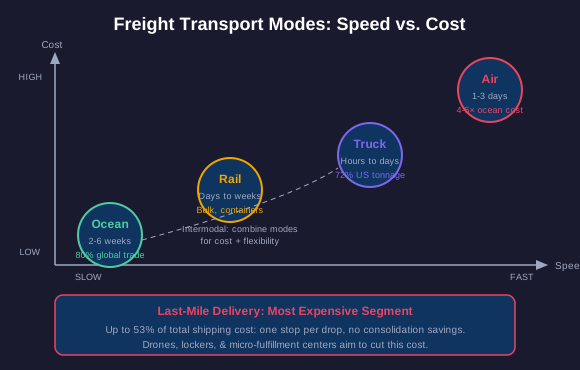
Every shipment involves a fundamental trade-off: speed versus cost. The four primary modes of freight transportation each occupy a different position on that spectrum.
Truck (over-the-road): The most flexible mode. Trucks can pick up & deliver door-to-door. About 72% of US freight tonnage moves by truck. Full truckload (FTL) shipments fill an entire trailer. Less-than-truckload (LTL) shipments share trailer space with other shippers. Trucking is fast for short to medium distances but expensive per ton-mile compared to rail & ship.
Rail: Moves massive volumes at low cost per ton-mile. A single freight train can carry the equivalent of 300 trucks. Rail is ideal for bulk commodities (coal, grain, chemicals) & intermodal containers over long distances. The trade-off is speed & flexibility, trains run on fixed schedules on fixed routes.
Ocean (maritime): The cheapest way to move goods internationally. A single container ship carries 10,000 to 24,000 TEUs (twenty-foot equivalent units, standard shipping containers). Ocean freight is slow, 2 to 6 weeks depending on the route, but the cost per unit is a fraction of air freight. Over 80% of global trade by volume moves by sea.
Air: The fastest & most expensive mode. Used for high-value, time-sensitive, or perishable goods, electronics, pharmaceuticals, fresh seafood. Air freight costs 4 to 5 times more than ocean per kilogram but delivers in days instead of weeks.
Intermodal transport combines multiple modes in a single shipment. A container might travel by ship from Shanghai to Long Beach, by rail from Long Beach to Chicago, & by truck from Chicago to a warehouse in Indianapolis. Each mode handles the leg it does best.
Last-mile delivery is the final leg from a local distribution center to the customer's door. It is the most expensive per-package segment of the entire supply chain, accounting for up to 53% of total shipping cost, because each stop serves only one recipient.
Transportation Management Systems (TMS): Software that plans shipments, selects carriers, optimizes routes, & tracks freight in transit. A TMS helps shippers compare rates, consolidate shipments, & find the best balance of cost & speed.
Choosing the Right Mode
A company in Ohio needs to ship three different orders this week. Order A is 20 tons of steel coils going to a factory in Texas, delivery needed within five days. Order B is 500 units of a new smartphone going from a factory in Shenzhen, China to a launch event in New York in three days. Order C is 2,000 shipping containers of furniture from Vietnam to warehouses across the US, delivery needed within eight weeks.
Demand Planning and Inventory Strategy
Predicting What Customers Will Buy
The central problem in supply chain management is this: you have to decide how much inventory to produce, order, & stock before you know exactly how much customers will buy. Get it wrong in either direction & you lose money.
Demand planning uses historical sales data, market trends, seasonality, & sometimes machine learning models to forecast future demand. A good forecast is never perfect: the goal is to be close enough that you can respond to the gap.
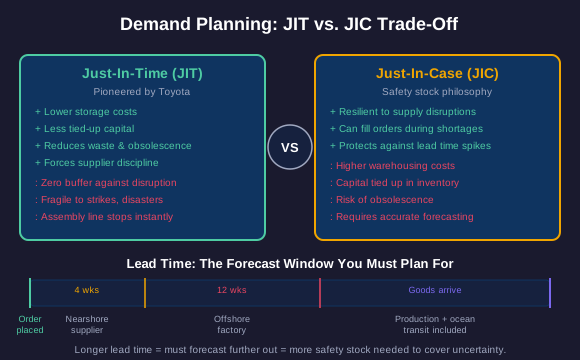
Lead time is the total time from placing an order with a supplier to having the goods available for sale. If your lead time from a factory in China is 12 weeks (production plus ocean shipping), you have to forecast demand 12 weeks out. Shorter lead times give you more flexibility.
Safety stock is extra inventory held as a buffer against demand spikes or supply delays. If your forecast says you will sell 1,000 units next month but actual demand could be 1,200, safety stock covers the gap. Too little safety stock means stockouts (lost sales). Too much means higher carrying costs (warehousing, insurance, tied-up capital).
Just-in-Time (JIT): A strategy pioneered by Toyota that minimizes inventory by having parts arrive exactly when they are needed on the production line. JIT reduces waste & storage costs but requires extremely reliable suppliers & transportation. When supply chains break, as they did during COVID: JIT operations are the first to shut down because they have no buffer.
Just-in-Case (JIC): The opposite philosophy: hold extra inventory to protect against uncertainty. JIC costs more in storage & capital but provides resilience against disruptions. After COVID, many companies shifted from pure JIT toward a hybrid approach with more safety stock for critical components.
Forecasting Trade-Off
A bicycle manufacturer uses just-in-time inventory for all components. Their tire supplier is a single factory in Southeast Asia with a 10-week lead time. In a normal year, this works well: tires arrive just as they are needed on the assembly line, & the manufacturer holds almost zero tire inventory.
Then a major port strike shuts down shipping from Southeast Asia for three weeks. The manufacturer has no tires in stock & no alternative supplier. Their assembly line stops. They cannot fill orders. Retailers cancel contracts & switch to competitors.
Technology Transforming Logistics
The Digital Supply Chain
Modern logistics runs on technology. Every package you track, every same-day delivery, every automated warehouse depends on layers of software & hardware working together.
Barcodes & RFID: Barcodes (like UPC codes) are the foundation of inventory tracking. Scanning a barcode updates the WMS instantly, this item was received, moved, picked, or shipped. RFID (Radio Frequency Identification) tags go further: they can be read without line-of-sight, at a distance, & hundreds at a time. An RFID reader can inventory an entire pallet in seconds without opening the box.
IoT (Internet of Things) tracking: GPS trackers on trucks, containers, & even individual pallets provide real-time visibility into where shipments are. Temperature sensors monitor cold chain integrity for food & pharmaceuticals. Vibration sensors detect rough handling. IoT turns a black box ('your shipment is in transit') into a live feed of location & condition data.
Route optimization: Algorithms that calculate the most efficient delivery routes considering distance, traffic, delivery windows, vehicle capacity, & driver hours-of-service regulations. A route optimizer can reduce fuel costs by 10-30% & increase the number of stops a driver can make per day. This is the technology behind UPS, FedEx, & Amazon route planning.
Automation & robotics: Automated storage & retrieval systems (AS/RS) use cranes & shuttles to store & fetch pallets in high-density racking without human operators. Autonomous mobile robots (AMRs) carry bins & shelving units to human pickers, eliminating walking. Automated sortation systems route packages to the correct outbound lane at speeds of 10,000+ packages per hour. Amazon's fulfillment centers use over 750,000 robots alongside human workers.
Technology Trade-Offs
A mid-sized e-commerce company ships 5,000 orders per day from a single warehouse. They currently use manual picking: workers walk the warehouse with paper pick lists, grab items from shelves, & bring them to a packing station. Average pick rate is 60 items per hour per worker. Error rate (wrong item picked) is about 2%.
The company is considering two investments: (1) implementing a WMS with barcode scanning to replace paper pick lists, or (2) deploying autonomous mobile robots (AMRs) that bring shelving units to stationary pickers.
Logistics Careers
Where Logistics Takes You
Logistics & supply chain management is one of the largest employment sectors in the world. The roles range from hands-on warehouse work to strategic corporate planning, & the field is growing as e-commerce & global trade expand.
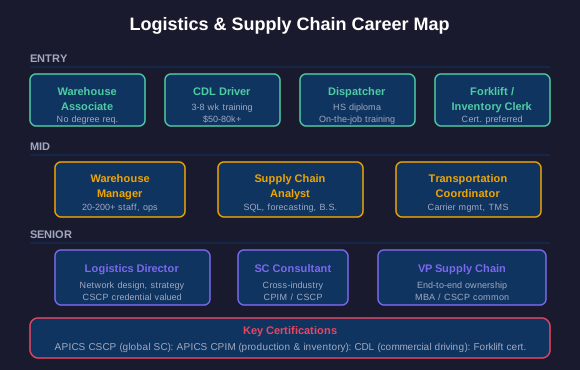
Dispatcher: Coordinates drivers, routes, & shipments in real time. Dispatchers work in trucking companies, delivery services, & emergency logistics. They manage schedules, handle delays, & keep freight moving. Strong communication & problem-solving skills are essential. Entry-level, often requiring only a high school diploma & on-the-job training.
Warehouse manager: Oversees all warehouse operations: receiving, storage, picking, packing, shipping, staffing, & safety. Manages teams of 20 to 200+ workers. Responsible for throughput targets, inventory accuracy, & cost control. Typically requires a few years of warehouse experience or a degree in logistics or business.
Supply chain analyst: Uses data to optimize inventory levels, forecast demand, evaluate supplier performance, & identify cost savings. Heavy use of spreadsheets, SQL, & analytics tools. A bachelor's degree in supply chain management, business, or a quantitative field is typical. Analysts are in high demand as companies invest in data-driven decision making.
CDL (Commercial Driver's License) driver: Operates tractor-trailers, tankers, & other heavy vehicles. CDL training takes 3 to 8 weeks. Trucking is the backbone of domestic freight, there is a persistent driver shortage in the US, with companies offering signing bonuses & competitive pay. Long-haul drivers earn $50,000-$80,000+. Specialized drivers (hazmat, oversized loads) earn more.
Certifications: The APICS Certified Supply Chain Professional (CSCP) credential is the most widely recognized supply chain certification globally. It covers supply chain design, planning, execution, & improvement. The APICS Certified in Production & Inventory Management (CPIM) focuses on internal operations. Both credentials significantly increase earning potential & are valued by major employers.
Your Path in Logistics
Connect Logistics to Your Future
You now understand how warehouses operate, how goods move across the globe, how companies plan for demand, & how technology is reshaping the field.