Welcome to Nuclear Physics 101
What This Course Is About
You already know the atom: protons and neutrons packed into a nucleus, electrons in orbitals outside. That is where chemistry lives: in the electron cloud.
Nuclear physics begins at the surface of the nucleus & goes deeper.
Inside the nucleus, forces a million times stronger than electromagnetism hold matter together against the furious repulsion of positively charged protons. When those forces release: in radioactive decay, in fission, in fusion: the energy densities dwarf anything chemistry can produce.
One kilogram of uranium fuel releases as much energy as 3,000 tonnes of coal. Not because of exotic matter: because E=mc² says a tiny amount of mass converts to an enormous amount of energy.
This module covers nuclear structure, the strong & weak forces, radioactive decay, half-life kinetics, binding energy, fission cross sections, fusion plasmas, & units of radiation measurement. By the end, you will be able to perform real nuclear engineering calculations.
Scale and Units
Getting Your Bearings
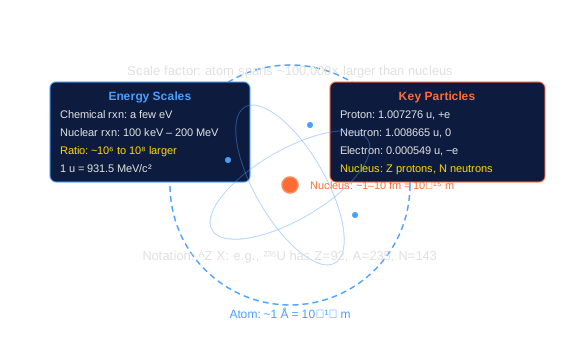
Size scale: A nucleus is roughly 1–10 femtometers (fm) in diameter, where 1 fm = 10⁻¹⁵ m. An atom is about 100,000 times larger (angstrom scale, ~10⁻¹⁰ m).
Energy scale: Chemical reactions involve energies of a few eV (electron volts). Nuclear reactions involve energies of hundreds of keV to hundreds of MeV: a factor of 10⁶ to 10⁸ larger.
Mass-energy: 1 atomic mass unit (u) = 931.5 MeV/c². That conversion factor is the bridge between nuclear mass measurements & energy.
Key particles:
- Proton: mass = 1.007276 u, charge = +e
- Neutron: mass = 1.008665 u, charge = 0
- Electron: mass = 0.000549 u, charge = −e
- 1 u = 1.66054 × 10⁻²⁷ kg
Notation: a nucleus with Z protons and N neutrons has mass number A = Z + N. Written ᴬ_Z X: e.g., ²³⁵U has Z=92, A=235, N=143.
Where Does the Energy Come From?
Before we build up the physics systematically, let's surface your intuition.
Protons, Neutrons, and the Nuclear Landscape
The Nucleon & the Chart of Nuclides
Protons and neutrons are collectively called nucleons. They are not fundamental: each is made of three quarks held together by gluons. But at nuclear energy scales, we treat them as point-like objects.
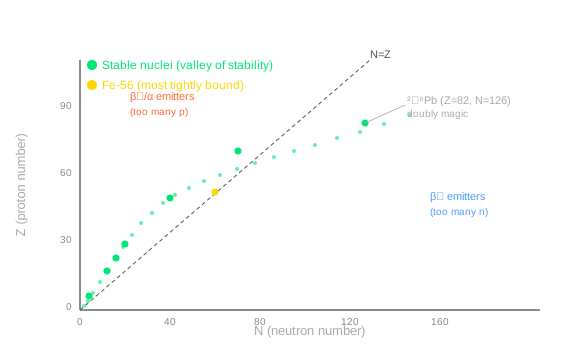
Every possible nucleus is identified by its (Z, N) pair. The chart of nuclides plots all known nuclei: Z on the vertical axis, N on the horizontal axis. Stable nuclei form a narrow band called the valley of stability.
Key feature: For light nuclei (Z < 20), the stable ratio is approximately N/Z ≈ 1. For heavy nuclei, stable nuclei have significantly more neutrons than protons. Lead-208 (Z=82, N=126) has N/Z = 1.54. This excess neutron count partially counteracts the Coulomb repulsion among protons.
Nuclei far from the valley of stability are unstable: they are radioactive. They decay toward stability by emitting particles or radiation.
Nuclear radius: empirically, R ≈ R₀ × A^(1/3), where R₀ ≈ 1.2 fm. This implies nuclear density is roughly constant at about 2.3 × 10¹⁷ kg/m³: a thimbleful of nuclear matter would weigh about 500 million tonnes.
Nuclear Shell Model
Magic Numbers & Nuclear Shells
Electrons in atoms occupy quantized shells: the Pauli exclusion principle forces them into distinct energy levels. Nucleons obey the same principle. The nuclear shell model (developed by Maria Goeppert Mayer and J. Hans D. Jensen, Nobel Prize 1963) describes nucleons filling discrete energy levels in a nuclear potential.
The result: nuclei with certain 'magic numbers' of protons or neutrons are exceptionally stable:
Magic numbers: 2, 8, 20, 28, 50, 82, 126
Evidence for magic numbers:
- Helium-4 (Z=2, N=2): doubly magic, extraordinarily stable: it is the alpha particle
- Oxygen-16 (Z=8, N=8): doubly magic
- Lead-208 (Z=82, N=126): doubly magic, heaviest stable nucleus
- Tin (Z=50) has 10 stable isotopes: more than any other element
- After magic-number shells are closed, binding energy per nucleon drops sharply
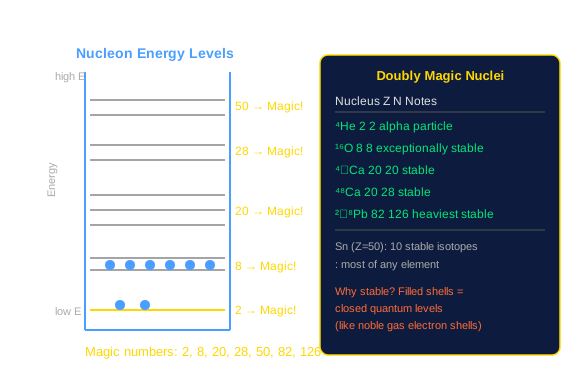
The shell model also predicts nuclear spin & parity. Each occupied nucleon orbital has a specific angular momentum quantum number j. The total nuclear spin I is the vector sum of all nucleon spins & orbital angular momenta. Parity π = (−1)^ℓ for each orbital. Even-even nuclei (even Z, even N) always have ground-state spin I=0 & positive parity.
Why Are Magic Numbers Special?
Lead-208 has Z=82 (magic) and N=126 (magic). It is the heaviest completely stable nucleus: nothing heavier is stable against all decay modes over geological timescales.
Helium-4 is doubly magic (Z=2, N=2). In alpha decay, the nucleus ejects a helium-4 nucleus. This is not a coincidence.
Force That Holds Nuclei Together
Why the Nucleus Does Not Explode
Consider a uranium-238 nucleus: 92 protons packed into a sphere of radius ~7.4 fm. The electrostatic repulsion between them is enormous: on the order of hundreds of MeV. Yet the nucleus is stable.
Something must overcome that repulsion. That something is the strong nuclear force: the strongest of the four fundamental forces.
Properties of the strong force:
- Range: extremely short: effective only within ~1–2 fm. Beyond 2 fm, it drops to essentially zero (Yukawa potential: V(r) ∝ e^(−r/r₀)/r where r₀ ≈ 1.5 fm).
- Magnitude: at nuclear distances, ~100 times stronger than the electromagnetic force
- Charge independence: acts equally between p-p, p-n, & n-n pairs (isospin symmetry)
- Saturation: each nucleon only interacts strongly with its immediate neighbors: not with all other nucleons. This is why nuclear density is roughly constant regardless of A.
- Short range wins close, Coulomb wins far: inside the nucleus, strong force dominates. As you add protons, Coulomb repulsion (which is long-range) grows faster than the strong force (which saturates). Eventually: around Z=83+: the nucleus becomes unstable.

Strong Force at the Quark Level
From Quarks to Nucleons to Nuclei
At the fundamental level, the strong force is described by quantum chromodynamics (QCD). Quarks carry color charge (red, green, blue) & exchange gluons to interact.
Each proton = two up quarks + one down quark (uud). Each neutron = one up + two down quarks (udd).
The force between quarks is carried by massless gluons, but unlike photons (which carry electromagnetism), gluons also carry color charge themselves: so they interact with each other. This makes QCD highly nonlinear and extremely difficult to solve analytically.
Confinement: Free quarks are never observed. The energy required to separate two quarks grows linearly with distance (like a rubber band), so before separation occurs, the energy creates a new quark-antiquark pair. Quarks are always confined inside hadrons (baryons like protons, or mesons).
The nuclear force as residual: What we call the strong nuclear force between nucleons is actually a residual color force: the leftover interaction between color-neutral objects, analogous to van der Waals forces between electrically neutral molecules. This residual force is mediated primarily by pion exchange (pions are the lightest mesons, mass ~135 MeV/c²). The pion's mass sets the range: ℏc/m_π c² ≈ 1.4 fm.
Saturation and the Liquid Drop Analogy
The strong force saturates: each nucleon only interacts with its neighbors, not with all nucleons in the nucleus. This is very different from gravity or electromagnetism, where every particle interacts with every other particle.
Because of saturation, nuclear binding energy grows roughly proportionally to A (volume term) rather than to A(A-1)/2 (which it would be if every pair interacted).
Types of Radioactive Decay
Why Nuclei Decay
An unstable nucleus decays to reach a lower energy state: closer to the valley of stability on the chart of nuclides. The energy released (Q-value) equals the mass difference between parent and products, converted via E=mc².
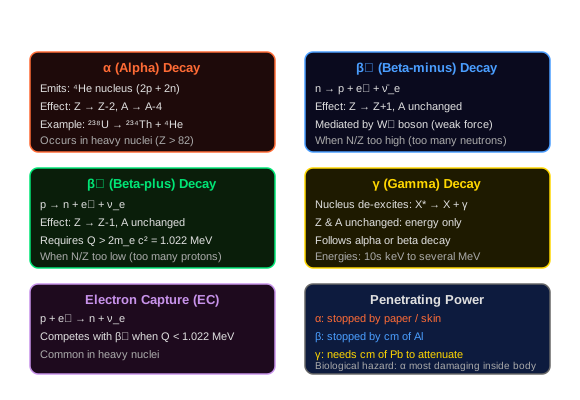
Alpha decay (α): The nucleus emits a helium-4 nucleus (²⁴He: 2 protons, 2 neutrons). Result: Z decreases by 2, A decreases by 4. Occurs in heavy nuclei (Z > 82 typically). Example: ²³⁸U → ²³⁴Th + ⁴He, Q = 4.27 MeV.
Beta-minus decay (β⁻): A neutron converts to a proton: n → p + e⁻ + ν̄_e (antineutrino). Result: Z increases by 1, A unchanged. Mediated by the weak force. Occurs when N/Z is too high (too many neutrons).
Beta-plus decay (β⁺): A proton converts to a neutron: p → n + e⁺ + ν_e (positron + neutrino). Result: Z decreases by 1, A unchanged. Occurs when N/Z is too low (too many protons). Requires Q > 2m_e c² = 1.022 MeV.
Electron capture (EC): A proton captures an inner-shell electron: p + e⁻ → n + ν_e. Same net result as β⁺ but no positron emitted. Competes with β⁺ when Q < 1.022 MeV or for heavy nuclei where inner-shell electron density at nucleus is high.
Gamma decay (γ): After alpha or beta decay, the daughter nucleus is often in an excited state. It de-excites by emitting a gamma photon (high-energy electromagnetic radiation). Z and A unchanged: only energy changes. This is analogous to atomic line emission but at MeV energies.
Internal conversion: An alternative to gamma emission. The nuclear excitation energy is transferred directly to an inner-shell electron, which is ejected. Competes with gamma emission, especially for low-energy transitions & heavy nuclei.
Quantum Tunneling and Alpha Decay
The Gamow Factor: How Alpha Particles Escape
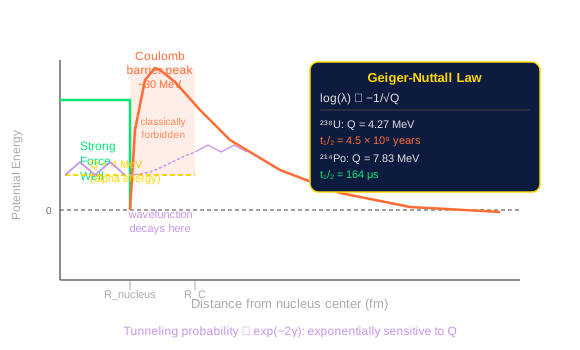
Alpha decay presents a quantum mechanical puzzle. Inside the nucleus, the alpha particle sits in an attractive potential well: the strong force holds it in. Just outside the nucleus, Coulomb repulsion takes over, creating a potential barrier.
Classically, the alpha particle cannot escape: it lacks the energy to climb over the Coulomb barrier (which peaks at ~30 MeV for uranium, while the alpha's Q-value is only ~4 MeV). Yet alpha decay happens.
Quantum tunneling: Because the alpha particle obeys wave mechanics, its wavefunction does not abruptly stop at the barrier. It exponentially decays through the classically forbidden region. There is a nonzero probability of finding the particle on the other side.
The tunneling probability is characterized by the Gamow factor G:
G = exp(−2γ) where γ = (Z_d × Z_α × e²)/(ℏv_α) × [arccos(√(R/R_C)) − √(R/R_C × (1 − R/R_C))]
The key dependence: higher-energy alphas (larger Q-value) have much larger tunneling probabilities → much shorter half-lives. This is the Geiger-Nuttall law: log(λ) ∝ −1/√Q, where λ is the decay constant.
Dramatic consequence: Changing Q by a factor of 2 changes the half-life by many orders of magnitude. Uranium-238 (Q=4.27 MeV) has t₁/₂ = 4.5 billion years. Polonium-214 (Q=7.83 MeV) has t₁/₂ = 164 microseconds. Same mechanism, vastly different time scales: entirely explained by the Gamow factor.
Geiger-Nuttall Law
Uranium-238 alpha decay Q-value: 4.27 MeV, half-life: 4.47 × 10⁹ years.
Polonium-212 alpha decay Q-value: 8.95 MeV, half-life: 0.3 × 10⁻⁶ seconds.
Thorium-228 alpha decay Q-value: 5.52 MeV, half-life: 1.9 years.
Beta Decay and the Weak Force
The Weak Force in the Nucleus
Beta decay is fundamentally different from alpha decay. It does not involve pre-formed clusters or tunneling in the same sense. Instead, a quark flavor changes via the weak force.
In β⁻ decay: a down quark in a neutron converts to an up quark, turning the neutron into a proton. The mediator is the W⁻ boson (mass ~80 GeV/c²). Because the W boson is so massive, the weak force has an extremely short range (~10⁻¹⁸ m) & is intrinsically slow.
Neutrinos: Beta decay always produces a neutrino (or antineutrino). This was predicted by Wolfgang Pauli in 1930 to explain the continuous beta spectrum: if only an electron were emitted, conservation of energy and momentum would require a fixed electron energy for each decay. The observed continuous spectrum proved a third particle (the neutrino) was carrying away variable fractions of the Q-value.
Fermi's theory of beta decay: Enrico Fermi's 1934 theory treats beta decay as a point interaction (the weak force range being negligible at nuclear scales). The decay rate depends on the Q-value to the fifth power: λ ∝ Q⁵. This means a small increase in Q drastically accelerates beta decay: though not as dramatically as in alpha decay.
Gamma decay details: After alpha or beta decay, daughter nuclei are typically in excited states (shown as ᴬ_Z X*). The nucleus de-excites by emitting a gamma photon with energy = E_excited − E_ground. Transition rates depend on the multipolarity of the transition (E1, M1, E2, etc.): electric dipole transitions are fastest (~10⁻¹⁴ s), while high-multipolarity transitions can be slow (forming isomers that live minutes to years). Technetium-99m (used in medical imaging) is a nuclear isomer with a 6-hour half-life, decaying via isomeric transition (gamma emission) to Tc-99.
Uranium-238 Decay Chain
U-238 → Pb-206: 14 Steps Over 4.5 Billion Years
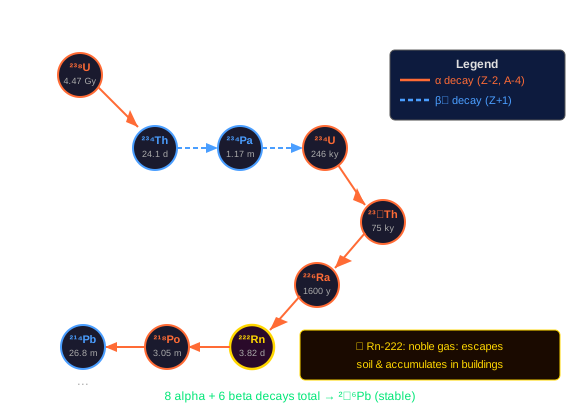
Heavy nuclei decay through a chain of sequential decays until they reach a stable nucleus. The U-238 chain produces 8 alpha decays & 6 beta decays before reaching stable Pb-206:
¹. ²³⁸U → ²³⁴Th + α (t₁/₂ = 4.47 Gy)
². ²³⁴Th → ²³⁴Pa + β⁻ (t₁/₂ = 24.1 days)
³. ²³⁴Pa → ²³⁴U + β⁻ (t₁/₂ = 1.17 min)
⁴. ²³⁴U → ²³⁰Th + α (t₁/₂ = 245,500 years)
⁵. ²³⁰Th → ²²⁶Ra + α (t₁/₂ = 75,400 years)
⁶. ²²⁶Ra → ²²²Rn + α (t₁/₂ = 1,600 years)
⁷. ²²²Rn → ²¹⁸Po + α (t₁/₂ = 3.82 days)
⁸. ²¹⁸Po → ²¹⁴Pb + α (t₁/₂ = 3.05 min)
⁹. ²¹⁴Pb → ²¹⁴Bi + β⁻ (t₁/₂ = 26.8 min)
¹⁰. ²¹⁴Bi → ²¹⁴Po + β⁻ (t₁/₂ = 19.7 min)
¹¹. ²¹⁴Po → ²¹⁰Pb + α (t₁/₂ = 164 μs)
¹². ²¹⁰Pb → ²¹⁰Bi + β⁻ (t₁/₂ = 22.3 years)
¹³. ²¹⁰Bi → ²¹⁰Po + β⁻ (t₁/₂ = 5.01 days)
¹⁴. ²¹⁰Po → ²⁰⁶Pb + α (t₁/₂ = 138 days)
Final product: ²⁰⁶Pb (stable)
Radon-222: Step 6–7 involves radon, a noble gas. Because it is a gas, it can escape from soil and accumulate in buildings. Radon is the second leading cause of lung cancer in the US after smoking: a direct consequence of uranium's natural decay chain.
Secular equilibrium: In an old uranium ore deposit, each intermediate reaches secular equilibrium with uranium-238. At equilibrium, the activity of each decay product equals the activity of U-238. This means even though intermediate half-lives range from microseconds to thousands of years, their activities are all equal at equilibrium.
Mathematics of Radioactive Decay
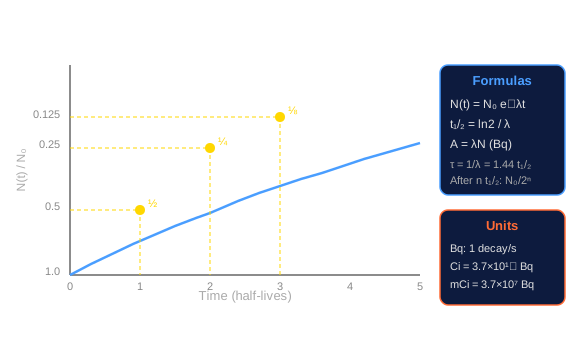
N(t) = N₀ × e^(−λt)
Radioactive decay is a purely statistical process. Each nucleus decays independently, with a fixed probability per unit time λ (the decay constant). This leads to first-order kinetics:
N(t) = N₀ × e^(−λt)
where N₀ is the initial number of nuclei & N(t) is the number remaining at time t.
Half-life: The time for half the nuclei to decay: t₁/₂ = ln(2)/λ ≈ 0.693/λ
Activity: A = λN: the number of decays per second. Unit: becquerel (Bq) = 1 decay/s. Older unit: curie (Ci) = 3.7 × 10¹⁰ Bq (defined as the activity of 1 gram of radium-226).
Specific activity: Activity per unit mass. For a pure isotope: SA = λ × N_A / M where N_A is Avogadro's number & M is molar mass. Short half-life → high specific activity. Po-210 has t₁/₂ = 138 days → SA ≈ 1.7 × 10¹⁴ Bq/g = 4,500 Ci/g. Uranium-238 has t₁/₂ = 4.47 Gy → SA ≈ 12,400 Bq/g.
Mean lifetime: τ = 1/λ = t₁/₂/ln(2) ≈ 1.44 × t₁/₂. After one mean lifetime, the number has decreased to 1/e ≈ 36.8% of its initial value.
After n half-lives: N(n) = N₀/2ⁿ
Secular Equilibrium
When Fast Daughters Reach Equilibrium with Slow Parents
Consider a parent nucleus P decaying to a daughter nucleus D (which itself decays). If the parent's half-life is much longer than the daughter's half-life (t_{P} >> t_{D}), the daughter reaches secular equilibrium with the parent.
At secular equilibrium: λ_P × N_P = λ_D × N_D, or equivalently, A_P = A_D (the activities are equal).
Physical meaning: The daughter is being produced by the parent at the same rate it is decaying. The daughter population is constant: the chain is in steady state.
Time to equilibrium: Approximately 7 × t₁/₂(daughter). Ra-226 (t₁/₂ = 1,600 years) reaches secular equilibrium with U-238 (t₁/₂ = 4.47 billion years) after ~11,200 years.
Practical consequence: In uranium mining, ore contains all daughters in secular equilibrium. Miners and mill workers are exposed not just to U-238, but to its entire equilibrium decay chain: including alpha-emitting radon, polonium, and lead isotopes, all at the same activity level as U-238.
Calculating Residual Activity
A research reactor produces Iodine-131 (t₁/₂ = 8.02 days) as a fission product. Immediately after shutdown, a sample contains 3.7 × 10¹⁰ Bq (1 Ci) of I-131.
I-131 is medically significant: it concentrates in the thyroid & is used both therapeutically (treating thyroid cancer) & is a radiation hazard from nuclear accidents (the Chernobyl & Fukushima releases involved significant I-131).
Mass Defect and E=mc²
Where Does the Binding Energy Come From?
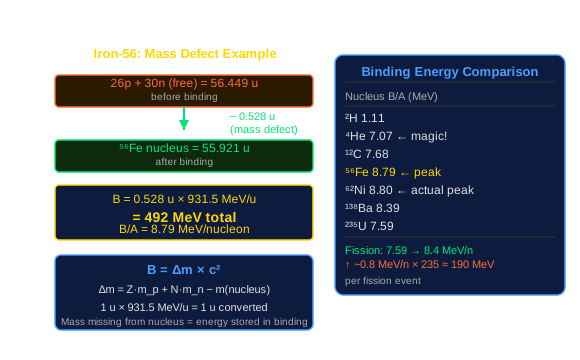
A nucleus weighs less than the sum of its free protons & neutrons. This is the mass defect (Δm), & it is the origin of nuclear binding energy.
Formula: B = Δm × c² = [Z × m_p + N × m_n − m(nucleus)] × 931.5 MeV/u
Example: Iron-56 (²⁵⁶Fe, the most tightly bound common nucleus)
- Z = 26 protons, N = 30 neutrons
- Mass of 26 free protons: 26 × 1.007276 u = 26.189 u
- Mass of 30 free neutrons: 30 × 1.008665 u = 30.260 u
- Sum of free nucleons: 56.449 u
- Measured mass of ⁵⁶Fe nucleus: 55.921 u
- Mass defect: Δm = 56.449 − 55.921 = 0.528 u
- Binding energy: B = 0.528 u × 931.5 MeV/u = 492 MeV
- Binding energy per nucleon: B/A = 492/56 = 8.79 MeV/nucleon
Example: Uranium-235
- Z = 92, N = 143, A = 235
- Sum of free nucleons: 92 × 1.007276 + 143 × 1.008665 = 236.908 u
- Measured atomic mass of ²³⁵U: 235.044 u (subtract 92 electron masses: 92 × 0.000549 u = 0.0505 u → nuclear mass ≈ 234.994 u)
- Mass defect: Δm ≈ 236.908 − 234.994 ≈ 1.914 u
- Binding energy: 1.914 × 931.5 ≈ 1,784 MeV total = 7.59 MeV/nucleon
Compare: ⁵⁶Fe is more tightly bound per nucleon than ²³⁵U. This is the physics behind why fission of uranium releases energy: the products (medium-mass nuclei like barium and krypton) are more tightly bound per nucleon than uranium.
Curve of Binding Energy
The Most Important Graph in Nuclear Physics
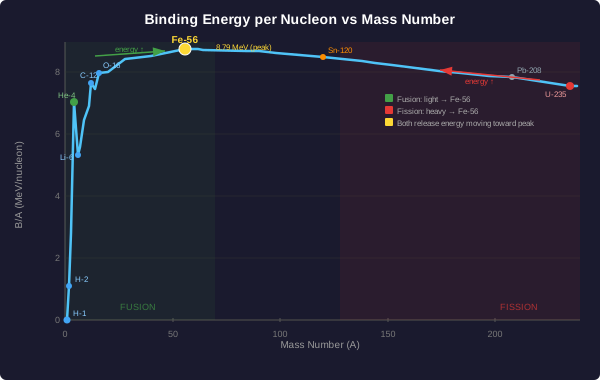
The binding energy per nucleon (B/A) plotted versus mass number A reveals the entire logic of nuclear energy:
Key features of the curve:
- Rise from A=1 to A~56: As nuclei grow from hydrogen to iron, B/A increases. Combining light nuclei into heavier ones releases energy (fusion).
- Peak near A=56-62: Iron-56 (8.79 MeV/nucleon) and nickel-62 (8.80 MeV/nucleon) sit at the peak. These are the most stable nuclei: the universe's 'ash' from stellar nucleosynthesis.
- Gradual decline from A=56 to A=238: Heavy nuclei are less tightly bound per nucleon than iron. As Coulomb repulsion accumulates with each added proton, binding energy per nucleon falls. Splitting heavy nuclei into medium-mass nuclei releases energy (fission).
- Notable bumps: Magic numbers create local peaks: helium-4 (7.07 MeV/nucleon) sits conspicuously above the trend for its mass range.
Energy released in fission of U-235:
U-235 has B/A ≈ 7.59 MeV/nucleon. Typical fission products (e.g., Ba-141 & Kr-92) have B/A ≈ 8.4 MeV/nucleon.
Energy released ≈ (8.4 − 7.59) × 235 ≈ 0.81 × 235 ≈ 190 MeV per fission
(Plus ~10 MeV from prompt neutron kinetic energy & gamma rays, total ~200 MeV per fission)
Energy released in D-T fusion:
D (²H, B/A = 1.11 MeV) + T (³H, B/A = 2.83 MeV) → ⁴He (B/A = 7.07 MeV) + n
Q = [m(D) + m(T) − m(⁴He) − m(n)] × 931.5 MeV/u = 17.6 MeV per reaction
Per kilogram of D-T fuel: ~3.4 × 10¹⁴ J = 340 TJ/kg: versus ~43 MJ/kg for gasoline (factor of ~8 million)
Why Iron Marks the Endpoint of Stellar Nucleosynthesis
Stars produce energy by fusing lighter nuclei into heavier ones: hydrogen into helium, helium into carbon, and so on. Each fusion step releases energy because the product is more tightly bound per nucleon than the reactants.
When a massive star's core reaches iron, the fusion stops.
How Fission Works
Nuclear Fission: Splitting the Heavy Nucleus
Fission occurs when a heavy nucleus (typically A > 230) absorbs a neutron & becomes so deformed that the strong force can no longer hold it together against Coulomb repulsion.
The fission process:
1. Nucleus absorbs a neutron → becomes ²³⁶U* (excited compound nucleus)
2. Nucleus oscillates: the liquid drop deforms
3. If excitation energy exceeds the fission barrier (~6 MeV for U-235 + slow neutron), the neck thins & the nucleus splits
4. Two fission fragments fly apart (Ba, Kr, Cs, I, etc.: typically A ~ 90 and A ~ 140)
5. Prompt neutrons (2-3 on average) are emitted within 10⁻¹⁴ seconds
6. Fragments undergo beta decay chains (they are neutron-rich) over hours to years
Energy distribution from one U-235 fission event (~200 MeV total):
- Kinetic energy of fission fragments: ~168 MeV
- Prompt neutron kinetic energy: ~5 MeV
- Prompt gamma rays: ~7 MeV
- Delayed betas from fragments: ~8 MeV
- Delayed gammas from fragments: ~7 MeV
- Antineutrino energy (escapes): ~12 MeV (not recoverable)
Recoverable energy in a reactor: ~188 MeV per fission
Neutron Cross Sections
Cross Sections: How Neutrons See Nuclei
A cross section (σ) measures the probability of a neutron-nucleus interaction. Despite the name, it is not a geometric area: it is an effective area that captures the quantum mechanical probability of interaction.
Unit: barn (b) = 10⁻²⁴ cm² = 10⁻²⁸ m². (Origin: during the Manhattan Project, physicists found uranium nuclei unexpectedly large in cross section & said the nucleus was 'as big as a barn.')
Key cross sections for U-235:
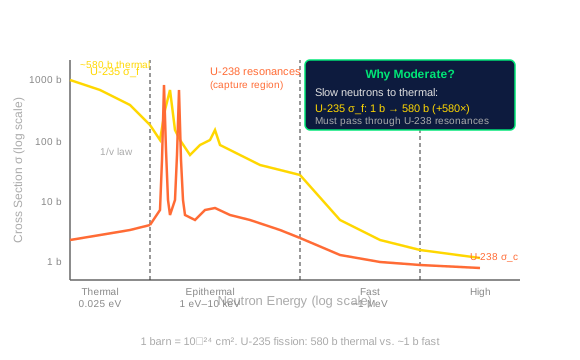
- Fission (σ_f): ~580 barns at thermal energies (0.025 eV)
- Total absorption: ~680 barns at thermal energies
- Fast neutron fission: ~1-2 barns at 1 MeV
The 1/v law: For thermal neutrons (low energy), interaction cross sections scale as 1/v (inverse velocity), or equivalently, 1/√E. Slower neutrons spend more time near a nucleus & have higher interaction probability.
Resonance region: Between thermal (~0.025 eV) and fast (~1 MeV) energies, many nuclei show dramatic peaks in cross section called resonances: corresponding to specific excited states of the compound nucleus. U-238 has enormous resonance capture peaks in the 1-1000 eV range, which is why thermal reactors use moderators to bring neutrons below the resonance region.
Consequence for reactor design: Thermal neutrons (slowed by a moderator: water, heavy water, graphite) have 300× higher fission probability in U-235 than fast neutrons. This is why most reactors use moderators.
Chain Reactions and Criticality
The Self-Sustaining Chain Reaction
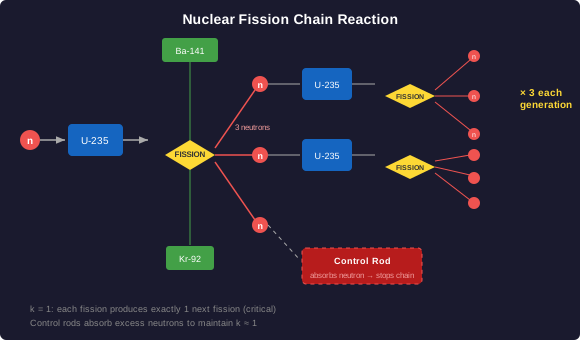
Each U-235 fission releases 2.43 prompt neutrons on average (denoted ν). For a self-sustaining chain reaction, exactly one of those neutrons must cause another fission.
Multiplication factor k: The ratio of neutrons in one generation to the previous generation.
- k < 1: subcritical: reaction dies out
- k = 1: critical: steady power
- k > 1: supercritical: reaction grows exponentially
Six-factor formula (for thermal reactors): k_eff = η × f × p × ε × P_NL(thermal) × P_NL(fast)
- η (eta): neutrons produced per neutron absorbed in fuel
- f: thermal utilization factor (fraction of thermal neutrons absorbed by fuel)
- p: resonance escape probability (fraction avoiding resonance capture during slowdown)
- ε (epsilon): fast fission factor
- P_NL: non-leakage probabilities
Delayed neutrons: Critical for reactor control. About 0.65% of neutrons from U-235 fission are delayed: emitted 0.05 to 55 seconds after fission. Without delayed neutrons, the reactor prompt period would be ~10⁻⁴ seconds: too fast for mechanical control rods. With delayed neutrons, the effective prompt period is ~0.1 seconds: controllable.
Prompt criticality: If k > 1 based on prompt neutrons alone (ignoring delayed), the reactor goes prompt critical. This is the condition in a nuclear weapon. Reactors are designed to never achieve prompt criticality.
Why Thermal Reactors Need Moderators
Natural uranium contains 99.3% U-238 & only 0.7% U-235. U-238 has a huge resonance absorption cross section for neutrons in the 1 eV to 10 keV range but does not fission with thermal neutrons. U-235 has a 580-barn fission cross section at thermal energies.
Most power reactors use 3-5% enriched uranium (3-5% U-235) with light water as both moderator & coolant.
Physics of Fusion
Overcoming the Coulomb Barrier
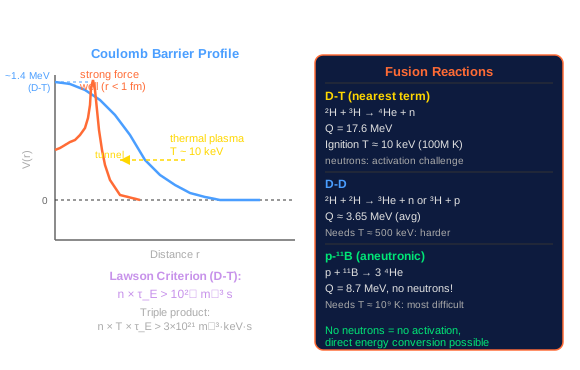
Fusion requires bringing two nuclei close enough for the strong force to take over: within ~1 fm. But both nuclei are positively charged, so they repel each other electrostatically.
The Coulomb barrier: The electrostatic potential energy at nuclear distance r for two nuclei with charges Z₁e & Z₂e:
V_C = k_e × Z₁ × Z₂ × e² / r
For D-T fusion (Z₁=1, Z₂=1, r ≈ 1 fm): V_C ≈ 1.4 MeV
Classically, you need nuclei with at least 1.4 MeV of kinetic energy (temperature ~10¹⁰ K). But quantum tunneling through the Coulomb barrier reduces this requirement: significant tunneling occurs at ~10⁻¹⁰ of the classical rate even at energies well below the barrier.
Thermal plasma: In a fusion reactor, nuclei are not monoenergetic. They follow a Maxwell-Boltzmann distribution. The reaction rate is the Maxwellian-averaged product of cross section & velocity: <σv>. This function peaks at different temperatures for different reactions.
Optimal temperatures:
- D-T (²H + ³H → ⁴He + n, Q = 17.6 MeV): peak <σv> at ~70 keV (≈ 800 million K). Practical ignition threshold: ~10 keV plasma temperature (≈ 100 million K)
- D-D (²H + ²H → ³He + n or ³H + p): peak at ~500 keV: requires much higher temperature
- D-³He (²H + ³He → ⁴He + p, Q = 18.3 MeV): peak at ~200 keV: aneutronic, very attractive but harder
- p-¹¹B (proton + boron-11 → 3 ⁴He, Q = 8.7 MeV): aneutronic, ~10^9 K required: most difficult
Why D-T first? D-T has the highest <σv> at the lowest temperature: about 100× higher than D-D at 10 keV. That is why all current fusion programs (ITER, NIF, private ventures like TAE, Commonwealth Fusion) use D-T despite the need to breed tritium and manage neutron activation.
Lawson Criterion
When Fusion Produces More Energy Than It Consumes
For a fusion plasma to be self-sustaining (ignition), the energy produced by fusion must exceed the energy lost from the plasma. This is quantified by the Lawson criterion, derived by John Lawson in 1957.
For D-T fusion, ignition requires: n × τ_E > 10²⁰ m⁻³ s (at T ≈ 20 keV)
where n is the plasma number density & τ_E is the energy confinement time (how long the plasma retains its energy).
Modern presentations use the triple product: n × T × τ_E > ~3 × 10²¹ m⁻³ · keV · s
Tokamak progress (triple product):
- JET (1997): n×T×τ_E ≈ 10²¹ m⁻³·keV·s, Q ≈ 0.65 (fusion energy / input energy)
- ITER (projected): Q ≈ 10 (500 MW fusion output from 50 MW input)
- DEMO (planned): Q > 25, net electricity production
Inertial confinement (NIF): Rather than confining plasma magnetically, NIF uses 192 laser beams to compress and heat a D-T pellet to fusion conditions. The pellet implodes in ~10⁻¹⁰ seconds: confinement time is the implosion time. NIF achieved ignition (Q > 1) in December 2022, the first time in history.
The energy challenge: Even at Q = 10, a fusion power plant must convert fusion energy to electricity (thermal efficiency ~40%) & recirculate power for plasma heating. Net efficiency Q_wall ≈ Q × η − 1. For economical power production, Q > ~25 is needed.
D-T vs D-D vs p-B11
Consider three fusion reactions:
D-T: Q = 17.6 MeV, optimal T ≈ 100 million K, produces energetic neutrons (14.1 MeV)
D-D: Q ≈ 3.65 MeV (average of two channels), optimal T ≈ 500 million K, neutrons emitted
p-B11: Q = 8.7 MeV, optimal T ≈ 10 billion K, fully aneutronic (only alpha particles produced)
Tritium has a half-life of 12.3 years and does not occur naturally: it must be bred from lithium in a blanket surrounding the reactor (⁶Li + n → ⁴He + T).
E=mc² in Numbers
Making Einstein's Equation Concrete
E = mc² where c = 2.998 × 10⁸ m/s, so c² = 8.988 × 10¹⁶ m²/s² = 8.988 × 10¹⁶ J/kg
Complete mass conversion (hypothetical):
1 gram of matter completely converted: E = 0.001 kg × 8.988 × 10¹⁶ J/kg = 8.988 × 10¹³ J = ~90 TJ
That is roughly the energy of a 20-kiloton nuclear weapon (Hiroshima bomb was ~15 kt TNT ≈ 63 TJ).
Mass defect in U-235 fission:
U-235 fissions to produce Ba-141 + Kr-92 + 3n (typical split)
Mass before: m(²³⁵U) + m(n) = 235.0439 u + 1.0087 u = 236.0526 u
Mass after: m(¹⁴¹Ba) + m(⁹²Kr) + 3 × m(n) = 140.9144 u + 91.9262 u + 3 × 1.0087 u = 235.8667 u
Mass defect: Δm = 236.0526 − 235.8667 = 0.1859 u
Energy released: 0.1859 u × 931.5 MeV/u = 173 MeV
(The remaining ~27 MeV comes from subsequent beta/gamma decays of fragments, antineutrinos, etc.)
Fraction of mass converted: 0.1859 u / 236.0526 u = 0.079%: less than 0.1% of mass converts to energy
For comparison: chemical combustion:
Burning 1 carbon atom (12 u): C + O₂ → CO₂, ΔH ≈ −393 kJ/mol = −4.1 eV per molecule
Mass defect: 4.1 eV / (931.5 × 10⁶ eV/u) = 4.4 × 10⁻⁹ u per atom: completely unmeasurable
Fraction of mass converted: ~3.6 × 10⁻¹⁰ = 0.000000036%: 200,000 times smaller than fission
Energy density comparison:
- Gasoline: ~43 MJ/kg
- U-235 fission: ~8.2 × 10¹³ J/kg = 82,000,000 MJ/kg
- D-T fusion: ~3.4 × 10¹⁴ J/kg = 340,000,000 MJ/kg
- Complete annihilation: 9 × 10¹⁶ J/kg = 90,000,000,000 MJ/kg
Calculate the Mass Defect
A nuclear power plant operates at 1,000 MW electrical output with 33% thermal efficiency (typical for a pressurized water reactor). It uses 1 year of operation to deliver this power.
1 year = 3.156 × 10⁷ seconds
Thermal power = 1,000 MW / 0.33 = ~3,030 MW thermal
Energy produced per year = 3,030 × 10⁶ W × 3.156 × 10⁷ s = 9.56 × 10¹⁶ J thermal
Hint: 1 u = 931.5 MeV/c², 1 MeV = 1.602 × 10⁻¹³ J, 1 u = 1.66054 × 10⁻²⁷ kg
Units of Radioactivity and Dose
A Complete Radiation Units Reference
Nuclear engineers and health physicists use a specific set of units. Understanding which quantity each unit measures: and when to use which: is essential.
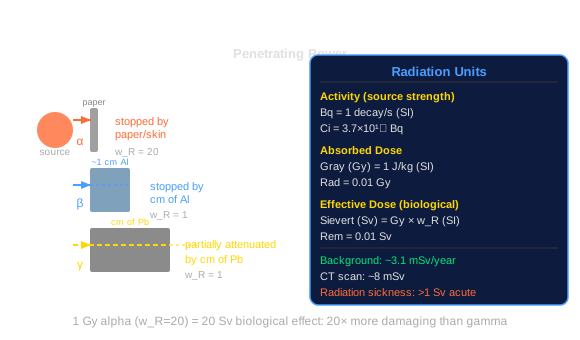
Activity (source strength):
- Becquerel (Bq): 1 Bq = 1 radioactive decay per second. SI unit.
- Curie (Ci): 1 Ci = 3.7 × 10¹⁰ Bq. Defined as the activity of 1 gram of Ra-226. Still widely used in US nuclear medicine. 1 mCi = 3.7 × 10⁷ Bq.
Activity tells you the source strength: how many decays per second: but says nothing about biological effect.
Exposure (ionization in air):
- Roentgen (R): Amount of X or gamma radiation producing 2.58 × 10⁻⁴ coulombs of ion charge per kilogram of dry air. Now largely replaced by SI units but still used in older dosimetry literature.
Absorbed dose (energy deposited in tissue):
- Gray (Gy): 1 Gy = 1 joule of energy deposited per kilogram of tissue. SI unit.
- Rad: 1 rad = 0.01 Gy = 10 mGy. Older unit (radiation absorbed dose).
Absorbed dose tells you energy deposited, but different radiation types cause different biological damage for the same energy deposition.
Effective dose (biological effect):
- Sievert (Sv): Effective dose = absorbed dose × radiation weighting factor (w_R). SI unit.
- Rem: 1 rem = 0.01 Sv = 10 mSv. (Roentgen equivalent man). Older unit.
Radiation weighting factors (w_R):
- Gamma rays, X-rays, beta: w_R = 1 (1 Gy = 1 Sv)
- Neutrons (1 MeV): w_R = 20
- Alpha particles: w_R = 20
- So 1 Gy of alpha radiation = 20 Sv biological effect: 20× more damaging per joule than gamma
Dose rate vs integrated dose:
Dose rate (Sv/hr or mSv/hr) is the instantaneous rate of energy deposition. Integrated dose (Sv) is the total accumulated over time.
Dose rate × time = integrated dose. But biological effects depend on both rate and total: acute high dose rate causes radiation sickness; same total dose spread over years has lower effect.
Reference doses:
- Annual background radiation (US average): ~3.1 mSv/year
- Chest X-ray: ~0.1 mSv
- CT scan (abdominal): ~8 mSv
- Occupational limit (US nuclear workers): 50 mSv/year
- Acute radiation sickness threshold: ~1 Sv whole-body acute dose
- LD50/30 (lethal dose for 50% of population in 30 days without treatment): ~4-5 Sv acute whole-body
Applying Radiation Units
A nuclear medicine patient receives a Tc-99m (technetium-99m) injection for a bone scan. The administered activity is 20 mCi.
Tc-99m decays by gamma emission only (E_γ = 140 keV), t₁/₂ = 6.0 hours.
Approximately 30% of the administered activity localizes in bone; 70% is cleared by the kidneys within 24 hours.
The effective dose to the patient from a 20 mCi Tc-99m bone scan is approximately 4.0 mSv (from dosimetry calculations).
Nuclear Physics in the World
Where This Physics Shows Up
Reactor types in operation today:
- Pressurized Water Reactor (PWR): ~70% of global nuclear capacity. H₂O moderator & coolant, 155 bar pressure, 315°C coolant temperature, 3-5% enriched UO₂ fuel.
- Boiling Water Reactor (BWR): H₂O moderator, boils in-core at 75 bar, single loop (coolant = steam directly drives turbine). More compact, slightly simpler.
- CANDU: D₂O moderator & coolant, natural uranium fuel, can be refueled online.
- RBMK (Chernobyl type): Graphite moderator, light water coolant. Positive void coefficient: when coolant boils, reactivity increases (unstable at low power). Now being retired.
- Fast Reactors (SFR, etc.): No moderator. Fast neutrons. Can breed plutonium from U-238 (breeder reactors), burn long-lived actinide waste. Sodium coolant (high thermal conductivity, no moderation). Russia's BN-800 is in commercial operation.
Medical physics:
- PET scan: Positron emitters (¹⁸F, t₁/₂ = 110 min) produce back-to-back 511 keV gammas from e⁺e⁻ annihilation: detected in coincidence to image metabolism.
- Radiation therapy: Linear accelerators produce 6-18 MV X-rays. Proton therapy uses Bragg peak physics: protons deposit maximum dose at a specific depth, sparing surrounding tissue.
- Neutron capture therapy (BNCT): Thermal neutrons captured by ¹⁰B in tumor cells → ¹¹B* → ⁴He + ⁷Li + gamma, depositing dose in the tumor cell itself.
Nuclear weapons physics:
- Fission bomb: Supercritical mass assembled in microseconds. Implosion design (Trinity, Fat Man) or gun-type (Little Boy). Yield in kt-Mt TNT equivalent.
- Thermonuclear weapon: Fission primary compresses & heats a fusion secondary (D-T or Li-D fuel). Yields up to ~50 Mt (Tsar Bomba). The fission is the trigger; fusion provides most of the yield.
Geophysics:
- Radiometric dating: ¹⁴C (t₁/₂ = 5,730 years) for recent organic material; U-Pb systems for rocks up to 4.5 billion years; K-Ar for igneous rocks. All based on N(t) = N₀e^(−λt).
- Earth's heat: ~45 TW of heat flows from Earth's interior. About half is primordial (from formation); half is from decay of long-lived radionuclides (²³⁸U, ²³²Th, ⁴⁰K): the planet is still warm because of radioactive decay.
Final Synthesis
You have now covered: nuclear structure & shell model, the strong & weak forces, alpha/beta/gamma/EC decay with quantum mechanics, half-life kinetics & secular equilibrium, binding energy & the curve, fission cross sections & chain reactions, fusion plasmas & the Lawson criterion, E=mc² calculations, & radiation units.
What You Have Learned
Nuclear Physics 101: Complete
You have covered the full scope of introductory nuclear engineering physics:
Nuclear structure: Nucleons, the chart of nuclides, the shell model, magic numbers (2, 8, 20, 28, 50, 82, 126), nuclear spin & parity, & nuclear radius scaling as R₀A^(1/3).
The strong force: Short-range Yukawa interaction, saturation, gluon exchange at the quark level, residual force via pion exchange, & the liquid drop model as a consequence of saturation.
Radioactive decay: Alpha (quantum tunneling, Gamow factor, Geiger-Nuttall), beta minus & plus (weak force, W boson, quark flavor change), electron capture, gamma de-excitation, internal conversion, & the complete U-238 → Pb-206 chain.
Half-life kinetics: N(t) = N₀e^(−λt), activity in Bq & Ci, specific activity, mean lifetime, secular equilibrium, & real decay calculations.
Binding energy: Mass defect calculation (Δm × 931.5 MeV/u), the Bethe-Weizsäcker formula terms, & worked examples for Fe-56 & U-235.
The binding energy curve: Why fusion releases energy for light nuclei, why fission releases energy for heavy nuclei, why iron is the endpoint of stellar nucleosynthesis, & energy densities in J/kg.
Fission physics: The compound nucleus, energy distribution of fission products, neutron cross sections & the barn, the 1/v law, resonance capture, the six-factor formula, delayed neutrons, & criticality.
Fusion physics: The Coulomb barrier, quantum tunneling, Maxwell-Boltzmann averages, D-T vs D-D vs p-B11 trade-offs, the Lawson criterion, tokamak progress, & NIF ignition.
E=mc² calculations: Complete mass conversion (1 g = 90 TJ), mass defect in U-235 fission (0.186 u = 173 MeV), & energy density comparisons.
Radiation units: Activity (Bq, Ci), absorbed dose (Gy, rad), effective dose (Sv, rem), radiation weighting factors, & reference doses.
Final Reflection
You have just covered the physics that underlies nuclear power generation, nuclear medicine, radiation safety, astrophysics, & weapons nonproliferation.
This is the foundation from which nuclear engineers design reactors, health physicists calculate dose limits, & policymakers make decisions about nuclear energy's role in decarbonization.