From Nucleus to Grid
You already know the building blocks: the atomic nucleus, fission, binding energy, & E=mc².
This module asks the next question: how do we actually use that: safely, reliably, for decades?
A nuclear power plant is, at its heart, a very controlled way to boil water. The trick is in the word controlled. Every reactor accident in history traces to a moment when that control was lost: by physics, by engineering, or by human decision.
We will go from the mathematics of chain reactions, through fuel cycles & coolant hydraulics, to the specific physics failures that caused SL-1, Chernobyl, & Three Mile Island.
This is community college-level nuclear engineering. Expect numbers, equations, & real reasoning.
What Do You Already Know?
Before we start, let's calibrate.
Neutron Life Cycle
Every Neutron Has a Story
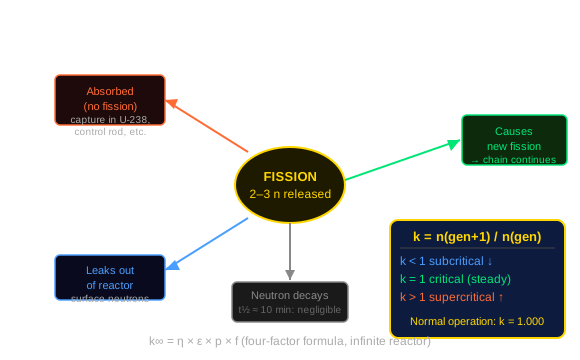
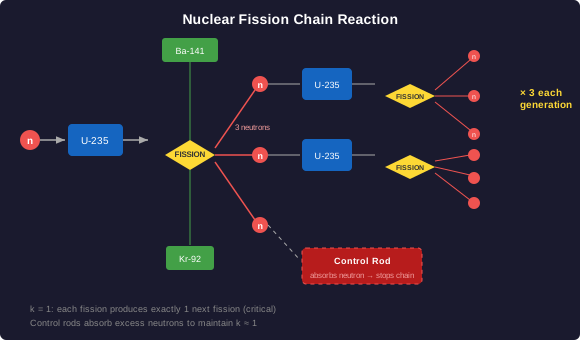
A neutron born from fission travels through the reactor & eventually does one of four things: it causes another fission, it is absorbed without causing fission, it leaks out of the reactor, or it decays (rarely: neutron half-life is about 10 minutes, far too slow to matter in reactor physics).
The ratio of neutrons in one generation to neutrons in the previous generation is the multiplication factor k.
- k < 1: subcritical: the chain reaction dies out
- k = 1: critical: the chain reaction sustains itself at constant power
- k > 1: supercritical: power is increasing
A normal operating reactor runs at exactly k = 1. A reactor starting up briefly has k slightly above 1. Shutdown means k is driven well below 1.
To understand what controls k, we use the four-factor formula for an infinite reactor (no leakage):
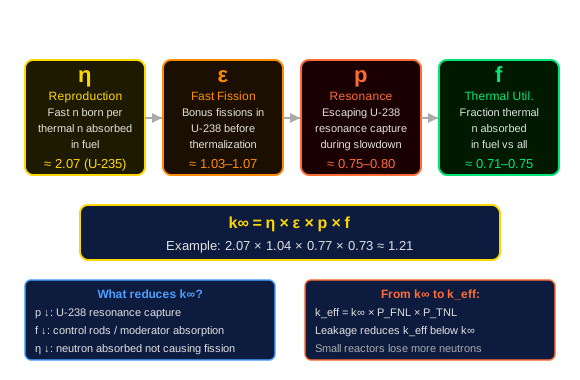
k∞ = η × ε × p × f
Each factor represents one stage in the neutron life cycle. We will go through each one.
Four-Factor Formula
k∞ = η × ε × p × f
η (eta), reproduction factor: the average number of fast neutrons produced per thermal neutron absorbed in fuel. For U-235, η ≈ 2.07. For Pu-239, η ≈ 2.11. This is the payoff factor, how many new neutrons does each fission give us?
ε (epsilon), fast fission factor: accounts for fast fissions in U-238. Fast neutrons born from U-235 fission can cause fission in the abundant U-238 before they slow down. ε ≈ 1.03–1.07 for a typical LWR fuel assembly. It is always greater than 1, a small bonus.
p: resonance escape probability: the probability a neutron slows down from fast to thermal energies WITHOUT being captured by U-238 resonance peaks. U-238 has enormous neutron capture cross-sections at specific energies (resonance peaks) in the epithermal range. In a typical LWR, p ≈ 0.75–0.80. This is the biggest loss term.
f: thermal utilization factor: the fraction of thermal neutrons absorbed in fuel (rather than in moderator, structural material, or control rods). f = Σ_fuel / Σ_total. In a typical LWR with no control rods inserted, f ≈ 0.71–0.75.
Example: η=2.07, ε=1.04, p=0.77, f=0.73 → k∞ = 2.07 × 1.04 × 0.77 × 0.73 ≈ 1.21
This means in an infinite reactor this fuel would be highly supercritical. Real reactors are finite: leakage reduces k below k∞.
Understanding the Four Factors
A reactor operator notices that inserting control rods deeper reduces reactor power. Control rods come from neutron-absorbing material (boron or hafnium) inserted into the fuel region.
Six-Factor Formula & Leakage
Real Reactors Are Finite
The four-factor formula assumes an infinite reactor: no neutrons escape. Real reactors have boundaries, & neutrons near the surface can stream out & be lost.
The six-factor formula adds two non-leakage probabilities:
k_eff = η × ε × p × f × P_FNL × P_TNL
- P_FNL: fast non-leakage probability: probability a fast neutron does NOT leak out before it thermalizes. Typically 0.97 in a large LWR.
- P_TNL: thermal non-leakage probability: probability a thermal neutron does NOT leak out before it is absorbed. Typically 0.99 in a large LWR.
Leakage is why small reactors are harder to make critical. A small reactor has a high surface-to-volume ratio: proportionally more neutrons reach the boundary & escape.
Geometric buckling B² quantifies the leakage tendency. A sphere has the lowest surface-to-volume ratio & thus lowest B² for a given volume: this explains why bomb cores are spherical (maximizing k_eff for a given mass).
In a large commercial PWR (1000 MWe), k∞ ≈ 1.2 at beginning-of-life with no control rods, but leakage & control rods bring k_eff to exactly 1.000 during operation.
Prompt Neutrons vs. Delayed Neutrons
Why Reactors Are Controllable
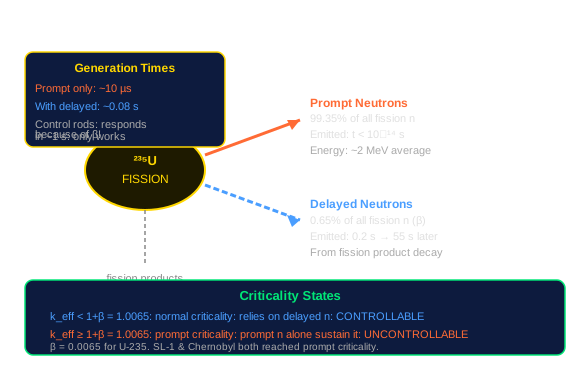
When U-235 fissions, most neutrons appear instantly: these are prompt neutrons, emitted within 10⁻¹⁴ seconds of fission. About 99.35% of all fission neutrons are prompt.
The remaining 0.65% are delayed neutrons, emitted seconds to minutes later by certain fission products as they decay. The average delay is about 13 seconds, though individual groups range from 0.2 seconds to 55 seconds.
This tiny delayed fraction (β = 0.0065 for U-235) is what makes reactors controllable.
Prompt criticality occurs when k_eff ≥ 1 on prompt neutrons ALONE: without needing the delayed fraction. This is the disaster scenario. At prompt criticality, the reactor period (time to increase by factor e) drops from minutes to milliseconds. No mechanical system can respond fast enough.
Normal criticality (k_eff = 1.000) relies on delayed neutrons to sustain the chain reaction. The effective neutron generation time is ℓ_eff ≈ β/λ ≈ 0.0065/0.08 ≈ 0.08 seconds: slow enough for mechanical control rods to regulate power.
The condition for prompt criticality is: k_eff ≥ 1 + β, i.e., k_eff ≥ 1.0065 for U-235.
We call this excess reactivity ρ ≥ β: the reactor is 'prompt supercritical.'
The SL-1 accident (1961) & the Chernobyl RBK-1000 during the 1986 test both achieved prompt criticality. Both destroyed themselves in under one second.
Why Delayed Neutrons Save Us
Reactor Period and the Inhour Equation
Measuring Reactivity
Reactivity ρ means ρ = (k-1)/k. At criticality, ρ = 0. Subcritical: ρ < 0. Supercritical: ρ > 0.
The unit dollar ($) normalizes reactivity to the delayed neutron fraction: 1$ = β ≈ 0.0065 for U-235. Prompt criticality occurs at ρ = 1$ = β.
One cent = 0.01$.
Reactor period T is the time for power to increase by a factor of e (≈2.718). Small positive reactivity insertions give long periods (stable, controllable). Approaching prompt criticality, the period collapses toward zero (unstable).
The inhour equation relates reactivity to reactor period. 'Inhour' means 'inverse hour.' The equation is:
ρ = (ℓ/T) + Σᵢ [βᵢ / (1 + λᵢT)]
Where βᵢ & λᵢ are the yield fraction & decay constant for each group of delayed neutrons (there are 6 groups for U-235), & ℓ is the prompt neutron lifetime.
For small positive reactivity (ρ << β), the equation gives T ≈ β/(ρ·λ̄): the reactor period is LONG & controllable.
As ρ → β (approaching prompt criticality), T → 0: period collapses, power rises explosively.
Practical implication: A startup requires positive reactivity. The operator watches the reactor period meter. A period of 30-60 seconds during startup is normal. A period below 10 seconds triggers a SCRAM (emergency shutdown).
Why We Need to Slow Neutrons Down
Fast Neutrons vs. Thermal Neutrons
Neutrons born from fission are fast: kinetic energies around 1–2 MeV. U-235 fission cross-section at 1 MeV: about 1 barn (10⁻²⁴ cm²).
Slow neutrons down to thermal energies (~0.025 eV at room temperature) & the U-235 fission cross-section jumps to about 585 barns: nearly 600 times higher.
This explains why thermal reactors (LWR, CANDU, AGR) use a moderator: a material that slows neutrons from MeV to eV without absorbing too many of them.
Thermalization happens through elastic scattering collisions. Each collision transfers some neutron kinetic energy to the target nucleus. The maximum energy transfer per collision is:
ΔE/E = 4A/(1+A)²
Where A is the atomic mass of the target. For hydrogen (A=1): ΔE/E = 1.0, a neutron can transfer ALL its energy in one collision. For carbon (A=12): ΔE/E = 0.28. For uranium (A=238): ΔE/E = 0.017, essentially no slowing.
This explains why hydrogen (in water) is such an efficient moderator: it can thermalize a neutron in ~18 collisions. Carbon (graphite) needs ~114 collisions. But hydrogen also absorbs neutrons (more on this below).
Moderator Comparison: H₂O vs. D₂O vs. Graphite
The Moderator Trade-off
A good moderator must:
1. Have low atomic mass (efficient energy transfer per collision)
2. Have low neutron absorption cross-section (don't steal the neutrons you're slowing)
These two requirements are in tension for ordinary hydrogen.
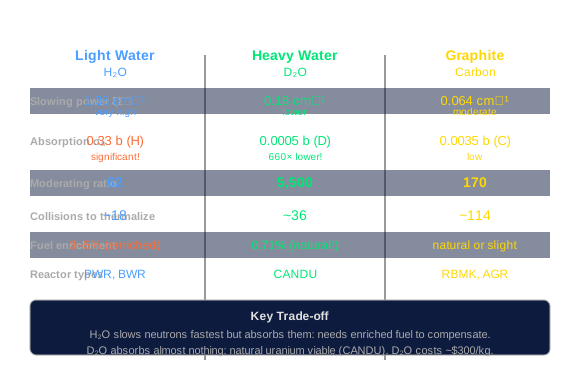
Light water (H₂O)
- Slowing power: very high (ξΣₛ ≈ 1.35 cm⁻¹)
- Absorption cross-section (H): 0.33 barns: significant
- Moderating ratio (ξΣₛ/Σₐ) ≈ 62
- Result: excellent moderator but absorbs enough neutrons that you MUST use enriched uranium (3–5% U-235) to compensate. Natural uranium (0.71% U-235) does not provide enough excess neutrons to overcome H₂O absorption.
Heavy water (D₂O)
- Slowing power: lower than H₂O (ξΣₛ ≈ 0.18 cm⁻¹): needs more collisions
- Absorption cross-section (D): 0.0005 barns: 660× lower than H
- Moderating ratio ≈ 5,500
- Result: D₂O absorbs almost no neutrons. You can run on natural uranium (0.71% U-235). This explains why CANDU reactors use natural uranium fuel.
Graphite (C)
- Slowing power: moderate (ξΣₛ ≈ 0.064 cm⁻¹)
- Absorption cross-section (C): 0.0035 barns: low but higher than D₂O
- Moderating ratio ≈ 170
- Result: can use natural or slightly enriched uranium. RBMK, Magnox, & AGR reactors use graphite. The Chernobyl reactor was graphite-moderated.
Sodium (Na): not a thermal moderator
- Sodium-cooled fast reactors deliberately avoid thermalizing neutrons. Fast neutrons are used directly. No moderator needed or wanted. The fast spectrum allows breeding of new fissile material (Pu-239 from U-238).
CANDU Advantage
Fast Reactors: No Moderator Needed
Why Sodium-Cooled Fast Reactors Skip the Moderator
Fast reactors (SFR, lead-cooled LFR) deliberately maintain a fast neutron spectrum. The coolant (liquid sodium or lead) has high atomic mass & low scattering cross-section: it does not thermalize neutrons.
Why operate fast? Two reasons:
1. Breeding: Fast neutrons can convert fertile U-238 into fissile Pu-239 more efficiently than thermal reactors. The breeding ratio (new fissile atoms created per fissile atom consumed) can exceed 1.0 in a fast reactor, a breeder reactor creates more fuel than it burns. U-238 is 99.3% of natural uranium, a nearly inexhaustible fuel source if we can breed it.
2. Transmutation: Fast neutrons can fission long-lived actinides (Am-241, Np-237, Cm-244) that are the primary long-term radiation hazard in spent nuclear fuel. Burning these in a fast reactor reduces high-level waste lifetime from >100,000 years to ~1,000 years.
The trade-off: sodium is chemically reactive with water & air (sodium fires), the fast spectrum means lower fission cross-sections (less efficient per neutron), & the engineering is more complex.
From Mine to Fuel Assembly
The Front End of the Fuel Cycle
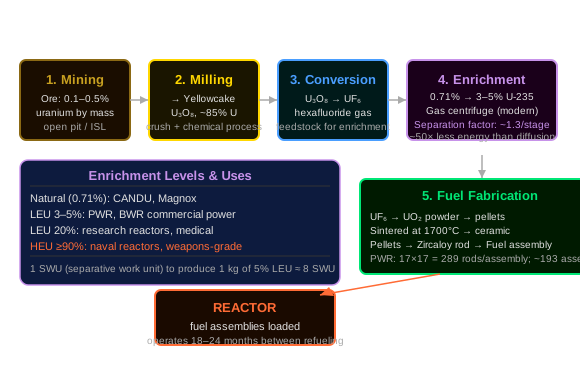
1. Mining: Uranium ore typically contains 0.1–0.5% uranium by mass. Open-pit or underground mining, or in-situ leach (ISL) where chemical solution dissolves uranium underground.
2. Milling: Ore is crushed & chemically processed to produce yellowcake (U₃O₈): about 85% uranium by mass. The mill tailings are mildly radioactive & require careful disposal.
3. Conversion: Yellowcake is converted to uranium hexafluoride (UF₆): a gas at modest temperatures. UF₆ is the working fluid for enrichment. The reaction: U₃O₈ + HF → UF₄ → UF₆.
4. Enrichment: Natural uranium is 99.3% U-238 & 0.71% U-235. Most reactors need 3–5% U-235. Two commercial processes:
Gaseous diffusion: UF₆ gas is pumped through thousands of porous barriers. U-235 is very slightly lighter than U-238, so ²³⁵UF₆ diffuses 1.004× faster than ²³⁸UF₆ per stage. This requires hundreds of stages in a cascade & enormous electrical energy (~2,400 kWh per SWU). Now largely obsolete.
Gas centrifuge: UF₆ spun at 50,000–70,000 RPM. Heavier ²³⁸UF₆ concentrates at the outer wall; lighter ²³⁵UF₆ at the center. Separation factor ~1.3 per stage (vs 1.004 for diffusion). Uses ~50× less electricity. Modern standard.
Enrichment gets measured in separative work units (SWU). Producing 1 kg of 5%-enriched uranium from natural uranium requires about 8 SWU.
5. Fuel fabrication: Enriched UF₆ is converted to uranium dioxide (UO₂) powder, pressed into ceramic pellets (~1 cm diameter, 1 cm tall), sintered at 1700°C, stacked into zirconium alloy (Zircaloy) tubes, sealed: these are fuel rods. Rods are assembled into a fuel assembly (e.g., 17×17 = 289 rods for a PWR assembly). A typical 1000 MWe PWR has ~193 fuel assemblies, totaling ~80 tonnes of uranium.
Enrichment levels & applications:
- Natural (0.71%): CANDU, Magnox
- Low-enriched uranium (LEU, <20%): commercial power, 3–5% for LWR
- Highly enriched uranium (HEU, ≥20%): naval reactors (≥90%), research reactors
- Weapons-grade: ≥90% U-235
Centrifuge vs. Diffusion
Spent Fuel and Reprocessing
The Back End of the Fuel Cycle
After 3–4 years in a reactor, spent fuel is physically hot, intensely radioactive, & still contains significant fissile material:
- ~94% U-238 (depleted of U-235)
- ~1% U-235 (still fissile)
- ~1% Pu-239, Pu-240, Pu-241 (created by neutron capture in U-238)
- ~4% fission products (Cs-137, Sr-90, I-131, & ~200 others)
- <0.1% minor actinides (Am, Np, Cm)
Once-through cycle: US policy: spent fuel is stored in wet spent fuel pools (water shields radiation & removes decay heat) for 5–10 years, then transferred to dry cask storage. No reprocessing. High-level waste (HLW) is planned for permanent geological disposal (Yucca Mountain, currently stalled).
PUREX reprocessing (France, UK, Japan, Russia): Spent fuel is dissolved in nitric acid. Solvent extraction (tributyl phosphate in kerosene) selectively extracts uranium & plutonium, leaving fission products behind. The recovered uranium (reprocessed uranium, RepU) can be re-enriched. The plutonium is mixed with depleted uranium to make MOX fuel (mixed oxide, ~5–7% PuO₂). MOX extends fuel resources ~10–20%.
Weapons-grade vs. reactor-grade plutonium:
Natural uranium in a reactor produces Pu-239. If left in the reactor long enough, neutron capture on Pu-239 produces Pu-240. Reactor-grade Pu (typically >18% Pu-240) is problematic for weapons because Pu-240 has a high spontaneous fission rate: it causes pre-detonation (fizzle) in gun-type designs. Weapons-grade Pu requires short irradiation times (<3 months) to limit Pu-240 buildup. Commercial power reactors (long fuel cycles of 18+ months) produce weapons-unusable reactor-grade plutonium. This is a deliberate proliferation barrier in the once-through fuel cycle.
Differential and Integral Rod Worth
How Much Is a Rod Worth?
Rod worth is the reactivity change caused by inserting a control rod. It is not constant: it depends on where the rod is inserted relative to the neutron flux distribution.
Differential rod worth (Δρ/Δx): the reactivity change per unit of rod insertion at a given position. It peaks where neutron flux is highest: at the center of the core. It is low near the top & bottom (low flux regions).
Integral rod worth: total reactivity change from fully withdrawn to a given insertion depth. It forms an S-curve: slow change at top (low flux), rapid change through the center (peak flux), slow change at bottom.
Rod ejection accident: If a control rod is suddenly ejected from the core (e.g., by failure of the rod drive mechanism), a large positive reactivity insertion occurs in milliseconds. The magnitude depends on the rod's worth (pcm to several dollars depending on rod position). If the ejected rod worth exceeds prompt criticality threshold (1$), a prompt criticality excursion occurs.
Rod shadowing / rod-rod interaction: Inserting one rod reduces local flux, which reduces the worth of nearby rods. Operators must account for this interaction when planning rod patterns.
Control rod materials: Boron-10 (σₐ = 3,840 barns at 0.025 eV), hafnium (σₐ = 102 barns, moderate but burns out slowly, preferred for long-life rods), silver-indium-cadmium alloy (used in PWRs, Ag provides fast response, In & Cd maintain worth as they burn up).
Xenon Poisoning: The Invisible Killer
Xe-135: The Most Powerful Neutron Absorber Known
Xenon-135 has a thermal neutron absorption cross-section of 2.6 million barns: by far the largest of any nuclide. For comparison, U-235 fission cross-section is 585 barns. Xe-135 is ~4,400× more absorptive per atom.
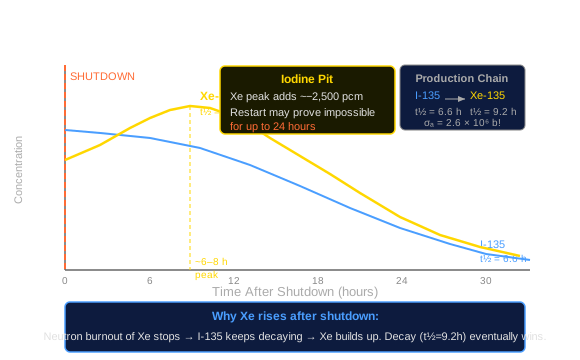
Production: Xe-135 comes primarily from the decay of I-135 (iodine), which is produced directly from fission. Only ~0.3% of Xe-135 comes directly from fission; ~95% comes via the decay chain:
Te-135 → I-135 (half-life 6.6 h) → Xe-135 (half-life 9.2 h) → Cs-135
Removal: Xe-135 is removed by two processes: (1) radioactive decay (half-life 9.2 h), & (2) neutron absorption (burned out by the neutron flux). At high power, neutron absorption is the dominant removal mechanism.
The iodine pit (xenon transient):
At steady-state operation, Xe-135 production & removal are balanced (xenon worth ≈ -2,500 pcm in a typical PWR).
When a reactor shuts down, neutron absorption of Xe-135 stops. But I-135 continues decaying into new Xe-135 for several hours. Xe-135 concentration RISES for 6–8 hours after shutdown: the iodine pit.
This can make the reactor temporarily impossible to restart (xenon override impossible) if there is insufficient excess reactivity.
The Chernobyl connection: On April 26, 1986, the Chernobyl Unit 4 test was delayed by ~9 hours due to grid demand. During this time, xenon built up. To proceed with the test, operators had to withdraw almost all control rods to overcome xenon poisoning. This left the reactor with virtually no shutdown margin: a critical precondition for the accident.
Why Xenon Makes Reactors Dangerous After Shutdown
Samarium Poisoning
Sm-149: The Longer-Term Poison
Samarium-149 is the second most important reactor poison. It has a thermal absorption cross-section of ~41,000 barns.
Production chain: Nd-149 → Pm-149 (half-life 53 h) → Sm-149 (stable)
Unlike xenon, Sm-149 is stable: it does not decay away. It can only be removed by neutron absorption. At steady-state power, Sm-149 reaches an equilibrium concentration representing about -700 pcm reactivity.
At shutdown: neutron burnout stops, but Pm-149 continues decaying into Sm-149. Since Sm-149 is stable, it accumulates over ~100 hours post-shutdown: adding about -600 pcm more negative reactivity.
At restart: the neutron flux burns out the excess Sm-149. Samarium poisoning is less severe than xenon (no iodine pit equivalent) but must be accounted for in long-term reactivity management.
Combined, xenon & samarium represent roughly -3,000 to -3,500 pcm of reactivity burden at shutdown peak: this must be balanced by control rod withdrawal or chemical shim (boric acid in PWRs) when restarting.
What Are Reactivity Coefficients?
The Difference Between Safe & Unsafe Reactors
A reactivity coefficient is the change in reactivity per unit change in some physical parameter (temperature, void fraction, power).
Negative coefficient: as power increases, reactivity decreases: the reactor is self-limiting. An inherently safe design.
Positive coefficient: as power increases, reactivity increases: the reactor amplifies disturbances. A potentially unstable design.
The sign of reactivity coefficients determines whether a reactor is inherently safe or requires active intervention to prevent runaway. This is the single most important safety parameter in reactor design.
Doppler Broadening: The Most Important Safety Mechanism
Doppler Coefficient of Reactivity
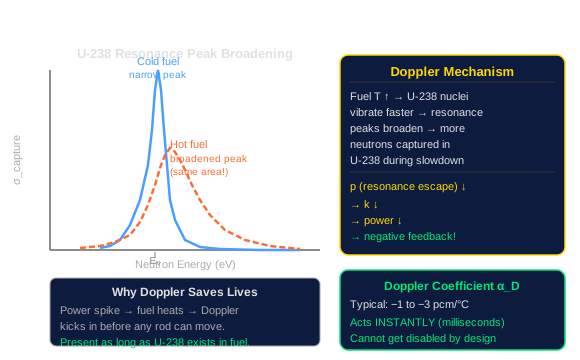
Doppler broadening is a quantum mechanical effect: as the temperature of the fuel rises, the thermal motion of U-238 nuclei broadens their neutron absorption resonance peaks.
In the epithermal energy range (1 eV to 10 keV), U-238 has enormous resonance absorption peaks. At low temperature, these peaks are narrow: a neutron must have a very precise energy to be absorbed. As temperature rises, the broadened peaks absorb neutrons from a wider energy range.
Effect on p (resonance escape probability): as fuel temperature rises → U-238 resonance peaks broaden → more neutrons are captured during thermalization → p decreases → k decreases → power decreases.
The Doppler coefficient (α_D) is typically -1 to -3 pcm/°C for U-235/U-238 fuel. This is STRONGLY negative.
Why this is the primary safety mechanism: It acts instantly (temperature changes at the speed of heat flow: milliseconds to seconds). It is always present as long as there is U-238 in the fuel. It does not depend on any active system or operator action. It cannot fail.
In any reactivity excursion (sudden power rise), the Doppler effect kicks in immediately & provides negative feedback before any mechanical system can respond. This explains why modern LWR fuel (with 95%+ U-238 in the fuel matrix) is inherently self-limiting.
Weapons note: Pure U-235 or Pu-239 metal has almost no Doppler feedback. This is one reason weapons use high-enrichment material: the Doppler safety mechanism that makes power reactors safe would also limit weapon yield.
Void Coefficient: What Separates LWR from RBMK
The Void Coefficient & Chernobyl Physics
The void coefficient (α_v) is the change in reactivity per unit change in void fraction (fraction of coolant that has boiled to steam bubbles).
In a Light Water Reactor (PWR or BWR):
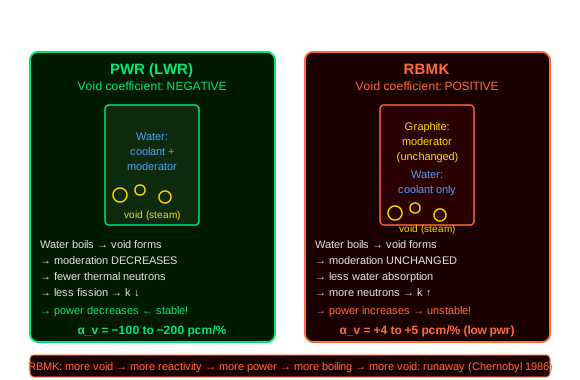
Water serves as BOTH coolant AND moderator. If the water boils (void forms), moderation is reduced. Less moderation → fewer thermal neutrons → less fission → power decreases. Additionally, water absorbs some neutrons: less water means fewer parasitic absorptions, which is slightly positive, but the moderation loss dominates.
Result: void coefficient is negative in LWRs (typically -100 to -200 pcm/% void). Loss of coolant reduces power automatically.
In the RBMK-1000 (Chernobyl reactor):
The RBMK used graphite as the moderator & water only as coolant. If water boils:
- Moderation is UNCHANGED (graphite moderator doesn't change)
- Neutron absorption in water DECREASES (less parasitic absorption)
- Net effect: positive void coefficient at low power
- As power rises, water boils more, positive void coefficient adds more reactivity, which raises power more: a positive feedback loop.
Positive void coefficient magnitude in RBMK: At low power with few control rods inserted, α_v ≈ +4 to +5 pcm/% void. This was known to Soviet designers but concealed from plant operators.
April 26, 1986: Chernobyl Unit 4 was operating at low power (~200 MWt, vs nominal 3,200 MWt) with most control rods withdrawn to overcome xenon poisoning. In this configuration: maximum positive void coefficient, minimal rod worth, xenon-suppressed power. When the test sequence caused reactor power to spike, boiling increased, void coefficient added reactivity, power rose faster, more boiling: unstable positive feedback. The reactor reached prompt criticality & destroyed itself in ~3 seconds.
Why the RBMK Ran Unstable at Low Power
Moderator Temperature Coefficient and Power Coefficient
Other Key Coefficients
Moderator temperature coefficient (MTC): reactivity change per degree of moderator temperature change. In a PWR: as water temperature rises, its density drops → less moderator per unit volume → less thermalization → fewer thermal neutrons → k decreases. MTC is negative in LWRs (typically -20 to -80 pcm/°C). This is a required safety specification: US NRC regulations require MTC ≤ 0 at all times.
Fuel temperature coefficient (FTC): driven primarily by Doppler broadening (described above). Always strongly negative in LWR fuel.
Power coefficient: the total reactivity feedback from all sources per unit power change. In a well-designed LWR: strongly negative. Power rises → fuel temperature rises (Doppler feedback) → moderator heats & develops voids (MTC & void feedback) → reactivity decreases → power stabilizes.
The combined effect: LWR reactors are inherently self-regulating. An operator who does nothing will find the reactor settling at a power level where feedback makes k = 1.000. This is not an accident: it is a deliberate design requirement.
A reactor with all-negative coefficients will never go prompt critical from a thermal feedback event. Prompt criticality in an LWR requires an external positive reactivity insertion larger than the prompt criticality threshold (>β ≈ 0.0065). In practice, this means control rod ejection or rapid boron dilution: both of which are analyzed explicitly in the design basis.
Heat Removal: From Fuel to Coolant
Keeping the Fuel Cool
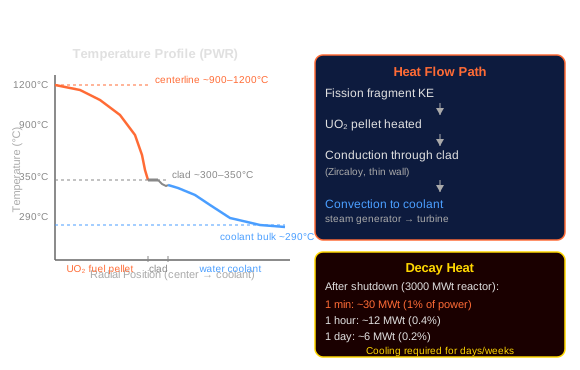
Fission produces heat primarily as kinetic energy of fission fragments (~83%) & prompt gamma radiation (~3%), deposited almost entirely within the fuel pellet. Beta decay of fission products (~4%) & gamma decay (~4%) add heat over time: this is decay heat, which continues after shutdown.
Decay heat follows the way-12 rule approximately: 1 minute after shutdown, decay heat ≈ 1% of operating power. After 1 hour: ~0.4%. After 1 day: ~0.2%. After 1 week: ~0.07%. Decay heat from a 3,000 MWt reactor 1 minute after shutdown is ~30 MWt: enough to melt the core if cooling is lost. This explains why emergency core cooling systems (ECCS) are so critical.
Heat flow path: Fuel pellet → fuel rod cladding (Zircaloy) → coolant water → steam generator (PWR) or directly to steam (BWR)
Temperature profile: Centerline fuel temperature in a PWR reaches ~900–1,200°C at full power. Zircaloy cladding surface: ~300–350°C. Coolant bulk: ~290–325°C. The steep gradient from pellet center to coolant means small power increases cause large fuel temperature increases: & large Doppler feedback.
Key thermal limit: Fuel centerline temperature must remain below UO₂ melting point (~2,865°C). Cladding temperature must remain below the Zircaloy oxidation threshold (~1,200°C), above which zirconium reacts exothermically with steam: Zr + 2H₂O → ZrO₂ + 2H₂. This reaction produced the hydrogen that exploded at Fukushima Units 1, 3, & 4.
Departure from Nucleate Boiling (DNB)
The Critical Heat Flux Limit
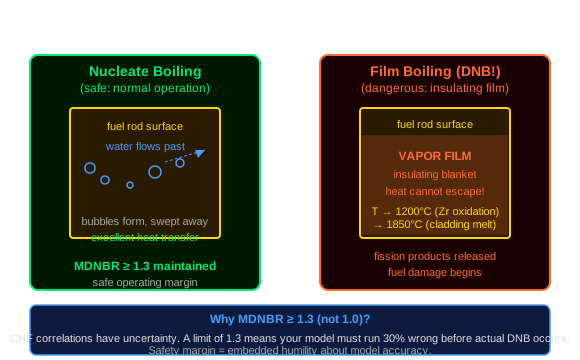
In a PWR, the coolant remains liquid at ~155 bar pressure (boiling point ~345°C). Small steam bubbles nucleate on the cladding surface & are swept away by flow, nucleate boiling, which is actually excellent heat transfer.
If local heat flux exceeds a critical value (critical heat flux, CHF), the bubbles coalesce into a continuous vapor film around the fuel rod. This vapor film is an insulator. The heat flux from the fuel cannot be removed by the vapor: the cladding temperature spikes rapidly. This is departure from nucleate boiling (DNB) or critical heat flux exceedance.
Consequence of DNB: Without rapid flow restoration, cladding temperature rises toward 1,200°C where Zircaloy oxidation begins, then toward melting (~1,850°C). Fuel pellets scatter, fission products are released to the coolant.
MDNBR (minimum DNB ratio): The ratio of the local critical heat flux to the actual heat flux, evaluated at the most limiting location in the core. A safety limit of MDNBR ≥ 1.3 is maintained at all times (1.3× margin to DNB). This limit constrains maximum reactor power & flow conditions.
Two-phase flow: In a BWR, bulk boiling is intentional: the core operates in two-phase flow (water + steam). The equivalent limit in BWRs is the critical power ratio (CPR) or minimum critical power ratio (MCPR) ≥ 1.2.
Core temperature profile: Axial heat flux follows the axial neutron flux profile (roughly a chopped cosine in a fresh core). The peak flux (& highest DNB risk) is at the core midplane. Radial peak is in the center assemblies. The hot channel factor (Fq or F∆H) quantifies how much higher the peak local power is than the core average: typically 2.5–3.0 in a PWR.
Why DNB Sets the Critical Safety Limit
PWR and BWR: The Dominant Designs
Light Water Reactors
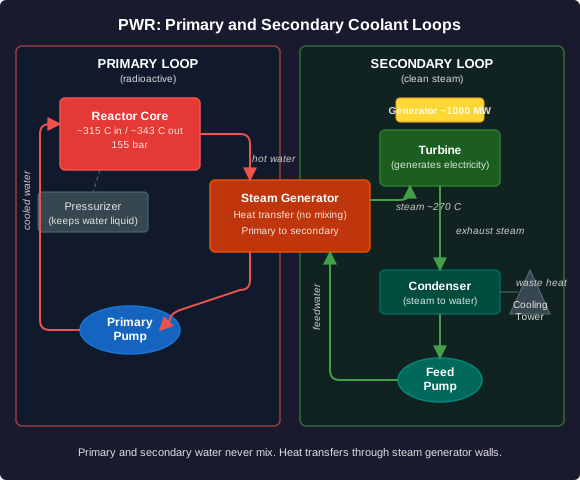
Light water reactors (LWRs) account for ~85% of the world's commercial nuclear capacity.
Pressurized Water Reactor (PWR)
- Primary loop: water at ~155 bar (15.5 MPa), ~290–325°C: pressurized above boiling point, stays liquid
- Heat exchanger: steam generators transfer heat from primary to secondary loop
- Secondary loop: water at ~60 bar, produces steam at ~280°C to drive turbines
- Advantage: primary radioactive water never contacts the turbine. Maintenance is easier.
- Power: 900–1,700 MWe per unit. Thermal efficiency ~33%.
- Examples: Westinghouse AP1000, French EPR, Russian VVER
Boiling Water Reactor (BWR)
- Direct cycle: water boils INSIDE the reactor vessel at ~75 bar (~290°C). Steam goes directly to the turbine.
- No steam generators needed: simpler, lower pressure vessel requirement
- The turbine is slightly radioactive (entrained fission gases in steam): requires shielding & remote maintenance
- Power control by recirculation flow rate (more flow → less void → more moderation → higher power) in addition to control rods
- Passive safety: lower pressure means less energy stored, simpler ECCS design
- Thermal efficiency ~33%, similar to PWR
- Examples: GE BWR/6, ABWR, ESBWR
VVER (Vodo-Vodyanoi Energetichesky Reaktor): Soviet/Russian PWR design. Horizontal steam generators vs. vertical in Western PWRs. Hexagonal fuel assembly geometry vs. square. Modern VVERs (VVER-1200) meet Western safety standards.
CANDU and RBMK: Pressure Tube Designs
Alternatives to the Pressure Vessel
CANDU (Canada Deuterium Uranium)
- Horizontal pressure tubes containing fuel & coolant (D₂O at high pressure), surrounded by low-pressure D₂O moderator in a calandria vessel
- Online refueling: fuel is replaced while the reactor operates at full power, without shutdown. Each pressure tube is individually accessed by a fueling machine. This allows 100% capacity factor without refueling outages (PWRs must shut down ~18 months for refueling)
- Natural uranium fuel (UO₂): no enrichment required. CANDU's neutron economy allows this.
- Also accepts MOX fuel, thorium fuel, & spent LWR fuel (recycling)
- All reactivity coefficients negative: inherently stable
- Example: CANDU-6 (700 MWe), ACR-1000 (advanced design with light water coolant)
RBMK-1000 (Reaktor Bolshoy Moshchnosti Kanalnyy: High-Power Channel Reactor)
- Soviet design: graphite moderator, light water coolant in vertical pressure tubes
- Large (1,000–1,500 MWe), low-enrichment uranium, online refueling
- Fatal physics flaw: positive void coefficient at low power with rods withdrawn (described in detail in the reactivity coefficients section)
- Additional design flaw: graphite tip effect, control rods had graphite tips. Inserting a rod from fully withdrawn first DISPLACED water from the bottom of the core (removing parasitic absorption) before the absorber section entered the active zone. Inserting rods to SCRAM initially added a brief positive reactivity pulse, the opposite of the intended effect.
- These two flaws combined to cause the Chernobyl disaster.
- All surviving RBMK plants have been modified to reduce positive void coefficient & redesign rods. They remain a uniquely Soviet design with no Western equivalents.
Generation IV Reactor Concepts
Beyond the Current Fleet
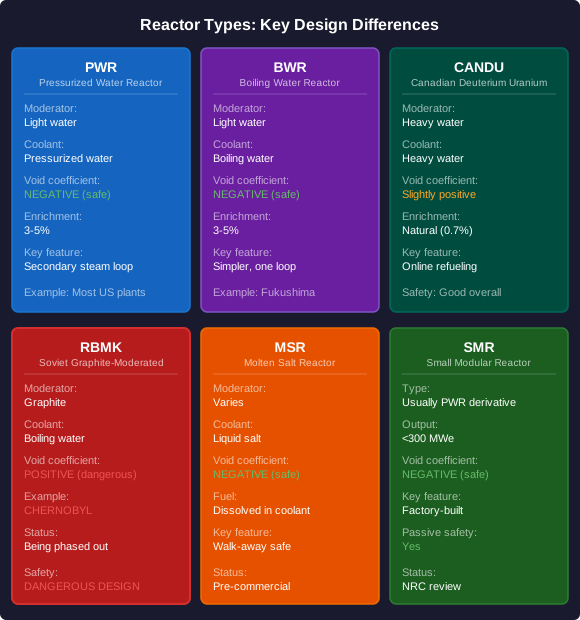
The Generation IV International Forum (GIF) identified six reactor concepts for development targeting ~2030+ deployment:
Molten Salt Reactor (MSR): fuel dissolved in molten fluoride salt (LiF-BeF₂ or NaF-ZrF₄). No solid fuel, no fuel cladding to melt. Passive drainage to freeze plug, if power is lost, the frozen plug melts & salt drains to a subcritical geometry. Operates at atmospheric pressure (~650°C). Thorium breeding possible.
Liquid Fluoride Thorium Reactor (LFTR): specific MSR design using Th-232/U-233 breeding cycle. Thorium is ~3× more abundant than uranium. U-233 produced from Th-232 (Th + n → Pa-233 → U-233). LFTR produces very little long-lived actinide waste. Advocacy community is enthusiastic; engineering challenges (corrosion at temperature, salt chemistry control) remain significant.
Sodium-cooled Fast Reactor (SFR): liquid sodium coolant, fast neutron spectrum, potential for breeding or actinide transmutation. Challenges: sodium reacts with water & air (requires inert atmosphere). Existing examples: BN-800 (Russia), Superphénix (France, decommissioned), Monju (Japan, closed after accident). EBR-II (US) demonstrated passive safety in 1986 with deliberately induced loss-of-flow, reactor safely shut itself down without SCRAM.
Lead-cooled Fast Reactor (LFR): lead or lead-bismuth coolant. Lead is not reactive with water or air (unlike sodium). High boiling point (1,740°C), no pressurization needed. Natural circulation cooling potentially possible. Challenge: lead is very heavy & corrosive to steel at high temperature. Russian submarine reactors used Pb-Bi coolant.
Supercritical Water Reactor (SCWR): water above its critical point (374°C, 221 bar), single phase, very high enthalpy. Thermal efficiency potentially ~44% vs ~33% for current LWRs. Combines BWR simplicity with high efficiency. Significant materials challenges at supercritical conditions.
Very High Temperature Reactor (VHTR): helium-cooled, graphite-moderated, outlet temperatures 700–950°C. Enables hydrogen production via thermochemical cycles. TRISO fuel particles (ceramic-coated microspheres) retain fission products even without active cooling. Example: HTR-PM (China, operational 2023).
Choosing a Reactor Type
Rankine Cycle
Converting Heat to Work
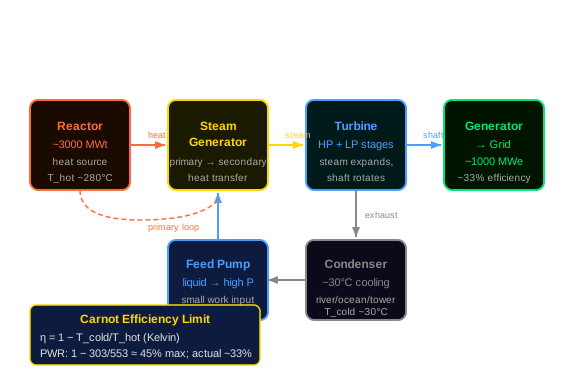
A nuclear plant is a steam power plant. The Carnot efficiency theorem sets the upper bound:
η_Carnot = 1 - T_cold/T_hot (temperatures in Kelvin)
PWR steam conditions: T_hot ≈ 280–290°C (553–563 K), T_cold ≈ 30–40°C (303–313 K)
η_Carnot = 1 - 308/558 ≈ 0.45 (45%)
Actual thermal efficiency ≈ 33%: the gap is irreversibilities in the real cycle (turbine losses, pump work, heat transfer temperature differences, moisture in steam).
The Rankine cycle stages:
1. Feed pump: subcooled liquid water pumped to boiler pressure (small work input)
2. Steam generator / boiler: heat from reactor converts water to steam (large heat input)
3. High-pressure turbine (HP): steam expands, turns turbine shaft, loses pressure & temperature
4. Moisture separator / reheater: wet steam dried & reheated between turbine stages
5. Low-pressure turbine (LP): steam expands further to condenser pressure
6. Condenser: steam condensed back to liquid by cooling water (river, ocean, cooling tower)
7. Feedwater heaters: steam extracted from turbine stages used to preheat feedwater (regeneration: improves cycle efficiency by reducing boiler heat input & condenser heat rejection)
Why nuclear runs at ~33% vs. coal/CCGT at 40–43%: Nuclear steam is significantly lower temperature & pressure than modern fossil-fuel plant steam. A coal plant can achieve 600°C steam (supercritical); PWR is limited to ~280°C by pressurizer constraints & fuel temperature limits. Lower T_hot → lower Carnot limit → lower achievable efficiency.
Why nuclear runs baseload: The fuel cost is almost entirely upfront (enrichment + fabrication). Variable operating cost (the fuel cost per MWh) is very low (~$7/MWh vs ~$30/MWh for gas). Capital cost is very high. This gives nuclear plants the lowest marginal operating cost of any dispatchable generator: economic to run at 100% output continuously. Nuclear is typically dispatched first in the merit order.
Nuclear Efficiency vs. Combined-Cycle Gas
Point Kinetics Equations
How Power Changes in Time
The point kinetics equations model the time-dependent behavior of neutron population (& therefore reactor power) as a function of reactivity:
dN/dt = [(ρ - β)/ℓ]·N + Σᵢ λᵢ·Cᵢ + S
dCᵢ/dt = (βᵢ/ℓ)·N - λᵢ·Cᵢ
Where N = neutron population, ρ = reactivity, β = total delayed neutron fraction, ℓ = prompt neutron lifetime, Cᵢ = delayed neutron precursor concentration for group i, λᵢ = decay constant for group i, S = external neutron source.
For small reactivity insertions (ρ << β), the solution gives the stable period:
T ≈ β / (ρ · λ̄)
Where λ̄ is the effective decay constant for delayed neutrons (~0.08 s⁻¹). For ρ = 0.01$ = 0.0001 (1 cent):
T ≈ 0.0065 / (0.0001 × 0.08) ≈ 813 seconds: very stable.
For ρ = 0.50$ = 0.00325:
T ≈ 0.0065 / (0.00325 × 0.08) ≈ 25 seconds: still controllable.
Prompt jump approximation: For a sudden reactivity insertion, the neutron population instantly jumps to a new level (on the prompt timescale of ~10 µs) before the slower delayed neutron dynamics take over. The prompt jump factor is 1/(1-ρ/β). For ρ = 0.50$, power jumps by a factor of 1/(1-0.5) = 2 instantly, then rises on the 25-second period. This explains why even small reactivity insertions cause immediate visible power responses.
Reactor Startup and Rod Drop Tests
Approaching Criticality
Startup procedure: The reactor begins subcritical. Control rods are slowly withdrawn. As rods withdraw, k approaches 1.000 from below.
1/M plot (subcritical multiplication): Before criticality, neutron count rate from a startup source is monitored. In a subcritical reactor with external source S & multiplication M = 1/(1-k):
Count rate ∝ M = 1/(1-k)
Plotting 1/(count rate) vs. rod position gives a curve that extrapolates to zero at criticality. Operators plot 1/M during approach to criticality & extrapolate to predict the critical rod position. If 1/M is decreasing faster than expected, criticality is closer than predicted: the operator must go slowly.
Rod drop test: A control rod is dropped into the core from a known position. The sudden negative reactivity insertion causes an exponential power decrease. By measuring the decay rate, the rod worth can be calculated.
The initial decay follows: P(t) = P₀·exp(-t/T_negative)
Where T_negative depends on the rod worth. More worth = faster decay.
Inverse period meter: The control room displays reactor period (positive = increasing power, negative = decreasing). During normal startup, period is held at 30–60 seconds. Alarms trigger if period falls below 20 seconds. Automatic SCRAM if period falls below ~10 seconds.
Criticality accidents (historical): In early nuclear program criticality accidents (Los Alamos Dragon experiments, SL-1 reactor, Tokaimura in Japan), the common factor was an uncontrolled addition of reactivity beyond prompt criticality threshold. At Los Alamos, physicists used bare plutonium hemispheres: any slip that brought them too close would cause prompt criticality. Louis Slotin survived one such accident briefly in 1946; Harry Daghlian did not in 1945.
SL-1: Prompt Criticality from Rod Ejection (1961)
SL-1: The World's First Fatal Reactor Accident
The SL-1 (Stationary Low-Power Reactor Number One) was a small US Army experimental reactor at the Idaho National Laboratory. On January 3, 1961, three operators were performing maintenance: manually reconnecting control rods.
The accident: The central control rod was manually withdrawn approximately 67 cm (26 inches) in about 0.5 seconds. This single rod withdrawal added approximately 3–4 dollars ($3-4) of positive reactivity: far above the prompt criticality threshold of 1$.
Physics: At ρ > β = 1$ prompt criticality was reached. The point kinetics equations show that at prompt criticality, the stable period collapses to the prompt neutron lifetime (~10 µs). Power rose by a factor of ~10,000 in approximately 4 milliseconds.
Energy release: Approximately 1.3 × 10¹⁷ fissions occurred in the first 4 ms. The coolant flashed to steam explosively. The steam explosion drove a water slug upward at ~160 km/h, carrying the reactor vessel lid & attached rods. One operator was impaled by a control rod & pinned to the ceiling.
Cause: Why was a single rod worth 3-4 dollars? In the SL-1, three rods controlled the entire reactor, each rod had very high worth. The central rod alone was worth ~5$. Additionally, the reactor was heavily loaded with fresh fuel at beginning of life with xenon-free conditions, maximum reactivity state.
Lessons: Reactor designs should ensure no single rod ejection can cause prompt criticality. Rod worth limits are now a standard design requirement. The SL-1 accident led directly to requirements for independent shutdown systems & limits on individual rod worth.
Three Mile Island: LOCA + Operator Confusion (1979)
TMI-2: A Systems Accident
Three Mile Island Unit 2 (PWR, 906 MWe, Pennsylvania) experienced a partial core meltdown on March 28, 1979. No prompt criticality occurred: the reactor itself SCRAMed successfully. The accident was a loss-of-coolant accident (LOCA) combined with operator error.
Initiating event: A stuck-open pilot-operated relief valve (PORV) on the pressurizer. The valve opened correctly when pressure rose, then failed to reclose. Primary coolant drained steadily through the open valve.
The key confusion: A light on the control panel indicated the PORV had received a signal to close, but it was a signal indicator, not a position indicator. The valve was open; the operators believed it was closed. They saw 'pressurizer level rising' (water level was rising because vapor space was filling, a symptom of loss of pressure, not high water inventory) & concluded the system was overfull. They throttled back the emergency core cooling injection.
The core: For about 2 hours & 20 minutes, the core was partially uncovered. Without cooling, decay heat (remember: ~1% of full power even at shutdown) raised fuel temperatures above 1,200°C. Zircaloy oxidized by steam (Zr + 2H₂O → ZrO₂ + 2H₂). Roughly 45% of the fuel melted & relocated to the bottom of the vessel.
Containment success: Despite severe core damage, the containment building prevented significant fission product release. Approximately 17 curies of radioiodine & 2.5 million curies of noble gases were released: significant, but far below catastrophic levels. No radiation fatalities.
Lessons: Human factors engineering became a mandatory consideration in nuclear safety. Control rooms were redesigned. Position indicators replaced signal indicators for critical valves. Emergency operating procedures were rewritten for symptom-based (not event-based) response. The Nuclear Regulatory Commission was restructured.
Chernobyl: Positive Void Coefficient + Operator Override (1986)
Chernobyl: The Perfect Physics Storm
Unit 4 of the Chernobyl Nuclear Power Plant (RBMK-1000, 3,200 MWt) destroyed itself on April 26, 1986, during a safety test. The accident was the confluence of a flawed reactor design & a series of operator decisions that placed the reactor in its most dangerous configuration.
The test: The turbine coastdown test aimed to demonstrate that a coasting turbine could provide enough power to run emergency coolant pumps for the ~75 seconds needed until diesel generators started. The test had been attempted three times before & failed. This was the fourth attempt.
Preconditions (each one dangerous alone; fatal together):
1. Xenon poisoning: A 9-hour delay (grid demand) caused xenon buildup. To proceed with the test, operators withdrew almost all control rods. Operating Technical Specification required a minimum of 15 control rods in the core; at the time of the accident, 6–8 were inserted.
2. Low power: The reactor was at ~200 MWt (~6% of nominal). In this power range, the RBMK void coefficient was most strongly positive.
3. Coolant pumps at full flow: Extra pumps were running for the test, causing subcooled water flow: suppressing boiling & requiring even more rod withdrawal to maintain power.
4. AZ-5 rod design flaw: At full insertion from fully withdrawn, the graphite-tipped rods would briefly add positive reactivity before the absorber section entered the core.
The accident sequence:
- Test begins. Turbine throttle closes. Coolant flow drops. Water begins to boil.
- Positive void coefficient adds reactivity. Power begins rising.
- Operators realize the situation & press AZ-5 (emergency SCRAM: all rods in).
- Graphite tips of all 211 control rods enter the core simultaneously, briefly adding ~3$ of positive reactivity: the opposite of the intended effect.
- Within ~3 seconds, power reached an estimated 30,000 MWt (~10× rated power), possibly up to 30,000× in some fuel channels.
- Prompt criticality excursion. Fuel fragmentation causes steam explosion. A second, larger explosion (likely prompt criticality in more fuel) follows 2–3 seconds later.
- The 1,000-tonne reactor lid is blown off. Graphite & burning fuel scatter across the site.
Why this happened in an RBMK & could not happen in an LWR:
- Negative void coefficient in LWRs means boiling reduces power, not increases it
- LWR control rods do not have graphite tips: SCRAM always adds negative reactivity
- LWR fuel is enriched: it does not require extremely low control rod insertion to sustain power
Comparative Accident Analysis
Defense in Depth
Why Reactors Have Multiple Independent Safety Barriers
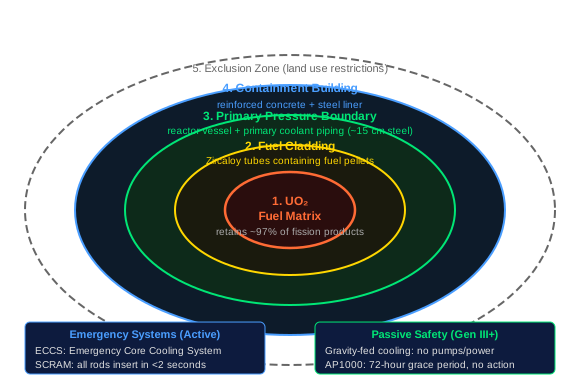
Modern nuclear safety is built on defense in depth: multiple independent barriers, each designed to prevent or mitigate accidents even if preceding barriers fail.
The five barriers in an LWR:
1. Fuel matrix: UO₂ ceramic retains ~97% of fission products even at high temperature
2. Fuel cladding: Zircaloy tubes contain fuel pellets & prevent fission product release to coolant
3. Primary pressure boundary: reactor vessel, pressurizer, & primary coolant piping: 15 cm steel
4. Containment building: reinforced concrete + steel liner, designed to withstand internal steam explosion & external aircraft impact
5. Exclusion zone: land use restrictions around the site
Emergency systems (active):
- ECCS (Emergency Core Cooling System): high-pressure & low-pressure injection systems that flood the core if primary coolant is lost
- SCRAM (Safety Control Rod Axe Man: the original term was literal): all control rods insert in <2 seconds
- Containment spray: water mist cools & de-pressurizes containment post-accident
Passive safety (Gen III+ designs: AP1000, ESBWR):
- Gravity-fed water tanks above the reactor: need no pumps or AC power
- Natural circulation cooling using density differences in water: no pumps required
- Passive autocatalytic recombiners (PARs) in containment: convert H₂ + O₂ → H₂O without ignition, preventing hydrogen explosions
- AP1000 designed for 72-hour grace period with no operator action
The Fukushima lesson: The AP1000 passive safety systems were designed specifically in response to Fukushima failure modes. Fukushima's active ECCS pumps lost AC power (tsunami flooded the generators). Passive systems require no external power.
Design a Safe Reactor
Pulling It All Together
You now have the complete physics toolkit for nuclear engineering: four-factor formula, criticality, delayed neutrons, moderation, fuel cycle, reactivity coefficients, thermal hydraulics, & accident analysis.