Welcome to 301
Nuclear Physics 301: Safety Systems & Defense in Depth
You have studied how atoms split & how reactors sustain a controlled chain reaction. Now the question becomes: how do you keep it controlled?
Nuclear energy is extraordinarily power-dense. A single uranium fuel pellet the size of a pencil eraser holds as much energy as 17,000 cubic feet of natural gas. That density is the source of both its promise & its challenge.
This module treats nuclear safety the way a licensed nuclear engineer or reactor operator treats it: as a discipline of layers, redundancy, diversity, & humility. Every system we study exists because someone, at some point, thought hard about what could go wrong.
By the end of this module you will understand why nuclear plants are the most rigorously engineered facilities humans have ever built: and why even that rigor has sometimes not been enough.
Warm-Up
Before we begin, consider the challenge. A large pressurized water reactor (PWR) generates about 3,400 megawatts of thermal energy. Even after the reactor shuts down, radioactive decay of fission products generates about 7% of that power: roughly 240 megawatts: in the first seconds after shutdown. An hour later it is still 1% (34 MW). That heat cannot simply stop.
IAEA Definition
Defense in Depth: The Organizing Philosophy
The International Atomic Energy Agency (IAEA) defines defense in depth as a multi-layered approach to safety, in which each layer acts as a backup to the ones before it. No single layer is assumed to be perfect. The safety case depends on having multiple independent layers, so that no single failure: and no single combination of failures from a single root cause: can lead to harm.
Defense in depth operates at every scale:
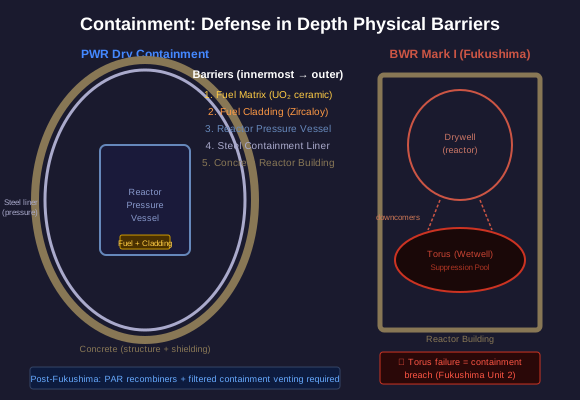
Physical barriers: fuel matrix → fuel cladding → reactor pressure vessel → containment building → reactor building (4-5 physical boundaries between fuel & environment)
Safety systems: each function (cooling, shutdown, power) is performed by at least 3 independent trains
Procedures: written procedures govern every evolution; abnormal & emergency procedures for every design basis event
Operators: licensed, trained, qualified, rested; independent authority to initiate shutdown
Management: nuclear safety culture, regulatory oversight, independent safety reviews
Regulation: NRC 10 CFR 50 design basis requirements, licensed operation, periodic inspections
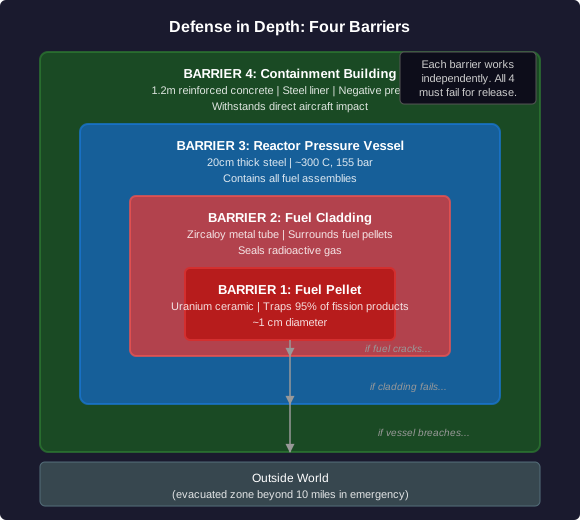
Key principle: No credit for failed layers. If you cannot confirm a barrier is intact, you assume it is not. The entire system is designed to be safe with any one active component failed: this is called the single failure criterion.
Redundancy, Diversity, and Independence
Three Properties That Make Defense Real
Nuclear safety systems must satisfy three distinct properties. Confusing them is a common & dangerous error.
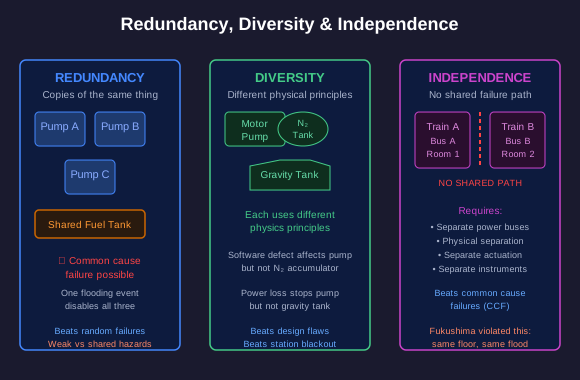
Redundancy means having more than one of the same thing. Three diesel generators are redundant. But if they all share the same fuel tank, the same start logic, or the same physical room, redundancy alone does not protect against a common cause failure.
Diversity means using different physical principles or different equipment to perform the same function. A high-pressure injection pump and a nitrogen-pressurized accumulator both deliver water to the core: but they work on entirely different principles. Diversity defeats failure modes that would defeat all redundant copies of one design.
Independence means that failure of one train cannot cause or prevent the operation of another. Independence requires:
- Separate power buses (different electrical feeds)
- Physical separation (barriers, different buildings, opposite sides of the reactor)
- Separate actuation logic (a short circuit in Train A cannot disable Train B)
- Separate instrumentation (Train A sensors do not feed Train B actuation)
Common cause failure (CCF) is the nightmare scenario: a single event disables multiple redundant trains simultaneously. Fukushima is the defining example: the tsunami was not just a loss of offsite power. It simultaneously disabled all three emergency diesel generators because they were all in the same low-lying building. Redundancy without independence is an illusion.
Single Failure Criterion
The NRC's single failure criterion (10 CFR 50, Appendix A, General Design Criterion 17) states that safety systems must be designed so that no single active component failure prevents the system from performing its safety function.
An 'active' failure is one that requires something to change state: a pump failing to start, a valve failing to open.
A 'passive' failure (e.g., a pipe crack) is addressed by separate design requirements.
Why Three Trains?
Every Safety-Critical System: Three Independent Trains
The rule of triple redundancy is not simply 'three is safer than two.' It is a precise engineering requirement with specific properties.
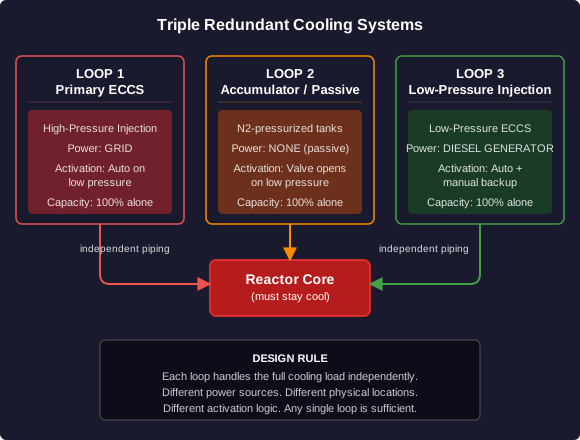
Each train must be capable of 100% of the safety function independently. If Train A handles cooling, it handles all the cooling needed. Trains B and C are not partial contributors: they are full backups.
Trains must be physically separated. Different buildings, or at minimum separated by fire barriers. Different cable routes. Different pipe runs. If a fire, flood, or explosion affects one train, it must not reach the others.
Trains must have separate power supplies. Different electrical buses fed from different sources. Train A on Bus A, Train B on Bus B, Train C on Bus C: each bus with its own emergency diesel.
Trains must have separate actuation logic. A relay failure in Train A's actuation circuit cannot prevent Train B from actuating. Ideally, they use different actuation principles entirely (diversity).
Why three and not two? With three trains, two-of-three voting logic means any single component failure still leaves two functional trains: you get both the single failure criterion AND some protection against common cause failures. With two trains, a single failure leaves you with one train: no margin, no defense against a second failure.
Diversity vs. Redundancy
Consider a PWR's emergency core cooling system. One approach: three identical high-pressure injection pumps, each powered by a separate diesel generator, in separate rooms.
A second approach: one high-pressure injection pump, plus one nitrogen-pressurized accumulator that requires no power, plus one gravity-fed water tank from an elevated reservoir.
Both provide three means of delivering water to the core.
ECCS: The Core's Last Line
Emergency Core Cooling Systems
The design basis accident for a PWR is the loss of coolant accident (LOCA): a break in the reactor coolant system that allows primary coolant to escape. A large-break LOCA can uncover the core in seconds. Without immediate flooding, fuel cladding temperatures rise above 2,200°F, zircaloy oxidizes, and fuel damage begins.
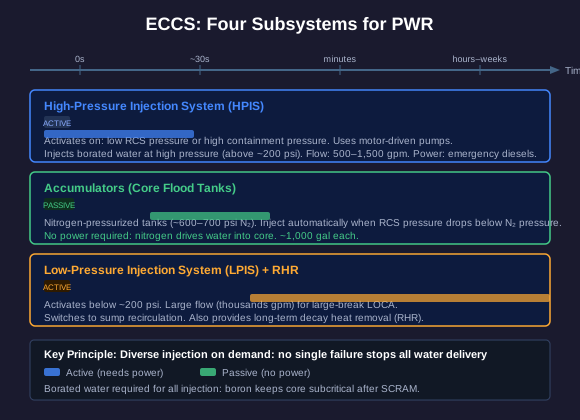
The ECCS for a typical PWR has four subsystems, each operating in a different phase of the accident:
High-Pressure Injection System (HPIS): Activates immediately on low reactor coolant pressure or high containment pressure. Injects borated water into the reactor coolant system while pressure is still high (above ~200 psi). Uses motor-driven pumps powered by emergency diesels. Flow rate: 500-1,500 gpm depending on design.
Accumulators (also called Core Flood Tanks): Passive nitrogen-pressurized tanks containing borated water. They inject automatically when reactor coolant pressure drops below the nitrogen pressure (typically 600-700 psi). No power required: the nitrogen pressure drives water into the core. Each accumulator holds ~1,000 gallons.
Low-Pressure Injection System (LPIS): Activates at low pressure (<200 psi). Provides large flow rates (thousands of gpm) for large-break LOCA. After the refueling water storage tank (RWST) empties, the system switches to sump recirculation: recirculating water from the containment sump back through the core. Must continue for weeks (decay heat removal).
Residual Heat Removal (RHR): Also called the Decay Heat Removal system. Primary purpose: remove decay heat after the reactor reaches cold shutdown. Operates at low pressure & low temperature, circulating coolant through heat exchangers. Also provides low-pressure injection capability.
BWR Core Spray Systems: Boiling water reactors use core spray nozzles above the fuel that spray water directly onto the fuel bundles: a different geometry than PWR flooding.
Decay Heat Curve
The decay heat curve is one of the most important numbers in nuclear safety. After reactor shutdown:
- t = 0 seconds: ~7% of rated power (240 MW for a 3,400 MW reactor)
- t = 1 minute: ~3.5%
- t = 1 hour: ~1% (~34 MW)
- t = 1 day: ~0.3% (~10 MW)
- t = 1 week: ~0.1%
- t = 1 year: fuel still generating measurable heat from long-lived isotopes
Ten megawatts of heat, sustained indefinitely, with no power to run cooling pumps. This was the exact situation at Fukushima Daiichi on March 11, 2011.
Passive ECCS: AP1000 Design
Next Generation: Passive Safety
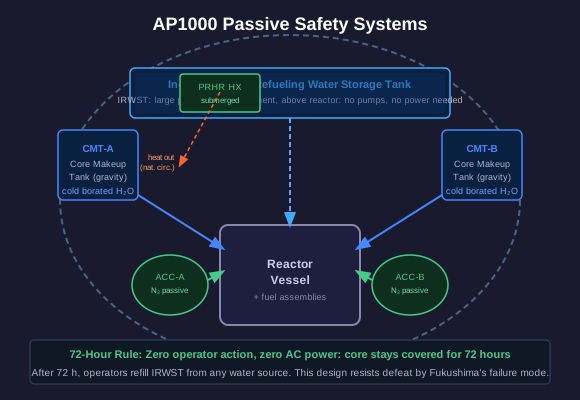
The Westinghouse AP1000 (Advanced Passive 1000 MWe) takes the lessons of active ECCS & inverts the design philosophy: instead of three trains of pumps needing power, all safety functions rely on gravity, natural circulation, compressed gas, & evaporation.
Core Makeup Tanks (CMT): Two large tanks of cold borated water mounted above the reactor. Normally isolated. On actuation, they drain by gravity into the reactor coolant system. Each tank holds enough water to keep the core covered for hours.
Accumulators: Same as conventional plants: nitrogen-pressurized, passive injection.
In-Containment Refueling Water Storage Tank (IRWST): A large water pool inside the containment building, above the reactor. Gravity-fed. Provides long-term cooling after CMTs empty. No pumps. No power.
Passive Residual Heat Removal Heat Exchangers (PRHR HX): Submerged in the IRWST. Natural circulation carries decay heat from the reactor into the IRWST water, which heats, boils, & vents to atmosphere through a chimney. No pumps. Entirely passive.
72-hour window: The AP1000 safety case demonstrates 72 hours of core cooling with no operator action & no power. After 72 hours, operators can refill the IRWST with water from any source.
This design diversity: passive vs. active: is why diversity matters. The AP1000's safety systems cannot be defeated by the failure mode that destroyed Fukushima.
Last Physical Barrier
Containment: The Final Boundary
If every other safety system fails & the fuel is damaged, containment is the last barrier between radioactive material & the public. It must hold: against internal pressure from steam, against hydrogen combustion, against missile impacts from failed equipment, & for as long as necessary.
PWR dry containment: A steel-lined reinforced concrete structure, typically 140 feet in diameter & 200 feet tall. Designed to hold the steam pressure from a complete double-ended guillotine break of the largest primary coolant pipe (design pressure ~60 psi). The steel liner is the pressure boundary; the concrete provides structural strength & biological shielding.
Ice condenser containment: A smaller, lower-pressure PWR containment design (used in some Westinghouse plants) that uses hundreds of tons of ice to absorb steam energy & keep containment pressure low in a LOCA. Allows a smaller, cheaper structure but requires periodic ice maintenance.
Double containment: Some designs place an inner steel containment inside an outer concrete secondary containment building. The space between them is kept at slightly negative pressure so any leakage from the inner containment is collected & filtered before release.
BWR containment: Mark I, II, III: General Electric BWR containments are smaller because they use a pressure suppression pool (torus or wetwell) to condense steam rapidly. The Mark I (Fukushima's design) is a drywell-torus arrangement: the torus is a large donut-shaped water pool below the drywell. A weakness: the torus is attached to the bottom of the drywell. If the torus fails, containment fails. This is exactly what happened at Fukushima Unit 1.
Passive autocatalytic recombiners (PAR): Post-Fukushima, most containments now include PARs: devices containing catalytic material (palladium or platinum) that reacts hydrogen with oxygen to form water, without ignition, at low concentrations. This prevents hydrogen accumulation that could cause deflagration or detonation.
Filtered containment venting: Post-Fukushima requirement in Europe & increasingly in the US: a hardened vent path with a multi-stage filter system (venturi scrubber + metal fiber filter) that allows operators to deliberately vent containment while retaining >99.9% of particulate radioactivity. This prevents the uncontrolled failure of containment from overpressure.
Design Basis and Beyond Design Basis
What Containment Is Designed For
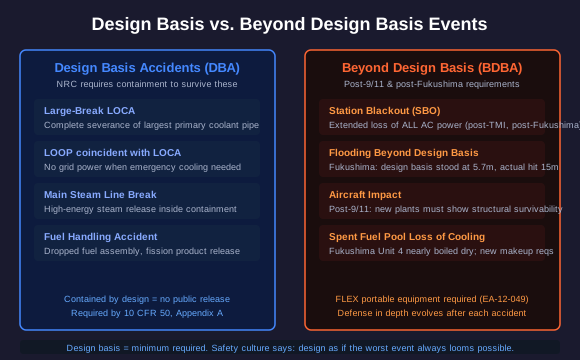
Design basis accidents (DBA): The NRC requires containment to survive any of these simultaneously:
- Large-break LOCA: complete severance of the largest primary coolant pipe, maximum coolant release
- Loss of offsite power (LOOP) coincident with LOCA: no grid power when you most need it
- Main steam line break: high-energy steam release inside containment
- Fuel handling accident: dropped fuel assembly, release of fission products from damaged fuel
Beyond design basis events (BDBA): Post-9/11 & post-Fukushima, plants must also address:
- Station blackout (SBO): extended loss of all AC power (post-TMI requirement, strengthened post-Fukushima)
- Flooding beyond design basis: Fukushima showed that design basis flood heights were too low
- Aircraft impact: NRC requires post-9/11 analysis of deliberate aircraft impact; new plants must demonstrate structural survivability
- Spent fuel pool loss of cooling: Fukushima Unit 4 spent fuel pool nearly boiled dry; post-Fukushima requirements added dedicated SFP makeup connections
Mark I Vulnerability
Fukushima Daiichi Units 1, 2, & 3 all had General Electric Mark I containments. The Mark I uses a drywell (a light bulb-shaped steel vessel around the reactor) connected to a toroidal suppression pool (the torus) by downcomers. Steam from the drywell is directed into the torus water for condensation.
During the accident, the torus at Unit 2 is believed to have been damaged, allowing fission products to escape directly to the reactor building & then to the atmosphere without passing through the full containment boundary.
Shutdown Systems
Reactivity Control: Three Independent Paths to Shutdown
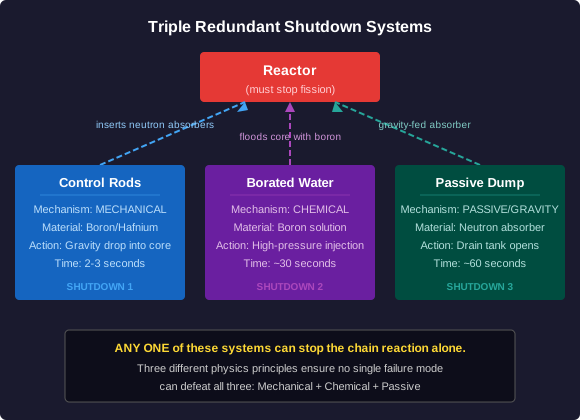
A reactor must be able to shut down & stay shut down under any conditions. No single failure can be allowed to prevent shutdown. The general design criterion (GDC 26) requires two independent reactivity control systems, each capable of holding the reactor subcritical.
Control rod drive mechanisms (CRDMs):
- PWR magnetic jack CRDMs: Control rods are held up by electromagnets. On loss of power (SCRAM signal or loss of power), the magnets de-energize & rods fall by gravity into the core. Fail-safe: power required to keep rods OUT. Loss of power = automatic insertion.
- BWR hydraulic CRDMs: Rods are driven in from below by high-pressure water. Emergency insertion uses high-pressure nitrogen to drive rods in rapidly. Some BWR designs also have an electrical backup for rod insertion.
Alternate Rod Insertion (ARI): A separate, diverse electrical signal path that can insert control rods independent of the normal SCRAM logic. Used if the normal SCRAM circuit fails.
Anticipated Transient Without Scram (ATWS): The regulatory scenario where the control rods fail to insert on demand. ATWS mitigation systems (ATWS-MF) provide boron injection independent of the normal SCRAM: typically automatic high-pressure boron injection triggered by a separate sensor set.
Emergency boration:
- High-pressure boron injection from a separate standpipe (separate from normal charging)
- Emergency boration via the ECCS boron injection lines
- Manual boration from the boric acid storage tanks
Passive designs: CANDU reactor: The CANDU has two completely independent shutdown systems: (1) mechanical shutoff rods that fall by gravity, and (2) high-pressure injection of gadolinium nitrate solution into the moderator: a separate physical circuit. These are independent in every sense: different actuation logic, different physical systems, different principles.
ATWS Analysis
During testing in 1979 at Three Mile Island Unit 2, a maintenance error caused a reactor trip (SCRAM) to fail to occur during a test. The event was caught quickly. But it prompted the NRC to require ATWS mitigation systems at all plants: because 'impossible to fail' systems had, in fact, failed.
An ATWS event in a PWR: the reactor power surges. Control rods fail to insert. Emergency boration is the last line of defense.
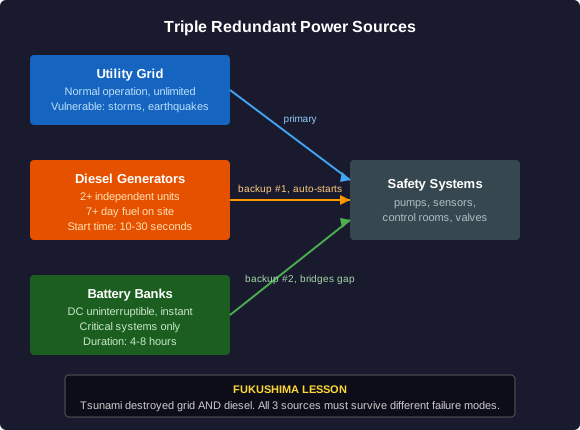
Three-Layer Power Architecture
Nuclear Plant Electrical Power: Three Independent Layers
A nuclear plant must maintain power to its safety systems regardless of what happens to the grid or its own generating equipment. The power architecture has three layers:
Layer 1: Normal operation: The plant generates its own power from the main turbine generator. Auxiliary loads (pumps, fans, controls) are powered from the plant's own output via unit auxiliary transformers.
Layer 2: Offsite power (preferred AC source): If the main generator trips, the plant connects to the grid through startup/reserve transformers. NRC requires at least two independent transmission lines from different substations: so a single transmission fault cannot cause total offsite power loss.
Layer 3: Emergency diesel generators (EDGs): If offsite power is lost, EDGs start automatically and load safety buses within 10 seconds. NRC requirements:
- Each EDG must reach rated voltage & frequency within 10 seconds of receiving a start signal
- Fuel storage: minimum 7 days at full load (NRC Regulatory Guide 1.9)
- Testing: monthly load test + 24-hour endurance test every 24 months
- Load sequencing: safety loads are connected in sequence to avoid overloading the diesel on start
Station batteries: DC power for instrumentation, control room panels, emergency lighting, SCRAM actuation circuits, ATWS actuation, & communication. Must supply loads for minimum 2 hours (Class 1E); most plants design for 4-8 hours. Battery chargers restore batteries when AC returns.
Post-Fukushima FLEX Strategy: NRC Order EA-12-049 requires all plants to have portable pumps & generators deployable within defined timeframes regardless of site conditions. FLEX equipment is staged in multiple locations (some in robust structures, some offsite) & can connect to hardened external connection points on reactor cooling & spent fuel pool systems.
Diesel Generator Requirements
Three Mile Island Unit 2, 1979: The accident sequence involved a turbine trip followed by a loss of feedwater, followed by a complex series of events that led to core damage. The emergency diesel generators started & ran correctly throughout the event.
Fukushima Daiichi, 2011: The earthquake caused reactor SCRAM. All six diesels started & ran. Then the tsunami arrived. The diesels for Units 1-3 were in basement rooms that flooded. The diesel for Unit 6 was in a higher location & survived. Units 5 & 6 did not suffer core damage.
Reactor Protection System
Reactor Protection System (RPS)
The Reactor Protection System is the automatic system that initiates a reactor SCRAM (rapid shutdown) when monitored parameters exceed safe limits. It is the first automatic defense against transients.
Monitored parameters that can initiate SCRAM:
- High neutron flux (high power)
- High reactor coolant temperature
- Low reactor coolant pressure (potential LOCA)
- High containment pressure
- Low reactor coolant flow
- High coolant level (BWR)
- Low-low water level (BWR)
- Loss of offsite power
- Manual trip (operator-initiated)
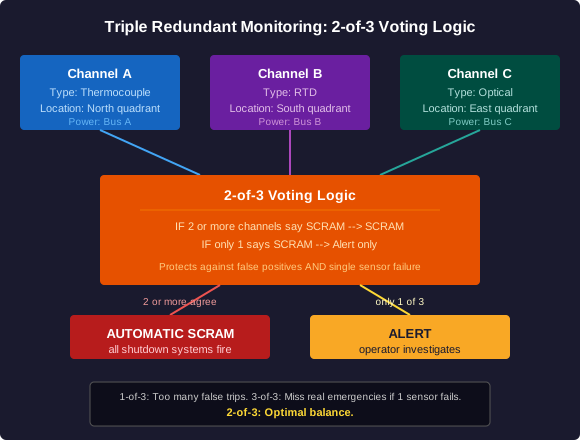
Voting logic: Each parameter gets measured by four independent sensors, each in a separate protection channel. A SCRAM requires 2-of-4 channels to exceed the setpoint. This means:
- A single failed sensor (false high reading) cannot cause a spurious trip
- Any two channels exceeding the setpoint initiates the trip
- A single failed channel (reading low falsely) leaves three channels, still 2-of-3 capable
Diverse and Dedicated Actuation System (DDAS): Modern digital RPS systems have an analog backup: DDAS: that can initiate safety functions independently of the digital I&C. This provides diversity: the digital and analog systems can fail for completely different reasons, and one failure does not prevent the other from functioning.
2-of-4 vs 2-of-3 Logic
The RPS uses 2-of-4 voting for initiating SCRAM (four sensors, two must agree to trip). But the individual sensors report to the actuation system using 2-of-3 voting within each train (three measurements, two must agree to actuate a specific safety function like ECCS).
These are not the same thing, & understanding the difference matters.
Minimum Staffing
Human Oversight: The Layer That Thinks
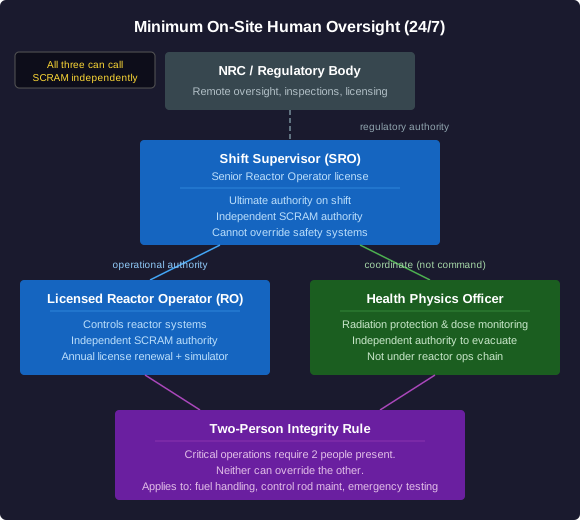
Nuclear plant operations require licensed personnel on shift at all times. NRC 10 CFR 50.54(m) establishes minimum staffing requirements. At minimum, operating crews include:
Reactor Operator (RO): NRC-licensed (10 CFR 55). Directly operates the reactor controls, main control board, & safety systems. Must be at the controls continuously during power operations.
Senior Reactor Operator (SRO): Higher NRC license. Supervises the RO. Has independent authority to initiate shutdown. Reviews & approves the RO's actions during abnormal events. Cannot be the same person as the RO on shift.
Shift Supervisor (SS): Senior SRO-licensed. Responsible for the overall conduct of operations & safety of the plant during the shift. Final authority on site for plant operations.
Shift Technical Advisor (STA): Post-TMI requirement (NUREG-0737). A licensed engineer assigned to each shift specifically to provide independent technical support during abnormal events: not distracted by operating controls, focused entirely on diagnosing the event.
Why multiple people? Defense in depth in the human layer. An RO under stress, focused on executing procedures, may miss the big picture. The SRO provides independent oversight. The STA provides independent technical analysis. The shift supervisor maintains situational awareness. No single human cognitive failure can prevent the plant from being safely controlled.
Human Performance Tools
Reducing Human Error: Systematic Tools
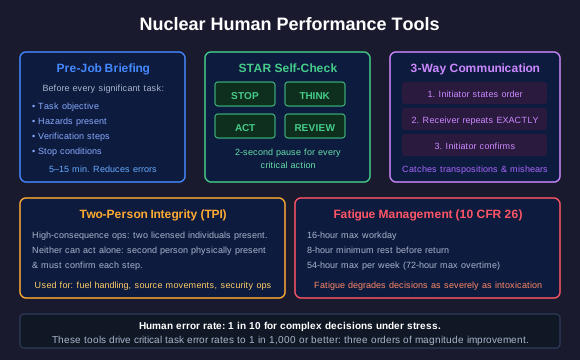
The nuclear industry has quantified human error rates for different task types. Error rates for complex decision-making under stress can exceed 1 in 10. The industry targets error rates of 1 in 1,000 or better for critical tasks: and achieves them through systematic human performance tools.
Pre-job briefing: Before any significant task, a briefing covers: task objective, hazards, expected conditions, steps to verify completion, stop conditions (if X happens, stop & call supervisor). Takes 5-15 minutes. Dramatically reduces task execution errors.
STAR (Stop, Think, Act, Review): Self-check technique for every critical action. Stop: pause before the action. Think: what am I about to do, & is this correct? Act: perform the action. Review: was the result what I expected? The two-second pause catches transposition errors, wrong-valve selections, & cognitive shortcuts.
Three-way communication: For all safety-significant verbal orders: (1) Initiator states the order: 'Align valve HV-233 to the open position.' (2) Receiver repeats back exactly: 'Align valve HV-233 to the open position.' (3) Initiator confirms: 'That is correct.' A communication error that is not caught in this exchange is unusual: it requires both parties to mishear or misremember.
Two-person integrity: For certain high-consequence operations (security-related, source handling), two licensed individuals must be present and mutually verify each other's actions. Neither person can perform the sensitive action alone: the second person must be physically present and confirm each step.
Fatigue management: NRC 10 CFR 26 establishes limits: 16-hour maximum work day, 8-hour minimum rest before returning to duty, 54-hour maximum per week, 72-hour maximum per week under overtime. Fatigue degrades decision-making as severely as intoxication: these limits are not productivity recommendations, they are safety requirements.
Emergency Operating Procedures
Before Three Mile Island (1979), nuclear plants used event-based emergency procedures: if X event occurs, execute procedure X. Operators had to correctly identify the event before taking action.
At TMI, operators received contradictory indications. A pressure relief valve was stuck open: this was a small-break LOCA: but operators misidentified the event and followed the wrong procedure. By the time the correct diagnosis was made, significant core damage had occurred.
Post-TMI, the industry developed symptom-based emergency operating procedures (EOPs). Instead of 'identify event, select procedure,' operators follow: 'observe symptoms, take protective actions for those symptoms, regardless of what you think the event is.'
The key symptom-based entry condition: any unexpected change in reactor coolant level, pressure, or temperature, regardless of cause, triggers the same core cooling verification sequence.
ALARA: As Low As Reasonably Achievable
Radiation Protection Engineering
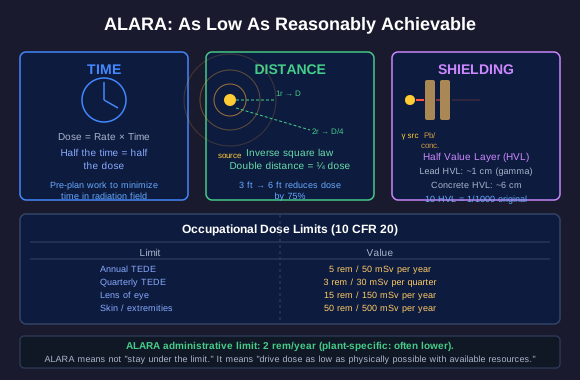
ALARA: As Low As Reasonably Achievable: is not simply a dose limit. It is a philosophy: dose should be driven as low as practical, not just kept below legal limits. The NRC mandates ALARA as a regulatory requirement (10 CFR 20.1101), not merely good practice.
External dose management: the three classic controls:
- Time: Cut time in the radiation field in half, cut dose in half. Pre-planned work sequences minimize unnecessary time in high-dose areas.
- Distance: Dose rate follows the inverse square law. Double your distance from a point source, quarter your dose rate. Working from six feet instead of three feet reduces dose by 75%.
- Shielding: Lead, concrete, water, & polyethylene attenuate different radiation types. The Half Value Layer (HVL) is the thickness that reduces intensity by half. Lead HVL for typical gamma: ~1 cm. Concrete HVL: ~6 cm. After ten HVLs (10 TVL = Tenth Value Layer), intensity is reduced to 1/1,000 of original.
Internal dose management:
- Radioactive material inside the body continues to irradiate organs until it decays or is excreted
- Pathways: inhalation (aerosols, gases), ingestion (contaminated food/water), absorption through skin (rare)
- Derived Air Concentration (DAC): the airborne concentration of a radionuclide that, if inhaled for 2,000 hours/year, delivers the occupational dose limit. Respirators & negative-pressure enclosures prevent inhalation dose.
- Annual Limit on Intake (ALI): total intake (inhalation + ingestion) that delivers the occupational dose limit
Occupational dose limits (10 CFR 20):
- 5 rem (50 mSv) per year total effective dose equivalent
- 3 rem (30 mSv) per quarter
- 15 rem (150 mSv) per year to lens of eye
- 50 rem (500 mSv) per year to skin or extremities
- Dose constraint for ALARA planning: 2 rem/year (plant-specific administrative limits often lower)
Contamination control:
- Radiologically Controlled Areas (RCAs) have controlled access, frisking on exit
- Step-off pads: paper or plastic at RCA exits; change shoe covers here to avoid tracking contamination
- Whole-body counting: after work in areas with potential internal contamination, whole-body gamma counts detect internal uptake
- Bioassay programs: urine & fecal analysis quantify internal dose from specific isotopes
ALARA in Practice
A radiation worker must replace a valve in a high-radiation area. The dose rate at the valve location is 500 mrem/hour. The job requires 30 minutes to complete. The worker's annual dose to date is 1,200 mrem against a plant administrative limit of 2,000 mrem/year.
Using ALARA principles & the three controls, evaluate whether this job can proceed & identify at least two specific actions to reduce dose.
Three Mile Island (1979)
Three Mile Island Unit 2: March 28, 1979
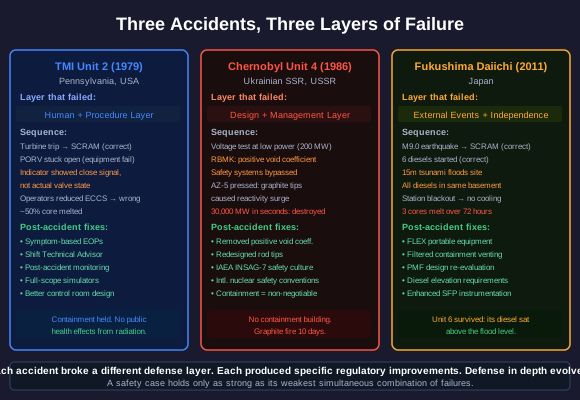
TMI was not a design failure: it was a defense in depth failure at the human and procedure layers.
What happened:
- A turbine trip caused a reactor SCRAM (automatic: worked correctly)
- A pressure relief valve (PORV) opened (correct) but stuck open (equipment failure)
- A control room indicator showed only that the valve had received a close signal: not that it was actually closed
- Coolant escaped through the stuck-open PORV. Pressure & temperature in the reactor fell
- Operators misread the symptoms as excessive coolant and reduced emergency cooling injection: the opposite of what was needed
- For over two hours, the reactor core was partially uncovered
- Approximately half the core melted
What the containment did: It held. Despite severe core damage and hydrogen accumulation inside containment, the containment structure retained essentially all the fission products. Off-site dose consequences were minor: no public health effects from radiation.
Post-TMI improvements (NUREG-0737):
- Symptom-based EOPs (replacing event-based)
- Shift Technical Advisors on every shift
- NRC-certified full-scope simulators for crew training
- Post-accident monitoring instrumentation (PAM): direct core cooling indicators, qualified display panel on AC-independent power
- Revised control room design standards (NUREG-0700)
- Improved operator licensing examination requirements
Chernobyl (1986)
Chernobyl Unit 4: April 26, 1986
Chernobyl was different in character from TMI: it was primarily a design deficiency combined with deliberate safety system bypasses.
What happened:
- A voltage stability test required running the reactor at low power (~200 MW, vs. rated 3,200 MW)
- At low power, the RBMK reactor had a positive void coefficient: steam bubbles in the coolant increased reactivity
- Control rods had a design defect: the graphite tips displaced water when first inserted, causing an initial reactivity increase before the neutron-absorbing part entered the core
- The test was delayed; the overnight crew was not trained for it
- Multiple safety systems were intentionally disabled to run the test
- On pressing the emergency shutdown button (AZ-5), the graphite rod tips caused a reactivity surge rather than the intended SCRAM
- Power spiked to 30,000 MW in seconds: about 10x rated power
- Fuel & coolant flashed to steam, causing a steam explosion that destroyed the reactor
- Graphite fire burned for 10 days, dispersing fission products across Europe
No containment: The RBMK had no full containment building. The reactor sat in a large industrial building without pressure-retaining capability. When the reactor was destroyed, there was no last barrier.
Post-Chernobyl changes:
- RBMK design modifications: removed positive void coefficient at low power, redesigned rod tips, added additional neutron absorbers
- International nuclear safety conventions strengthened
- Nuclear safety culture concept formalized by IAEA (INSAG-7)
- Western regulatory emphasis on containment as a non-negotiable requirement
Three Accidents, Three Lessons
You now know the three major civilian nuclear accidents: TMI (1979), Chernobyl (1986), & Fukushima (2011). Each revealed a different kind of defense in depth failure.
Quantifying Risk
PRA: Moving From 'Safe Enough' to 'How Safe?'
Deterministic safety analysis says: design the plant to survive these specific accidents. Probabilistic Risk Assessment (PRA) asks a different question: given all the ways things could go wrong, what is the probability that they actually do?
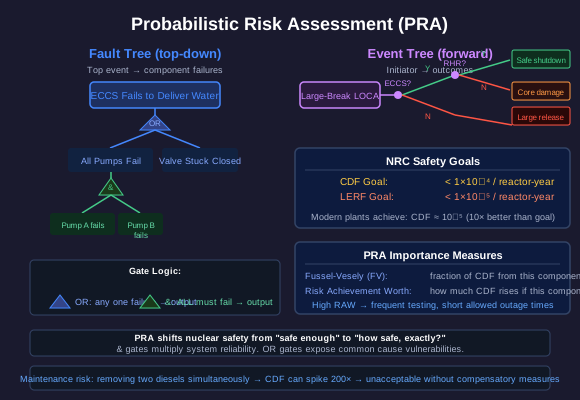
Core damage frequency (CDF): The probability that reactor core will be significantly damaged in any given year. NRC's safety goal: CDF < 1×10⁻⁴ per reactor-year (once in 10,000 reactor-years). Modern plants typically achieve CDF < 1×10⁻⁵ (once in 100,000 reactor-years).
Large early release frequency (LERF): The probability of a large, early release of radioactivity to the environment (before evacuation could be completed). NRC safety goal: LERF < 1×10⁻⁵ per reactor-year.
Fault trees: Graphical logic diagrams that show the combinations of component failures that lead to a defined top event (e.g., 'ECCS fails to deliver water to core'). Uses AND gates (all must fail) & OR gates (any one failure sufficient). AND gates reduce probability (require multiple simultaneous failures). OR gates increase probability.
Event trees: Graphical diagrams that start with an initiating event (e.g., 'large-break LOCA occurs') & trace the consequences depending on whether safety systems succeed or fail. Each branch represents the success or failure of a safety function. Terminal nodes are accident sequences: safe shutdown, core damage, large release.
Importance measures: PRA identifies which components & systems contribute most to risk.
- Fussel-Vesely (FV) importance: the fraction of CDF contributed by a component's failures. High FV = this component matters a lot.
- Risk Achievement Worth (RAW): how much CDF increases if this component is assumed failed. High RAW = this component must not be out of service for long.
RAW drives maintenance & testing scheduling: high-RAW components get frequent testing & short allowed outage times.
PRA and Maintenance Scheduling
A nuclear plant has three emergency diesel generators (A, B, C). PRA analysis shows:
- CDF with all three operable: 2×10⁻⁵ per year
- CDF with diesel A out of service for maintenance: 8×10⁻⁵ per year (4x increase)
- CDF with diesels A & B simultaneously out: 4×10⁻³ per year (200x increase)
The maintenance team wants to take diesels A & B out of service simultaneously for a major overhaul lasting 30 days.
Spent Fuel: The Long Obligation
Spent Fuel: Active & Passive Management
When fuel is removed from a reactor after 3-5 years of operation, it is intensely radioactive & thermally hot from decay heat. The same decay heat curve applies: 7% of rated power immediately, declining over years.
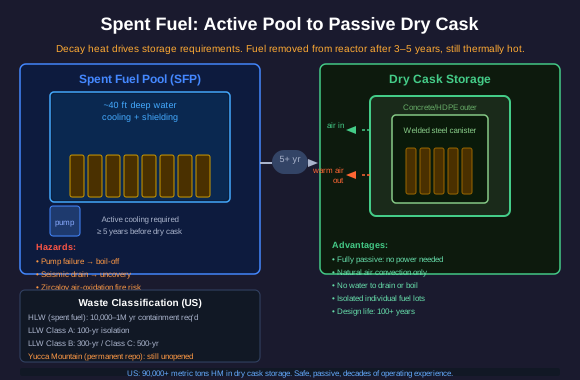
Spent fuel pools (SFP): Immediately after removal, spent fuel assemblies are placed in a spent fuel pool: a water-filled basin, typically 40 feet deep, adjacent to the reactor building. Water serves dual purposes: cooling and shielding (water above the fuel absorbs radiation, allowing workers on the pool deck to receive low doses).
Minimum pool cooling time before dry cask: Approximately 5 years for PWR fuel. The fuel must cool to the point where passive air cooling in a dry cask can handle the remaining decay heat without any water.
Zircaloy fire risk: If spent fuel assemblies are uncovered (pool water lost), zircaloy cladding can oxidize in air at high temperatures. Unlike the steam-zircaloy reaction that produces hydrogen, air-zircaloy oxidation at red-hot temperatures can sustain a zircaloy fire: a self-sustaining exothermic reaction. Fukushima Unit 4's spent fuel pool was within days of reaching temperatures where this could have occurred.
Post-Fukushima SFP requirements (NRC Order EA-12-051):
- Reliable instrumentation for SFP water level & temperature
- Ability to add makeup water to SFP from diverse sources
- Strategies to maintain or restore SFP cooling under extended loss-of-power scenarios
Dry cask storage: After 5+ years in the pool, fuel is transferred to dry casks: welded steel canisters surrounded by concrete or high-density polyethylene shielding. Cooling is entirely passive: natural air convection through vents in the outer structure. No power required. Design life: 100+ years. Currently over 90,000 metric tons of heavy metal in dry cask storage in the US alone.
High-level waste disposal: Spent fuel is classified as high-level nuclear waste. US law (Nuclear Waste Policy Act) designates Yucca Mountain, Nevada as the permanent repository: but it has not opened due to political opposition. The NRC requires that a repository provide 10,000 years of containment (EPA standard: 1 million years for doses beyond 10,000 years). Deep geological disposal uses the rock formation itself as the primary barrier, with engineered barriers (glass vitrification, metal canisters, bentonite clay) as additional layers.
Low-level waste (LLW): Contaminated clothing, tools, filters, resins. Three NRC classes:
- Class A: lowest activity, shortest-lived isotopes. Shallow land burial, 100-year isolation requirement
- Class B: moderate activity. Shallow burial with 300-year isolation
- Class C: higher activity, longer-lived isotopes. Requires 500-year isolation; near-surface disposal with greater engineered barriers
Volume reduction techniques (incineration, compaction, melting) are mandatory to minimize disposal space
Dry Cask Safety Case
A critic argues that dry cask storage is unsafe because the casks have no active cooling, no power connections, & sit outdoors on concrete pads. A nuclear engineer responds that dry casks may actually be safer than the spent fuel pool.
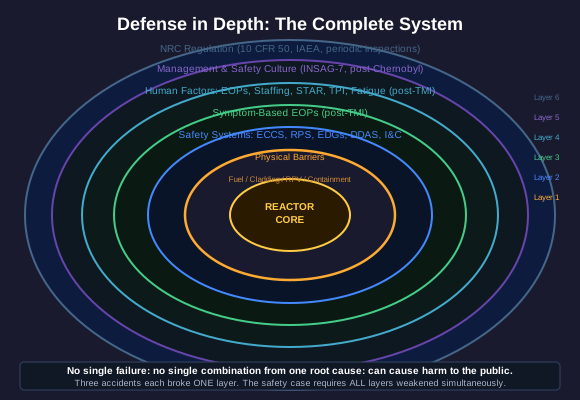
Defense in Depth: The Full Picture
Nuclear Safety Engineering: A Systems Discipline
You have now studied every layer of nuclear safety engineering. Step back & see the system:
Physical barriers (fuel matrix, cladding, pressure vessel, containment) are passive: they do not require any action to work. They are the foundation.
Safety systems (ECCS, RPS, EDGs, DDAS) are active with passive backups (accumulators, gravity tanks, batteries). Each function has three independent trains. Each train is 100% capable. Active & passive approaches are diverse.
Instrumentation (RPS, ECCS actuation, PAM) monitors dozens of parameters with 2-of-4 voting logic: resistant to spurious trips and to sensor failures that would prevent trip.
Procedures (symptom-based EOPs) guide operators to protective actions without requiring a correct diagnosis. Post-TMI. Essential.
Human factors (staffing, training, human performance tools, fatigue limits) reduce the probability that the human layer fails. Post-TMI STA requirement. Simulator training. Pre-job briefings. STAR. Three-way communication.
Management & safety culture ensure that safety is not traded away for efficiency. Post-Chernobyl INSAG-7. The lesson of Chernobyl is that safety systems disabled by management are safety systems that do not exist.
Regulation (NRC 10 CFR 50, IAEA standards, periodic inspections) provides independent oversight at the highest layer. A regulator that does not inspect is a regulator that does not exist.
The three major accidents revealed that defense in depth fails not from a single dramatic failure, but from a combination of small failures, incorrect assumptions, & inadequate margins in multiple layers simultaneously. The safety case is only as strong as its weakest simultaneous combination.
Final Integration
Final Question: The Hardest One
A newly proposed reactor design claims to be so safe that it needs only a single ECCS train (not three), no emergency diesels (passive cooling only), & a simplified staffing model with two operators on shift instead of four.
The designer argues: 'Passive cooling means power is not needed, so diesels are unnecessary. The reactor cannot melt down by physics, so simplified staffing is justified.'