Welcome
Welcome to the fundamentals of patient care: the knowledge that every nurse builds a career on.
Nursing is both a science & an art. The science is clinical: anatomy, pharmacology, pathophysiology. The art is human: communication, empathy, advocacy. Neither works without the other.
Modern nursing traces back to Florence Nightingale, who during the Crimean War proved that sanitation & systematic care reduced mortality more than medicine alone. She did not just treat patients: she collected data, changed systems, & held institutions accountable.
Every nurse operates within a defined scope of practice set by their state board of nursing. This scope determines what you can assess, what you can administer, & when you must escalate to a physician. Working within scope is not a limitation: it is what keeps patients safe.
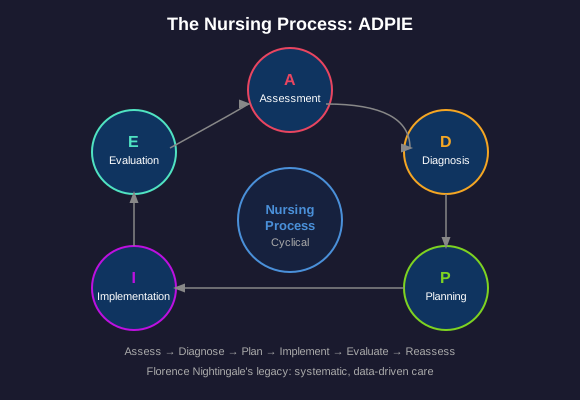
The nursing process is the framework for all patient care: ADPIE: Assessment, Diagnosis (nursing diagnosis), Planning, Implementation, Evaluation. It is cyclical. You assess, you intervene, you reassess. A nurse who stops evaluating stops being safe.
This lesson covers six core competencies: what nurses do, vital signs, patient assessment, medication administration, infection control, & career pathways.
Warm-Up
Quick Check-In
Before we get into clinical skills, let us see where you start from.
Five Vital Signs
Vital Signs: The Numbers That Tell the Story
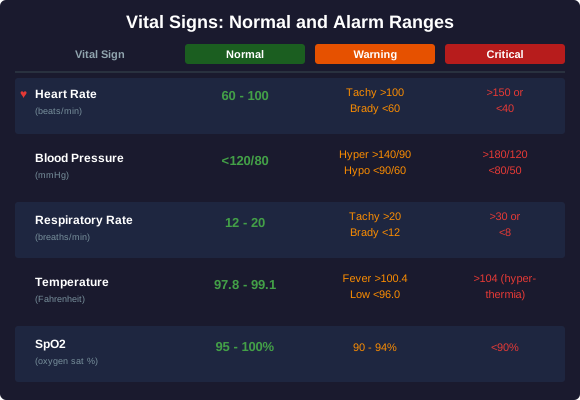
Vital signs are the first objective data you collect on every patient, every time. They are called vital because they measure the functions essential to life.
Temperature: Normal adult range is 97.8-99.1F (36.5-37.3C). Fever (pyrexia) is 100.4F (38.0C) or above. Hypothermia is below 95.0F (35.0C). Route matters: oral, tympanic, axillary, rectal, & temporal artery readings differ. Rectal is the gold standard for accuracy.
Pulse: Normal adult resting heart rate is 60-100 beats per minute. Below 60 is bradycardia. Above 100 is tachycardia. You assess rate, rhythm (regular or irregular), & quality (strong/bounding or weak/thready). Common sites: radial, carotid, apical, pedal.
Respiration: Normal adult rate is 12-20 breaths per minute. Count without telling the patient, if they know you are watching, they change their pattern. Assess rate, depth, rhythm, & effort. Labored breathing, use of accessory muscles, or nasal flaring are red flags.
Blood pressure: Measured in mmHg as systolic over diastolic. Normal adult is less than 120/80. Hypertension stage 1 is 130-139/80-89. Hypotension is generally below 90/60. The Korotkoff sounds you hear through the stethoscope mark systolic (first sound) & diastolic (last sound).
SpO2 (Oxygen saturation): Measured by pulse oximetry. Normal is 95-100%. Below 90% is a clinical emergency. Factors that can give false readings: nail polish, cold extremities, carbon monoxide poisoning (reads falsely high), poor peripheral perfusion.
Interpreting Vital Signs
Putting It Together
Vital signs are only useful if you can interpret them in context.
Head-to-Toe Assessment
Head-to-Toe Assessment: The Systematic Survey
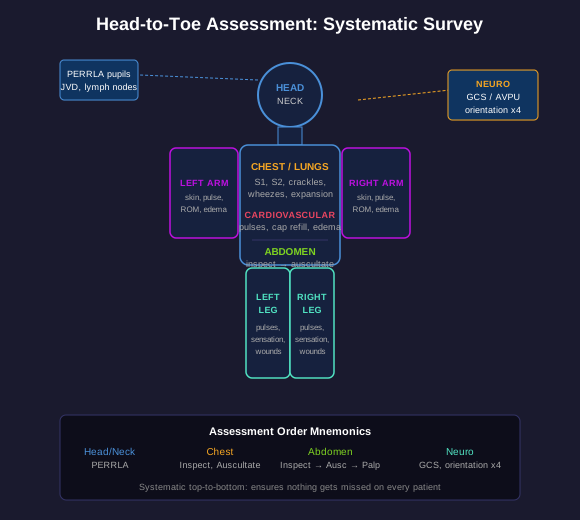
A head-to-toe assessment is a comprehensive, systematic physical examination performed on every patient. The structure ensures nothing gets missed.
Head & neck: Pupils (PERRLA: Pupils Equal, Round, Reactive to Light & Accommodation), facial symmetry, oral mucosa, neck vein distension (JVD), lymph nodes, tracheal position.
Chest & lungs: Auscultate all lung fields bilaterally. Listen for crackles (fluid), wheezes (narrowed airways), or diminished/absent breath sounds. Assess chest expansion symmetry.
Cardiovascular: Heart sounds (S1, S2, any murmurs or extra sounds), peripheral pulses, capillary refill (normal is under 3 seconds), edema in extremities.
Abdomen: Inspect, auscultate, then palpate (in that order, palpating before listening can alter bowel sounds). Listen for bowel sounds in all four quadrants. Note any distension, tenderness, or guarding.
Extremities & skin: Skin color, temperature, moisture, turgor (hydration), any wounds or pressure injuries. Check pulses distally. Assess range of motion.
Neurological: Level of consciousness (Glasgow Coma Scale or AVPU), orientation (person, place, time, situation), grip strength, sensation, gait if ambulatory.
SBAR Communication
SBAR: Speaking So People Listen
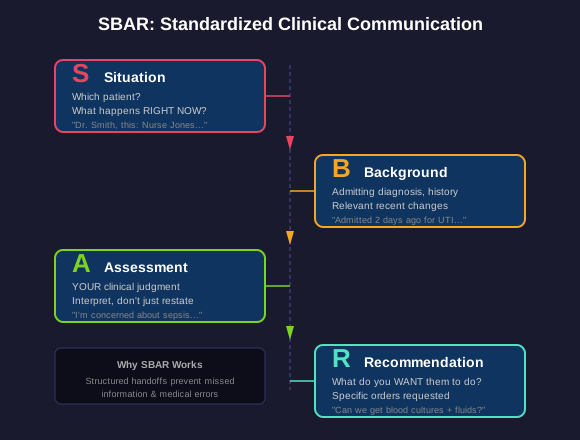
SBAR is the standardized communication framework used in healthcare to relay critical patient information quickly & clearly.
S: Situation: What is happening right now? State the patient, the unit, & the immediate concern.
B: Background: What is the relevant clinical context? Admitting diagnosis, relevant history, recent changes.
A: Assessment: What do you think is going on? Your clinical judgment based on the data.
R: Recommendation: What do you want the provider to do? Order labs? Come evaluate? Change a medication?
SBAR prevents the rambling, disorganized handoffs that lead to missed information & medical errors. It works for nurse-to-nurse handoffs, nurse-to-physician calls, & rapid response activations.
Five Rights
The Five Rights of Medication Administration
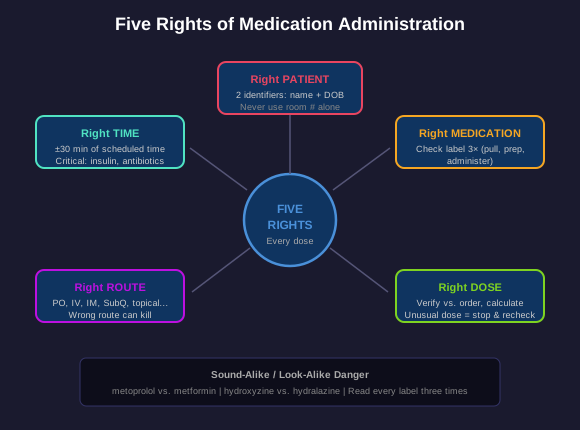
Medication errors are among the most common & preventable causes of patient harm. The Five Rights are the minimum safety check before every medication administration.
Right patient: Verify identity using two identifiers (name & date of birth, or name & medical record number). Never rely on room number alone. Patients get moved. Ask the patient to state their name, do not ask 'Are you Mr. Smith?' because a confused patient will say yes to anything.
Right medication: Compare the medication label to the order. Read the label three times: when you pull it, when you prepare it, & when you administer it. Look-alike/sound-alike drugs are a major source of errors (metformin vs. metoprolol, hydroxyzine vs. hydralazine).
Right dose: Verify the dose against the order. Perform dose calculations if needed. When a calculated dose seems unusually large or small, stop & double-check. A pediatric dose that requires ten adult tablets is a red flag.
Right route: Oral, sublingual, intramuscular, intravenous, subcutaneous, topical, rectal, inhaled, each route has different absorption rates & onset times. A medication meant for oral use given IV can be lethal.
Right time: Administer within the facility-defined window of the scheduled time (typically 30 minutes before or after). Some medications are time-critical: insulin before meals, antibiotics at exact intervals to maintain therapeutic levels.
Many facilities now teach additional rights: right documentation, right reason, right response, & the right to refuse.
Medication Safety Scenario
Applying the Five Rights
Knowing the rights is not enough: you must apply them under real conditions, where interruptions & time pressure create opportunities for error.
Hand Hygiene and Standard Precautions
Infection Control: The Most Important Thing You Will Ever Learn
Healthcare-associated infections (HAIs) affect roughly 1 in 31 hospital patients on any given day. Many are preventable. The single most effective intervention is hand hygiene.
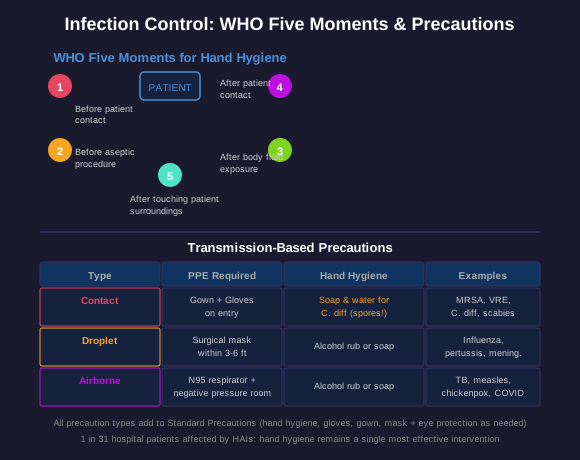
When to perform hand hygiene (WHO Five Moments): before patient contact, before aseptic procedures, after body fluid exposure, after patient contact, & after touching patient surroundings.
Alcohol-based hand rub is preferred for most situations: it is faster & more effective against most organisms than soap & water. Exception: use soap & water when hands are visibly soiled, after caring for patients with C. difficile (spores are alcohol-resistant), & after caring for patients with norovirus.
Standard precautions apply to ALL patients, regardless of diagnosis. They include: hand hygiene, gloves (when touching blood or body fluids), gown (if splashing is anticipated), mask & eye protection (if spraying or splattering is possible), & safe injection practices.
Transmission-based precautions add to standard precautions for known or suspected infections:
- Contact precautions: Gown & gloves for entry. Used for MRSA, VRE, C. difficile, scabies.
- Droplet precautions: Surgical mask within 3-6 feet. Used for influenza, pertussis, meningococcal disease.
- Airborne precautions: N95 respirator & negative pressure room. Used for tuberculosis, measles, chickenpox, COVID-19.
Infection Control Scenario
Applying Infection Control
Knowing the categories is step one. Applying them correctly under pressure is where patient safety lives.
Nursing Career Ladder
From CNA to NP: The Nursing Career Ladder
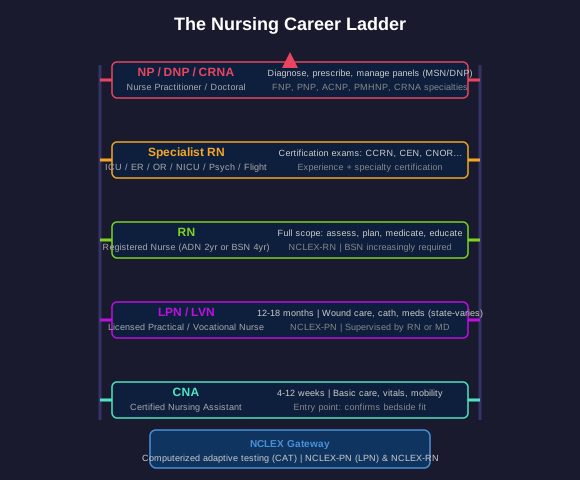
Nursing offers one of the clearest career ladders in healthcare. Each step expands your scope of practice, your autonomy, & your earning potential.
CNA (Certified Nursing Assistant): Training takes 4-12 weeks. CNAs provide basic patient care: bathing, feeding, mobility assistance, vital signs. They work under the supervision of licensed nurses. This is the entry point, & the best way to find out if bedside care is for you before committing to a nursing program.
LPN/LVN (Licensed Practical/Vocational Nurse): A 12-18 month program. LPNs perform more clinical tasks: wound care, medication administration (varies by state), catheter insertion. They work under the supervision of RNs or physicians. Must pass the NCLEX-PN.
RN (Registered Nurse): Two pathways: ADN (Associate Degree in Nursing, 2 years) or BSN (Bachelor of Science in Nursing, 4 years). Both sit for the same NCLEX-RN exam. RNs have full scope: assessment, care planning, medication administration, patient education, care coordination. BSN is increasingly preferred & often required for hospital positions.
NP (Nurse Practitioner): Requires a Master's (MSN) or Doctoral (DNP) degree. NPs can diagnose, order tests, prescribe medications, & manage patient panels. In many states, NPs practice independently without physician oversight. Specializations include Family (FNP), Pediatric (PNP), Acute Care (ACNP), Psychiatric-Mental Health (PMHNP), & more.
The NCLEX: The National Council Licensure Examination is the gateway. NCLEX-PN for LPNs, NCLEX-RN for RNs. It uses computerized adaptive testing (CAT), the test adjusts difficulty based on your answers. You need to demonstrate competence above the passing standard.
Your Nursing Path
Charting Your Course
Nursing specializations range from operating room to mental health, from neonatal intensive care to community health, from flight nursing to informatics. The field is broad enough to fit nearly any interest.