Welcome
Getting to space is not about going up. It is about going sideways: fast enough that you fall around the Earth instead of back down to it.
In 1687, Isaac Newton described a thought experiment: imagine a cannon on top of a very tall mountain. Fire the cannonball horizontally. It falls in an arc and hits the ground. Fire it faster: it travels farther before hitting the ground. Fire it fast enough, and the curve of its fall matches the curve of the Earth. It never lands. It orbits.
That insight: orbit is controlled falling: is the foundation of everything that follows. Every satellite, every space station, every interplanetary probe is just a very sophisticated cannonball.
This lesson covers the physics that gets rockets into orbit & moves spacecraft between worlds. This is the math that NASA, SpaceX, & every space agency on Earth uses every day.
Warm-Up
Before We Begin
The International Space Station orbits at about 400 km above Earth. That is less than the distance from New York to Boston. The astronauts inside are not far from Earth at all: yet they float.
Three Laws That Govern All Orbits
Kepler's Laws
Before Newton explained WHY objects orbit, Johannes Kepler described HOW they orbit. Working from decades of observational data collected by Tycho Brahe, Kepler discovered three laws that describe every orbit in the solar system.
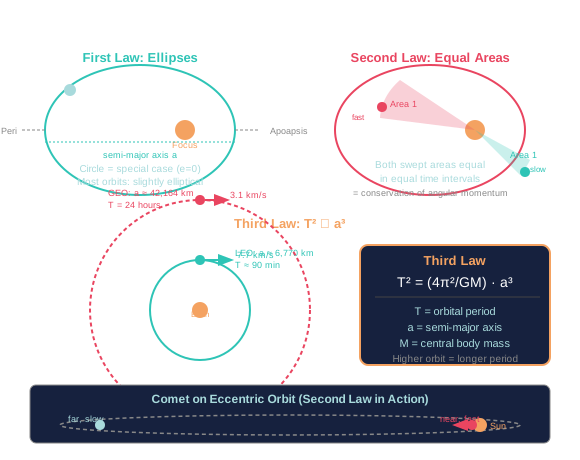
First Law (Law of Ellipses): Every orbit is an ellipse with the central body at one focus. A circle is just a special case of an ellipse. Most real orbits are slightly elliptical: the object is sometimes closer to the central body (periapsis) and sometimes farther away (apoapsis).
Second Law (Equal Areas): A line drawn from the orbiting body to the central body sweeps out equal areas in equal times. This means an object moves faster when it is closer to the body it orbits (near periapsis) & slower when it is farther away (near apoapsis). This is conservation of angular momentum in action.
Third Law (Harmonic Law): The square of an orbit's period is proportional to the cube of its semi-major axis: T-squared is proportional to a-cubed. A satellite farther from Earth takes longer to complete one orbit: not just because the path is longer, but because it also moves slower.
Applying Kepler
Kepler's Third Law in Practice
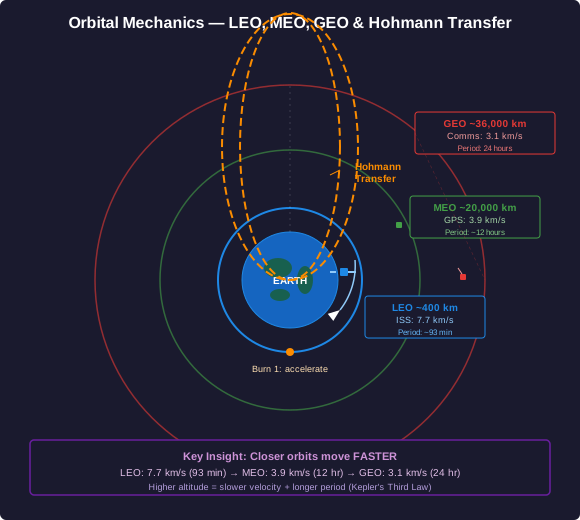
The ISS orbits at about 420 km altitude with a period of roughly 93 minutes. Geostationary satellites orbit at about 35,786 km altitude with a period of exactly 24 hours: they stay fixed over one point on the equator because they orbit at the same rate the Earth rotates.
Kepler's Third Law connects these: higher orbit means longer period. The exact relationship is T-squared = (4 pi-squared / GM) * a-cubed, where a is the semi-major axis measured from Earth's center (not the surface).
How Fast Is Orbit?
Circular Orbital Velocity
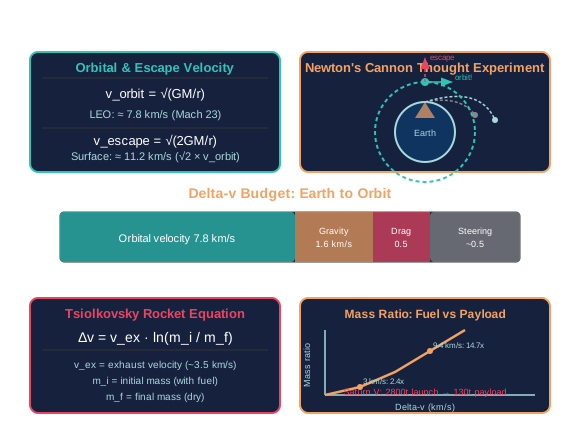
For a circular orbit, the velocity needed to maintain orbit at a given altitude is: v = sqrt(G*M / r), where G is the gravitational constant, M is the mass of the central body, & r is the orbital radius measured from the center of the body.
For low Earth orbit, this works out to about 7.8 km/s: roughly 28,000 km/h or Mach 23. That is the speed Newton's cannonball needs to reach.
Escape Velocity
To leave a body's gravitational influence entirely, you need escape velocity: v_escape = sqrt(2 G M / r). Notice this is exactly sqrt(2) times the circular orbital velocity: about 41% faster.
From Earth's surface, escape velocity is about 11.2 km/s.
Delta-v: The Currency of Spaceflight
Delta-v (change in velocity) is how mission planners measure the cost of every maneuver. Getting from the launch pad to LEO costs about 9.4 km/s of delta-v: more than the orbital velocity of 7.8 km/s because you also have to fight gravity and air resistance during ascent.
Every kilogram of payload requires exponentially more fuel, governed by the Tsiolkovsky rocket equation: delta-v = v_exhaust * ln(m_initial / m_final). This explains why rockets are mostly fuel.
Tyranny of the Rocket Equation
The Rocket Equation
The Tsiolkovsky rocket equation says: delta-v = v_exhaust * ln(m_initial / m_final). The natural logarithm means the relationship between fuel mass & delta-v is exponential.
For a chemical rocket with an exhaust velocity of about 3.5 km/s, reaching LEO (9.4 km/s delta-v) requires a mass ratio of about e^(9.4/3.5) = e^2.69 = about 14.7. That means for every kilogram you put in orbit, you need roughly 13.7 kg of fuel & structure on the launch pad.
This is why the Saturn V weighed 2,800 tonnes at launch but delivered only 130 tonnes to LEO: a ratio of about 21:1.
Changing Orbits
The Hohmann Transfer
A Hohmann transfer is the most fuel-efficient way to move between two circular orbits. It uses two engine burns:
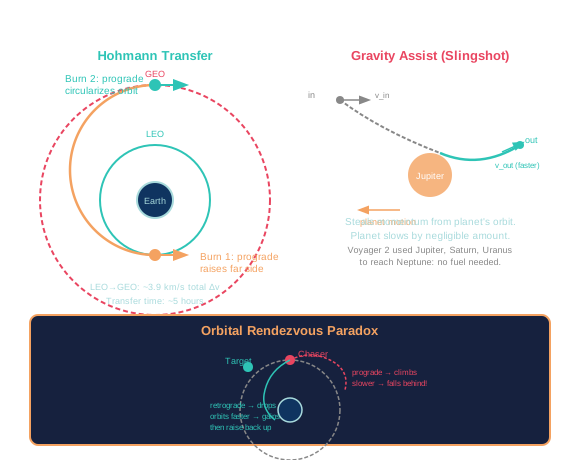
1. First burn (at periapsis): Fire prograde (in the direction of travel) to raise the opposite side of your orbit. You are now on an elliptical transfer orbit whose low point touches the inner orbit & whose high point touches the outer orbit.
2. Second burn (at apoapsis): When you reach the high point, fire prograde again to circularize into the outer orbit.
To go from LEO to geostationary orbit requires about 3.9 km/s of delta-v total.
Gravity Assists
A gravity assist (or gravitational slingshot) uses a planet's gravity and orbital motion to change a spacecraft's velocity without using fuel. The spacecraft falls toward the planet, gains speed, then swings away. Relative to the planet, it leaves at the same speed it arrived: but relative to the Sun, it has gained (or lost) velocity depending on the geometry.
Voyager 2 used gravity assists at Jupiter, Saturn, and Uranus to reach Neptune: a mission that would have been impossible with chemical propulsion alone.
Rendezvous & Docking
To catch another spacecraft in the same orbit, you cannot simply speed up: that raises your orbit and you actually move away. Instead, you drop to a lower (faster) orbit, gain ground, then raise back up to meet the target. This is called a phasing orbit.
Orbital Mechanics Paradox
A Counterintuitive Problem
You are in a circular orbit & you want to catch a spacecraft that is ahead of you in the same orbit. Your instinct says to fire your engines forward to speed up & close the gap.
Orbits and Trajectories in Practice
Low Earth Orbit (LEO)
160-2,000 km altitude. Period: 90-127 minutes. This is where the ISS lives (420 km), where most Earth observation satellites operate, & where SpaceX Starlink satellites orbit (~550 km). Getting to LEO costs about 9.4 km/s of delta-v.
Geostationary Orbit (GEO)
35,786 km altitude, 24-hour period, equatorial. A satellite here appears to hang motionless in the sky: perfect for communications and weather monitoring. Getting from LEO to GEO costs an additional ~3.9 km/s.
Lunar Trajectories
The Moon is about 384,400 km away. A trans-lunar injection burn from LEO costs about 3.1 km/s. Apollo missions took about 3 days to reach the Moon. The Artemis program uses a near-rectilinear halo orbit (NRHO) around the Moon as a staging point for Gateway.
Mars Transfer Windows
Mars transfers use Hohmann-like trajectories that open every 26 months when Earth & Mars are correctly aligned. The transfer takes about 7-9 months. The total delta-v from LEO to Mars orbit is about 5.7 km/s. SpaceX Starship is designed for Mars missions, using orbital refueling to load enough propellant for the transfer.
Designing a Mission
Mission Design Is Delta-v Budgeting
Every mission is a chain of maneuvers, each with a delta-v cost. Mission planners add them up & work backward through the rocket equation to determine how much propellant is needed.
For example, a Mars landing mission budget might look like: LEO insertion (9.4 km/s) + trans-Mars injection (3.6 km/s) + Mars orbit insertion (1.0 km/s) + descent & landing (1.0 km/s) = about 15 km/s total. Each stage of delta-v multiplies the fuel requirement exponentially.
Where This Knowledge Takes You
Flight Dynamics & Mission Design
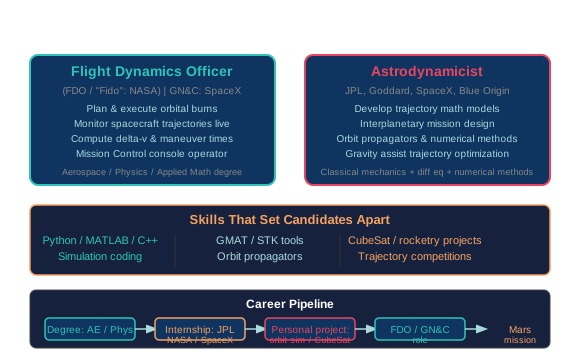
The people who plan & execute orbital maneuvers are called flight dynamics officers (FDOs, pronounced 'fido') at NASA, or GN&C (Guidance, Navigation, & Control) engineers at SpaceX. They compute trajectories, plan burns, & monitor spacecraft orbits in real time.
Astrodynamics
Astrodynamicists are the specialists who develop the mathematical models of orbital motion. They work at NASA's Jet Propulsion Laboratory (JPL), Goddard Space Flight Center, and at companies like SpaceX, Blue Origin, and Rocket Lab. Their tools are the equations we covered today: Kepler's Laws, the vis-viva equation, the rocket equation, and numerical orbit propagators.
The Path
Most flight dynamics and astrodynamics roles require a degree in aerospace engineering, physics, or applied mathematics. Key coursework: classical mechanics, differential equations, numerical methods, and astrodynamics. JPL and NASA internships are highly competitive but are the most direct pipeline. SpaceX hires aggressively from top aerospace programs and values hands-on projects: CubeSats, rocketry clubs, and trajectory optimization competitions.
What Sets Candidates Apart
Coding ability (Python, MATLAB, C++) is as important as the math. Familiarity with tools like GMAT (General Mission Analysis Tool) or STK (Systems Tool Kit) is valuable. Personal projects: trajectory simulations, orbit propagators, CubeSat missions: demonstrate applied knowledge that coursework alone does not.
Synthesis
Putting It All Together
You now understand the core physics of orbital mechanics: why orbit is falling, how Kepler's Laws describe orbital motion, what delta-v means, how Hohmann transfers work, & why the rocket equation governs everything.