Welcome
Most people spend 16+ years in school & never take a single class on how money works.
They graduate, get a paycheck, open a credit card, and figure it out by trial and error: often expensive error.
This lesson covers the fundamentals: how to budget, how debt really works, how investing builds wealth over time, & how to protect what you earn.
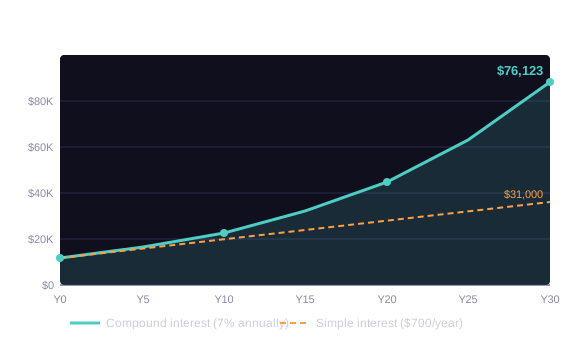
Albert Einstein allegedly called compound interest the eighth wonder of the world. Whether or not he actually said it, the math backs it up: $10,000 invested at 7% annual return becomes $76,000 in 30 years: without adding another dollar.
That same math works against you when it is credit card debt at 24% interest.
Understanding these forces is the difference between money working for you & money working against you.
Warm-Up
Before We Start
Think about money decisions you have already made or watched someone close to you make: opening a bank account, paying rent, dealing with a car payment, or deciding whether something was worth the price.
Income vs. Expenses
The Foundation: Income vs. Expenses
Every financial plan starts with two numbers: what comes in & what goes out.
Income is money you earn: salary, wages, freelance payments, side gigs. Your gross income is before taxes; your net income (take-home pay) is what actually hits your bank account.
Expenses fall into two categories:
- Fixed expenses: the same every month: rent, car payment, insurance, subscriptions
- Variable expenses: they fluctuate: groceries, dining out, entertainment, gas
The 50/30/20 Rule
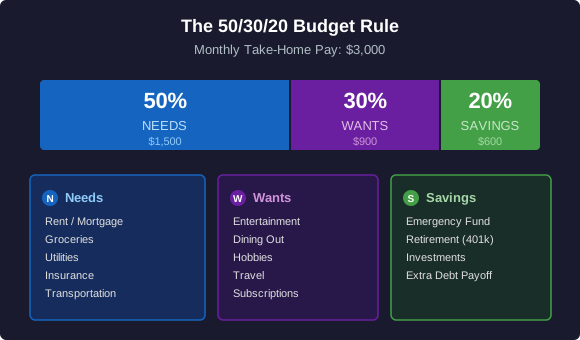
A popular starting framework splits your after-tax income:
- 50% Needs: housing, food, utilities, transportation, insurance, minimum debt payments
- 30% Wants: dining out, entertainment, hobbies, travel, upgrades
- 20% Savings and Debt Payoff: emergency fund, retirement contributions, extra debt payments
Tracking & the Emergency Fund
Most people have no idea where their money goes. Tracking expenses for even one month is often shocking.
An emergency fund is 3-6 months of essential expenses saved in a liquid account. It is the buffer between you and financial disaster: a job loss, medical bill, or car repair that would otherwise go on a credit card.
How Debt Works
Good Debt vs. Bad Debt
Not all debt is equal. The distinction matters.
Good debt finances something that grows in value or increases your earning power:
- A mortgage (housing typically appreciates, & you need somewhere to live)
- Student loans for a degree with strong earning potential (but not all degrees qualify)
- A business loan that generates revenue exceeding the interest cost
Bad debt finances consumption that loses value immediately:
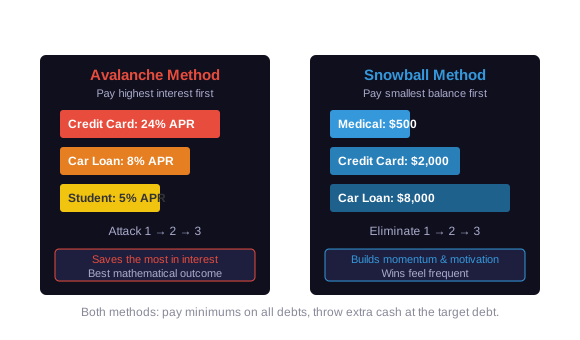
- Credit card balances carried month to month (average APR: 20-28%)
- Car loans on vehicles you cannot afford (cars depreciate the moment you drive off the lot)
- Buy-now-pay-later schemes on discretionary purchases
Interest Rates & the Minimum Payment Trap
A credit card with a $5,000 balance at 24% APR charges about $100 per month in interest alone. If you make only the minimum payment (often $25 + interest), you will pay over $4,000 in interest & take 10+ years to pay it off.
This is the minimum payment trap: the bank makes it easy to pay just enough to keep the debt alive as long as possible.
Credit Scores
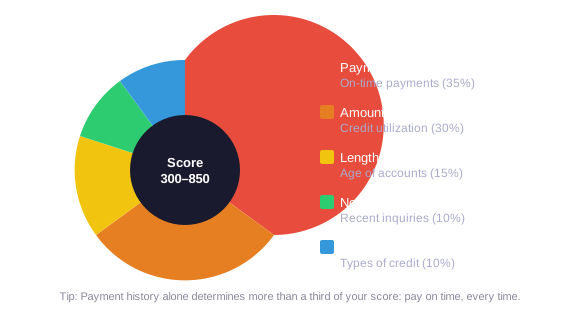
Your credit score (300-850) is a number that tells lenders how risky you are. It affects the interest rate you get on mortgages, car loans, & even whether a landlord will rent to you.
Key factors: payment history (35%), amounts owed (30%), length of credit history (15%), new credit (10%), credit mix (10%).
Building good credit is simple in theory: pay on time, keep balances low, do not open too many accounts at once.
Student Loans
The Student Loan Question
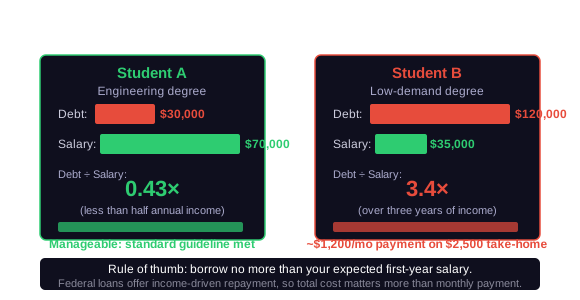
Student loans are the most common form of debt for young adults. They can be good debt: if the degree leads to earnings that justify the cost.
Key considerations:
- Federal vs. private loans: federal loans have fixed rates, income-driven repayment plans, and potential forgiveness programs. Private loans often have variable rates and fewer protections.
- Return on investment: a $40,000 degree that leads to a $70,000/year career is different from a $200,000 degree that leads to a $35,000/year career
- Interest accrues during school on unsubsidized loans: your balance grows before you even graduate
- Total cost matters more than monthly payment: stretching payments over 25 years lowers the monthly bill but dramatically increases total interest paid
Building Your Money
Why Invest?
Saving money in a bank account is safe, but inflation erodes its value. If inflation is 3% & your savings account earns 0.5%, your money loses purchasing power every year.
Investing puts your money to work. Over long periods, the stock market has returned roughly 7-10% per year after inflation.
The Core Options
- Stocks: you own a piece of a company. High potential return, high volatility. Individual stocks are risky; one company can fail.
- Bonds: you lend money to a government or corporation. Lower return, lower risk. Bonds pay interest and return your principal at maturity.
- Index funds: a basket of stocks that tracks a market index (like the S&P 500). You get broad diversification at low cost. Warren Buffett recommends index funds for most investors.
Risk vs. Return
Higher potential returns come with higher risk. Stocks can drop 30% in a bad year. Bonds rarely lose value but grow slowly. The right mix depends on your age & timeline.
Time in Market vs. Timing the Market
Trying to buy low and sell high sounds logical but almost nobody does it consistently: not even professionals. Time in the market beats timing the market. Starting early matters more than starting with a lot.
If you invest $200/month starting at age 22 at 7% average return, you will have about $525,000 by age 62. If you wait until 32 to start, you will have about $245,000. That ten-year delay costs $280,000.
Retirement Accounts: 401(k) & IRA
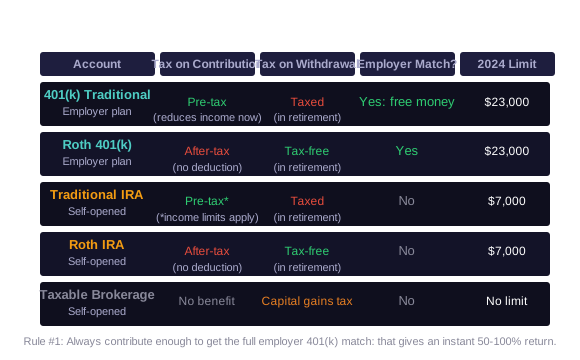
- 401(k): employer-sponsored. Contributions reduce your taxable income. Many employers match a percentage: that is free money. Always contribute at least enough to get the full match.
- IRA (Individual Retirement Account): you open it yourself. Traditional IRA gives a tax break now; Roth IRA gives tax-free withdrawals in retirement.
Protecting Your Money
Insurance: Paying to Avoid Catastrophe
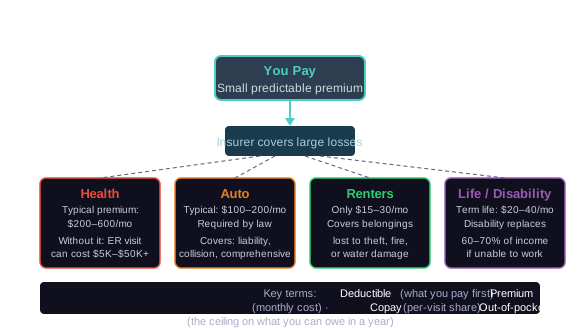
Insurance is a trade: you pay a predictable small amount (the premium) so that if something terrible happens, you do not face a financially devastating bill.
- Health insurance: without it, a single ER visit can cost $5,000-$50,000+. Even with insurance, understand your deductible (what you pay before insurance kicks in) and copay (your share of each visit).
- Auto insurance: required by law in most states. Liability coverage pays for damage you cause to others. Collision and comprehensive cover your own vehicle.
- Renters insurance: typically $15-30/month. Covers your belongings if they are stolen, damaged by fire, or destroyed. Most renters do not have it, and most regret that after a loss.
Taxes: What You Actually Owe
- W-2 income: you work for an employer who withholds taxes from each paycheck. At tax time, you reconcile what was withheld against what you actually owe.
- 1099 income: freelance or contract work. No taxes are withheld, so you must set aside money and pay estimated taxes quarterly. Many freelancers get blindsided by a large tax bill.
- Tax brackets are marginal: if you earn $50,000, you do not pay the top bracket rate on all $50,000. Each bracket rate applies only to the income within that range. The first ~$11,000 is taxed at 10%, the next chunk at 12%, and so on.
- Deductions reduce your taxable income. The standard deduction (about $14,000 for a single filer) means you pay no federal tax on that portion. Itemized deductions (mortgage interest, charitable donations) can exceed the standard deduction for some filers.
- Withholding is how much your employer takes from each paycheck for taxes. If too much is withheld, you get a refund. If too little, you owe. A large refund is not a bonus: it means you gave the government an interest-free loan all year.
Long-Term Thinking
Net Worth: The Real Scoreboard
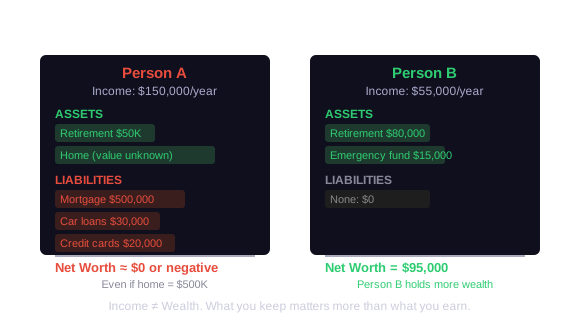
Your net worth is everything you own (assets) minus everything you owe (liabilities). A person earning $200,000 with $300,000 in debt has a lower net worth than someone earning $50,000 with $40,000 in savings & no debt.
Income is not wealth. Net worth is wealth.
Lifestyle Creep
Lifestyle creep is when your spending rises to match every pay raise. You get a $10,000 raise and suddenly your car payment, dining budget, and subscriptions absorb all of it. Your income went up but your savings rate stayed flat: or dropped.
The antidote: when you get a raise, save at least half of the increase before adjusting your lifestyle.
Housing
A home can build wealth through equity, but it is also the largest financial commitment most people make. Key rules of thumb:
- Keep housing costs under 28% of gross income (the mortgage industry standard)
- A home is not purely an investment: it has maintenance costs, property taxes, and insurance
- Renting is not throwing money away. Renting makes sense when you need flexibility, when buying is overpriced relative to renting, or when you cannot afford a 20% down payment without draining your emergency fund
Side Income & Long-Term Thinking
Building wealth is not about one big windfall. It is about consistent habits over decades: spend less than you earn, invest the difference, avoid high-interest debt, protect yourself with insurance, & increase your income over time through skills, education, or side revenue.
The most powerful wealth-building tool is time. Starting early with small amounts beats starting late with large amounts, because compound growth is exponential.