Welcome
Welcome to Renewable Energy: Powering the Future.
Global electricity demand is rising every year. More people, more devices, more data centers, more electric vehicles: all pulling power from the grid. For over a century, fossil fuels (coal, natural gas, & oil) have generated the bulk of that power. They work, but they come with a cost: carbon emissions, air pollution, finite supply, & price volatility tied to geopolitics.
Renewables, solar, wind, hydroelectric, geothermal, generate electricity without burning fuel. They are not new ideas. Windmills have existed for centuries. Hydroelectric dams powered early electrification. What is new is the scale, the plummeting cost, & the speed of adoption.
In this lesson, you will learn how these technologies actually work, how the grid holds it all together, & where the jobs are.
How the Grid Works
The Electrical Grid
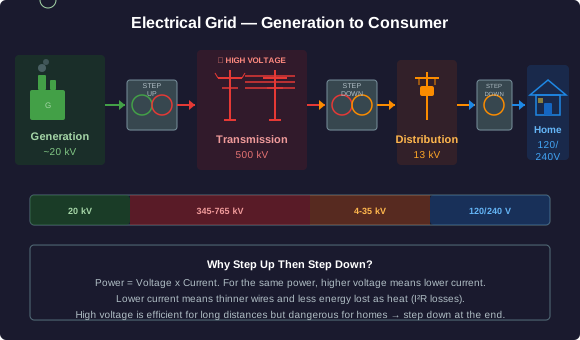
The grid is a machine that must balance supply & demand in real time. Electricity cannot be easily stockpiled: at any given second, generation must roughly equal consumption. Too much supply & frequency rises. Too little & you get brownouts or blackouts.
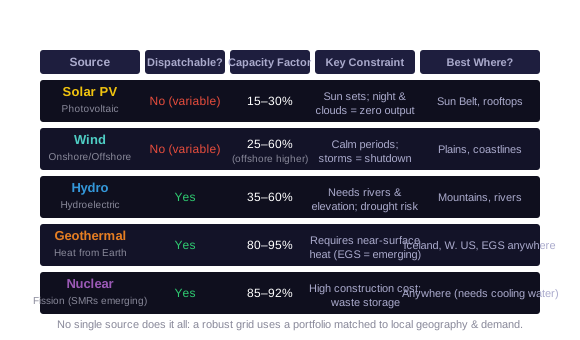
Traditional grids rely on dispatchable generation: plants that operators can ramp up or down on command. A natural gas turbine can spin up in minutes. A coal plant takes hours. Nuclear runs at a steady baseline.
Renewables introduce a challenge: solar & wind are variable. The sun sets, the wind dies. This does not make them useless: it makes grid management more interesting. The energy transition is not just about building solar panels. It is about redesigning how the entire system balances supply & demand.
Key terms you will see throughout this lesson:
- Capacity: The maximum power a generator can produce, measured in watts (kW, MW, GW).
- Capacity factor: The ratio of actual output to maximum possible output over time. A solar panel with a 25% capacity factor produces, on average, one quarter of its rated maximum.
- Baseload: The minimum level of demand on the grid over a 24-hour period.
- Peak demand: The highest point of electricity consumption, usually late afternoon on hot days when air conditioning runs hard.
Photovoltaics and Panel Types
How Solar Panels Work
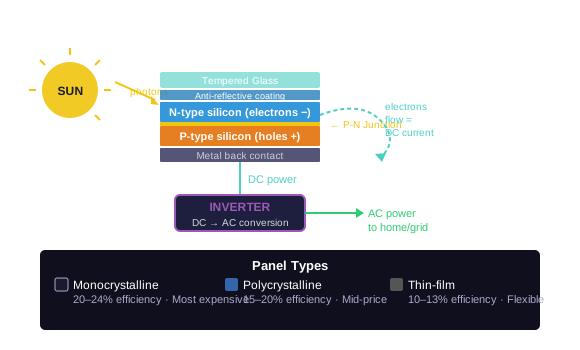
A solar panel converts sunlight directly into electricity using the photovoltaic (PV) effect. When photons from sunlight hit a semiconductor material (usually silicon), they knock electrons loose. Those electrons flow through a circuit, creating direct current (DC) electricity.
There are three main types of solar panels:
- Monocrystalline: Cut from a single silicon crystal. Highest efficiency (20-24%), most expensive, recognizable by their uniform dark appearance.
- Polycrystalline: Made from melted silicon fragments. Slightly lower efficiency (15-20%), cheaper to manufacture, with a speckled blue look.
- Thin-film: A thin layer of photovoltaic material (like cadmium telluride) deposited on glass or flexible substrate. Lower efficiency (10-13%) but lightweight, flexible, & cheap. Used in building-integrated applications.
Inverters & Net Metering
Solar panels produce DC power, but the grid & most appliances run on alternating current (AC). An inverter converts DC to AC. In residential systems, there are two main types:
- String inverters: One central inverter for the whole array. Cheaper, but if one panel is shaded, it drags down the whole string.
- Microinverters: One small inverter per panel. More expensive but each panel operates independently, so shading on one panel does not affect the others.
Net metering lets residential solar owners sell excess electricity back to the grid. Your meter literally spins backward when you produce more than you consume. Policies vary widely by state & utility: some offer full retail credit, others offer wholesale rates, & some are phasing out net metering entirely.
Scale: Rooftop vs. Solar Farms
Residential rooftop systems are typically 5-15 kW. Utility-scale solar farms can exceed 1 GW: covering thousands of acres with tracking systems that follow the sun across the sky. The economics are different at each scale: rooftop offsets retail electricity prices, while utility-scale competes at wholesale.
Turbine Design and Capacity
How Wind Turbines Work
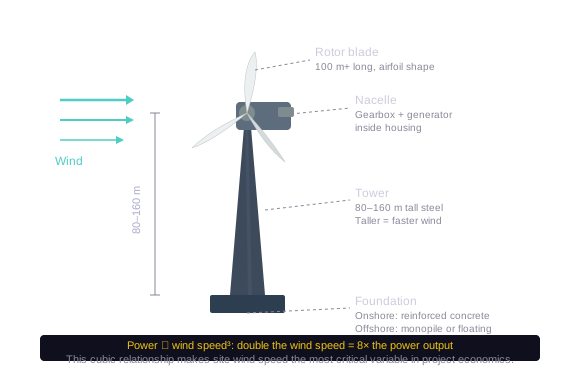
A wind turbine converts kinetic energy from moving air into electricity. The basic anatomy:
- Rotor blades: Usually three, shaped like airplane wings. Wind flowing over the blade creates lift, spinning the rotor. Modern blades can exceed 100 meters long.
- Nacelle: The housing at the top of the tower containing the gearbox (in geared turbines), generator, & control systems. Some modern designs use direct-drive generators, eliminating the gearbox entirely.
- Tower: Steel or concrete, typically 80-160 meters tall. Taller towers access faster, more consistent wind.
- Foundation: Onshore turbines sit on reinforced concrete. Offshore turbines use monopiles driven into the seabed, jacket foundations, or floating platforms.
The Power in Wind
Wind power scales with the cube of wind speed. Double the wind speed & you get eight times the power. This explains why site selection matters enormously: a location with 15 mph average wind produces far more energy than one with 10 mph.
Onshore vs. Offshore
Onshore wind is cheaper to build & maintain. The US Great Plains & Texas dominate onshore wind. Capacity factors typically range from 25-45%.
Offshore wind is more expensive but the payoff is stronger, steadier winds & higher capacity factors (40-60%). Offshore also avoids land-use conflicts & visual objections. The US East Coast is seeing major offshore development, with projects like Vineyard Wind off Massachusetts.
Intermittency
Wind is variable. It blows harder at night than during the day in many locations, which is actually complementary to solar. But there are calm days, & storms can force turbines to shut down for safety. Managing intermittency is not about any single technology: it is about portfolio diversity & storage, which we will cover next.
Energy Storage Technologies
Why Storage Matters
Solar produces when the sun shines. Wind blows when it blows. But people want electricity at 7 PM when they get home, turn on the lights, cook dinner, & charge their car. Storage bridges the gap between when energy is generated & when it is consumed.
Battery Storage
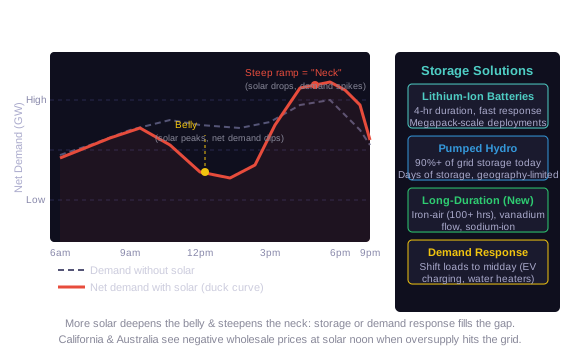
Lithium-ion batteries dominate the current market. The same chemistry in your phone & laptop, scaled up to shipping-container-sized units. Tesla's Megapack, Fluence's grid batteries, & dozens of competitors are deploying gigawatt-hours of storage worldwide.
- Strengths: Fast response time (milliseconds), modular, declining costs.
- Weaknesses: 4-hour duration is typical (not enough for multi-day events), lithium mining has environmental costs, degradation over time.
Other battery chemistries are emerging: iron-air batteries (Form Energy) promise 100+ hours of storage at low cost. Sodium-ion batteries avoid lithium entirely. Flow batteries (like vanadium redox) can scale duration independently of power.
Pumped Hydro
The oldest & largest form of grid storage. Water is pumped uphill to a reservoir when electricity is cheap, then released downhill through turbines when electricity is expensive. Over 90% of grid storage worldwide is pumped hydro. It is proven, long-lasting, & can store enormous amounts of energy: but it requires specific geography (two reservoirs at different elevations).
The Duck Curve
In California & other solar-heavy grids, net demand (total demand minus solar generation) forms a shape like a duck when plotted over a day. During midday, solar floods the grid & net demand drops. In the evening, solar disappears & demand spikes as people come home. The grid must ramp up other generators rapidly to fill the gap: the steep neck of the duck.
The duck curve gets deeper every year as more solar is added. Storage, demand response (paying customers to shift consumption), & time-of-use pricing are all strategies to flatten the duck.
Smart Grid
A smart grid uses sensors, automation, & two-way communication to manage electricity flows dynamically. Smart meters let utilities see consumption in real time. Automated switches reroute power around faults. Demand response programs signal devices to reduce consumption during peak periods. The transition from a dumb grid (one-way power flow from big plants to passive consumers) to a smart grid (distributed, interactive, responsive) is as important as the generation transition itself.
Hydroelectric, Geothermal, Nuclear, and Hydrogen
Hydroelectric Power
Falling water spins turbines. It is simple, proven, & provides about 16% of global electricity. Large dams (like Hoover Dam or Three Gorges) can generate gigawatts. Small-scale run-of-river hydro diverts part of a stream through a turbine without a large reservoir.
- Pros: Dispatchable, long-lived (50-100+ years), low operating costs, doubles as flood control & water supply.
- Cons: Environmental impact (altered river ecosystems, displaced communities), geography-dependent, vulnerable to drought, most good sites already developed.
Geothermal Energy
Heat from the Earth's interior drives steam turbines. Iceland generates 25% of its electricity from geothermal. The western US has significant geothermal resources.
- Pros: Baseload power (runs 24/7), tiny land footprint, near-zero emissions.
- Cons: Location-limited (needs accessible heat), high upfront drilling costs, risk of drilling into insufficient resources.
- Emerging: Enhanced Geothermal Systems (EGS) inject water into hot dry rock to create artificial reservoirs, potentially unlocking geothermal anywhere. Companies like Fervo Energy are demonstrating this technology.
Nuclear Power
Nuclear fission splits uranium atoms to produce heat, which drives steam turbines. It generates about 10% of global electricity with near-zero carbon emissions during operation.
- Pros: Enormous energy density, reliable baseload, small land footprint, low lifecycle emissions.
- Cons: High construction costs & long build times, radioactive waste storage (tens of thousands of years), public perception challenges, regulatory complexity.
- Emerging: Small Modular Reactors (SMRs) promise factory-built, cheaper, safer nuclear. Companies like NuScale & X-energy are pursuing NRC approval.
Hydrogen
Hydrogen is not an energy source: it is an energy carrier. You must produce it using energy from somewhere else.
- Green hydrogen: Made by electrolyzing water using renewable electricity. Clean but currently expensive.
- Gray hydrogen: Made from natural gas via steam methane reforming. Cheap but produces CO2.
- Blue hydrogen: Gray hydrogen with carbon capture. Debated effectiveness.
Hydrogen is most promising for applications that are hard to electrify: heavy industry (steelmaking), long-haul trucking, shipping, & long-duration energy storage.
Working in Clean Energy
The Clean Energy Job Market
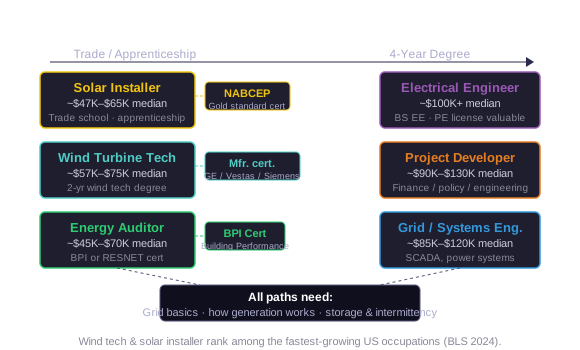
The energy transition is creating jobs faster than almost any other sector. The US Bureau of Labor Statistics lists wind turbine technician & solar installer among the fastest-growing occupations. But the career options go far beyond climbing towers & mounting panels.
Solar Photovoltaic Installer: Design, install, & maintain residential & commercial solar systems. Physical work on rooftops. Median salary around $47,000, but experienced installers & crew leads earn significantly more. Entry path: trade school, apprenticeship, or on-the-job training.
Wind Turbine Technician: Maintain & repair wind turbines, often at heights above 80 meters. Requires comfort with heights, mechanical aptitude, & willingness to work in remote locations. Median salary around $57,000. Training: 2-year technical degree in wind energy technology.
Electrical Engineer: Design power systems, inverters, grid interconnections, & control systems. Bachelor's degree required, PE license valuable. Median salary around $100,000. Specializing in power systems or renewables opens doors at utilities, developers, & equipment manufacturers.
Energy Auditor: Assess buildings for energy efficiency, recommend improvements, & verify savings. Combines technical knowledge with communication skills. Certifications: BPI (Building Performance Institute) or RESNET HERS Rater.
NABCEP Certification: The North American Board of Certified Energy Practitioners offers the gold-standard certification for solar professionals. NABCEP-certified installers & designers command higher salaries & are preferred by employers. Certifications include PV Installation Professional, PV Design Specialist, & PV Technical Sales.
Other Paths: Project developer, energy storage engineer, grid operator, environmental compliance specialist, energy policy analyst, utility-scale construction manager, EV charging infrastructure planner. The field is broad & growing.
What They All Have in Common
Every one of these careers requires understanding the fundamentals you have learned in this lesson: how generation works, how the grid balances supply & demand, how storage fills gaps, & how different technologies fit together. The people who thrive in clean energy are systems thinkers.