Welcome
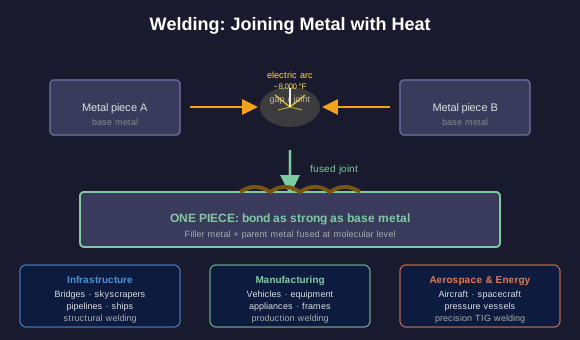
Every bridge you drive over, every skyscraper you walk past, every pipeline carrying fuel across a continent: they all depend on welded joints holding strong.
Welding is the process of joining two pieces of metal by melting them together, usually with a filler material, to create a bond as strong as or stronger than the base metal itself.
It is one of the oldest & most essential trades in the world. Without welders, there is no modern infrastructure, no aerospace, no shipbuilding, no manufacturing.
In this lesson, we will cover the core science behind welding, the major processes used in the trade, how joints are designed & read from blueprints, & the safety discipline that separates professionals from amateurs.
Warm-Up
Before we get into the shop, let's see what you already know or have noticed.
Big Three Processes
MIG, TIG, & Stick
There are dozens of welding processes, but three dominate the trade. Each has strengths & trade-offs.
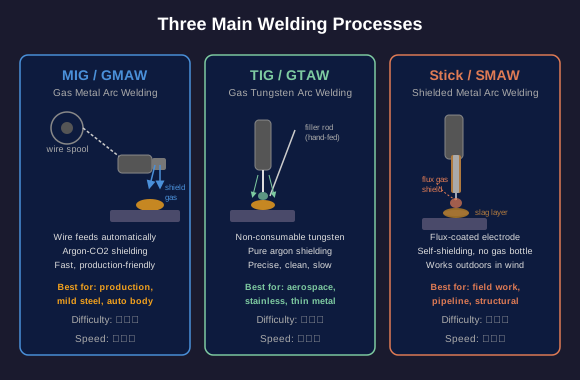
MIG (GMAW, Gas Metal Arc Welding): A wire-fed process. The machine feeds a spool of filler wire through the gun while shielding gas (usually argon-CO2 mix) protects the weld pool from contamination. MIG is fast, easy to learn, & great for production work on mild steel & aluminum. It is the go-to process in manufacturing & auto body shops.
TIG (GTAW, Gas Tungsten Arc Welding): The precision process. A non-consumable tungsten electrode creates the arc, & the welder feeds filler rod by hand with the other hand. Pure argon shielding gas. TIG produces the cleanest, most precise welds & is required for aerospace, food-grade stainless, & thin-wall tubing. It is the slowest of the three & the hardest to master.
Stick (SMAW, Shielded Metal Arc Welding): The workhorse. A flux-coated electrode melts & deposits filler metal while the flux creates its own shielding gas & slag layer. No external gas bottle needed. Stick works outdoors in wind & rain, on rusty or dirty metal, & in tight spaces. Pipeline welders, structural ironworkers, & field repair crews rely on it.
The right process depends on the metal, the joint, the environment, & the quality standard.
Choosing the Right Process
A fabrication shop gets three jobs in one week. Job one is welding stainless steel tubing for a food processing plant: the welds must be perfectly clean with no contamination. Job two is repairing a cracked steel beam on an outdoor bridge in January wind. Job three is welding 200 identical mild steel brackets on a production line.
Physics of the Electric Arc
What Happens When You Strike an Arc
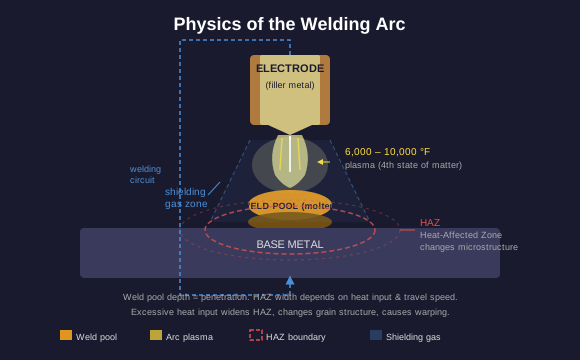
The welding arc is a sustained electrical discharge across a gap between the electrode & the workpiece. When the circuit closes, current flows through the gas in the gap, ionizing it into plasma: the fourth state of matter.
That plasma reaches temperatures between 6,000 & 10,000 degrees Fahrenheit, far above the melting point of steel (around 2,500 F). The intense heat creates a weld pool: a small puddle of molten metal on the workpiece.
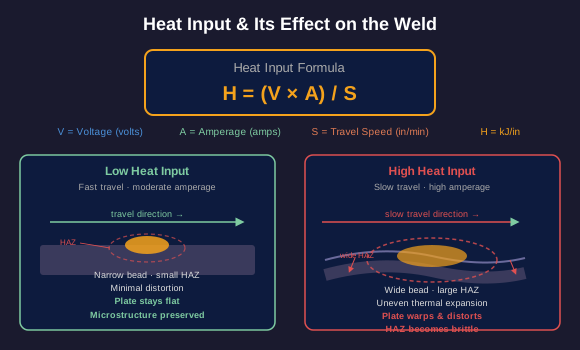
The Heat-Affected Zone (HAZ): The area surrounding the weld pool that does not melt but gets hot enough to change the metal's microstructure. The HAZ can become brittle or weakened if the welder applies too much heat or moves too slowly. Controlling heat input is one of the most important skills in welding.
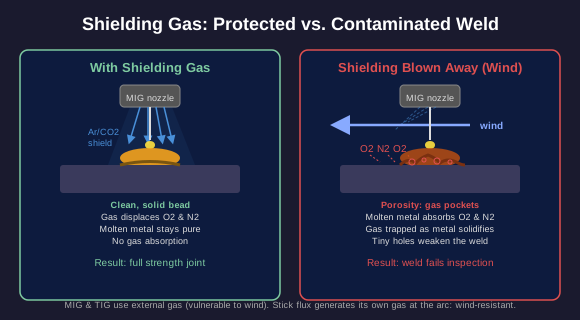
Shielding Gas: Molten metal reacts violently with oxygen & nitrogen in the air. Oxidation creates porosity (tiny gas bubbles trapped in the weld) & weakens the joint. Shielding gas, argon, CO2, or a mix: displaces the atmosphere around the weld pool, keeping it clean.
Without shielding, the weld pool absorbs atmospheric gases & the resulting weld is porous, brittle, & structurally worthless. Every welding process has some form of shielding: external gas in MIG & TIG, flux coating in Stick.
Why Shielding Matters
A welder is running MIG on a mild steel plate outdoors. A strong gust of wind blows across the work area. The arc looks normal, but when the welder chips the spatter & inspects the bead, it is full of tiny holes & looks rough & porous.
Controlling Heat
Two welders run the same joint on identical steel plates. Welder A moves quickly with moderate amperage. Welder B moves slowly with high amperage, putting much more heat into the metal.
Both welds look acceptable on the surface, but welder B's plate is warped & bent, & the metal next to the weld is discolored & brittle.
Five Basic Joints
How Metal Pieces Come Together
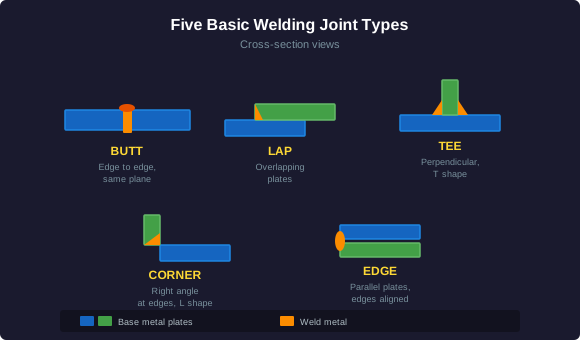
Every welded connection starts with how the pieces are positioned relative to each other. There are five basic joint configurations.
Butt joint: Two pieces placed edge to edge in the same plane. Used for plate & pipe. The most common joint in structural & pressure work. Often requires beveling (grinding an angle on the edges) to allow full penetration on thick material.
Lap joint: Two pieces overlapping. Simple, strong in shear, common in sheet metal & auto body work.
T-joint: One piece set perpendicular to another, forming a T shape. The weld is typically a fillet weld at the intersection.
Corner joint: Two pieces meeting at a right angle along their edges, forming an L. Used in frames, boxes, & enclosures.
Edge joint: Two pieces set parallel with their edges aligned. Mainly used for thin sheet metal & low-stress applications.
Fillet welds are triangular welds deposited in the inside corner of a T-joint, lap joint, or corner joint. Groove welds fill a prepared groove (bevel) between two pieces in a butt joint.
Welding symbols on blueprints tell the welder exactly what type of weld to make, its size, length, & location. The basic symbol sits on a reference line with an arrow pointing to the joint. The weld type symbol goes on the reference line: below the line means weld on the arrow side, above the line means weld on the other side.
Reading the Job
A structural engineer sends you a drawing for a steel table frame. Four legs made of square tubing must be welded to a flat plate top. The joints where the legs meet the underside of the plate will bear the full weight of anything placed on the table.
Welding Hazards and Protection
The Non-Negotiables
Welding produces hazards that can cause permanent injury or death. Safety is not optional: it is the first skill every professional welder masters.
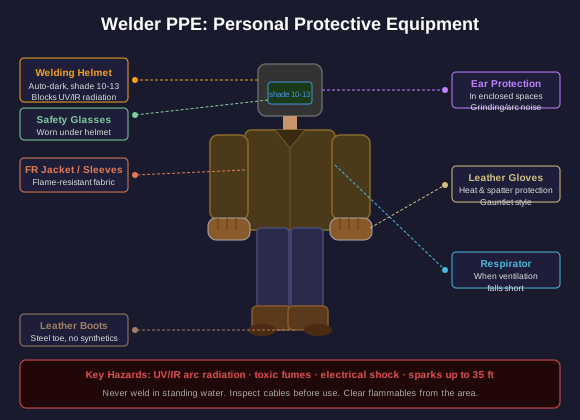
UV & infrared radiation: The arc emits intense ultraviolet light that causes arc eye (photokeratitis), which feels like sand in your eyes & can cause temporary blindness. Prolonged exposure causes skin burns similar to severe sunburn. A proper welding helmet with the correct shade lens (shade 10-13 for arc welding) is mandatory. Auto-darkening helmets switch from a light shade to welding shade in milliseconds when the arc strikes.
Fumes & ventilation: Welding vaporizes metal, flux, & coatings, producing fumes that contain manganese, chromium, zinc, & other toxic compounds. Galvanized steel (zinc-coated) produces zinc oxide fumes that cause metal fume fever, flu-like symptoms that hit hours after exposure. Stainless steel fumes contain hexavalent chromium, a known carcinogen. Adequate ventilation, fume extraction, or a respirator is required.
Electrical hazards: Welding machines deliver high current at relatively low voltage, but the open-circuit voltage (typically 60-80 volts) can deliver a fatal shock in wet conditions. Never weld in standing water. Inspect cables & connections for damage. Always ground the workpiece properly.
Fire & burns: Sparks & molten metal travel up to 35 feet. Clear the area of flammables. Wear flame-resistant clothing, leather gloves, & leather boots. A fire watch is required when welding near combustible materials.
PPE summary: welding helmet (correct shade), safety glasses underneath, leather gloves, flame-resistant jacket or sleeves, leather boots, ear protection in enclosed spaces, & a respirator when ventilation is insufficient.
Safety Decisions
You arrive at a job site to weld a repair on a steel handrail inside a small mechanical room. The room has no windows & a single door. There are cardboard boxes & oily rags stored in the corner about 10 feet from the weld location. The floor has some puddles from a recent pipe leak.
Where Welding Takes You
Welding Careers & Certification
Welding is not one career: it is a platform that opens doors to dozens of specializations, many of them high-paying & in constant demand.
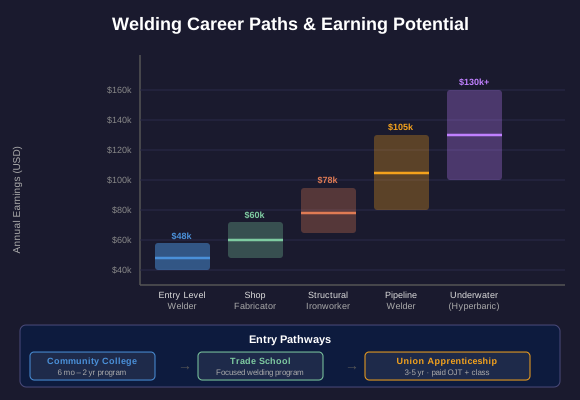
Pipeline welder: Joins sections of oil, gas, & water pipelines in the field. Often Stick or downhill welding on carbon steel pipe. Pipeline welders travel constantly & earn premium pay. A skilled pipeline welder can earn over $100,000 per year.
Underwater welder (hyperbaric welder): Welds on offshore platforms, ship hulls, & underwater infrastructure. Combines commercial diving certification with welding skills. One of the highest-paid & most dangerous welding specializations.
Aerospace welder: TIG welding on exotic alloys like titanium, Inconel, & aluminum-lithium for aircraft & spacecraft. Extreme precision & cleanliness standards. Every weld is inspected & documented.
Structural ironworker-welder: Welds structural steel on buildings, bridges, & heavy equipment. Often works at height on beam connections.
Certification: The American Welding Society (AWS) administers welder qualification tests. The most common is the AWS D1.1 Structural Welding Code qualification. Passing a certification test means you welded a test coupon that was bent or X-rayed & passed inspection. Certifications are specific to process, position, & material, a cert for MIG on plate does not cover TIG on pipe.
Getting started: Community college welding programs (6 months to 2 years), trade school programs, & union apprenticeships (typically 3-5 years with paid on-the-job training) are the main entry points. Apprenticeships combine classroom instruction with real-world welding under a journeyman.
Planning Your Path
Connect Welding to Your Future
You now know the major welding processes, the physics of the arc, how joints are designed, & the safety discipline the trade demands.